






Zach Matthews
Forum Replies Created
-
AuthorPosts
-
Zach Matthews
The Itinerant AnglerHey KB –
I am ostensibly a products guy for the magazines and I had to look up eVent (the proper spelling, apparently) myself.
The Itinerant AnglerIt doesn’t make any pretensions to being waterproof, David.
The Itinerant AnglerHey Dave –
I updated my original post with answers to your questions.
Zach
PS Thanks to Andrew Wright for the photos.
The Itinerant Angler

Either this Fishpond pack or a larger Granite Gear snowboarder/winter rescue pack, if I have to haul a tripod.
I was in the process of writing a longer post here when my computer crashed. Now:
I would disagree with Tim that the Fishpond Double Haul is a B- product, at least so far. I’ve only got about twenty hours on mine but I’d rate it a medium A for the time being.
Here’s what I like about the bag:
(1) it is expandable for whenever I need to haul something larger, but it stays slender for ducking under tree branches whenever I am not loaded up;
(2) the hydration bladder sleeve is external, which makes it easy to drop in the bladder, and also it is separated from the interior compartment for better protection from the inevitable didn’t-get-the-cap-screwed-on-right leaks;
(3) the pack isn’t overly adjustable but that just means it doesn’t have so many straps. I use both the waist and chest straps to help hold all my winter insulation in place;
(4) there are two exterior pockets, one of which is perfect for my Garmin GPS (good for use when hiking in North Georgia). The other is a little redundant but I wind up storing candy bars and such in there so I don’t have to dig out the camera, etc.;
(5) unlike probably the majority of Fishpond’s products, the pack isn’t too big.
Now, that said, here’s some reservations I would add:
(1) Construction is just fine so far, but I have had the seams pull apart on one Fishpond product previously;
(2) the chestpack is just not something I would ever use. I don’t like feeling like a pregnant woman when fishing, and it interferes with the cast. Same reason I don’t use a vest. The chestpack, however, is an excellent little shoulder bag for walking a beach (I have used it for this purpose, and the present of the bottom strap connectors means you can cinch it in place at your hip so it won’t swing around;
(3) the hanging loop is way, way under-engineered for hanging up anything but an empty pack. The D-ring meant for a net is an adequate substitute but it won’t hang on many hooks;
(4) the connectors for the chestpack stick up when the chest pack is not present, as they are full-sized backpack connectors rather than something lighter;
(5) There are, as with almost every fly fishing product, too many pockets, especially inside the exterior pockets. There’s even a little divider like for a pen or a thermometer or something. Overkill, in my opinion;
On the balance it’s still a great product. I use Fishpond’s retractable zinger tube (which is excellent, btw), and punch a zinger through the front strap cinches to hang a set of snips on my left chest. Then I just clip on my hemos and hang a bunch of tippet spools on a metal spindle (probably also Fishpond now that I think about it) and I have all the convenience of a vest with none of the restrictions in casting. The bag is plenty big enough to carry a large DSLR and a flash and lunch, with room to expand to gobble up a layer if it warms up outside. I would recommend this thing easily to a friend.
Zach
The Itinerant AnglerThat would be a truly amazing gift to come home to.
The Itinerant AnglerOk, I actually recognized the baboons, which immediately brought to mind an article I read some time ago about how a baboon attacks a human.
The Itinerant AnglerMan, speaking of Lamson… they haven’t updated their website since about 2001.
The Itinerant AnglerThe drag is literally identical to those used on the Lightspeed, Velocity, etc. – interchangeable parts, even.
The Itinerant AnglerCrazy as it sounds, the only fly fishing video I ever felt I learned from was Wendell (“Ozzy”) Ozovich’s underwater videos of trout feeding, breeding, and protecting their territory.
The Itinerant AnglerFor what it’s worth (and believe me, coming from me it’s worth a lot less), I agree entirely with Richard.
The Itinerant AnglerNo, not going to make it, boys.
Zach
The Itinerant AnglerXi2 rods have probably the lowest swing weight of any rod I’ve ever cast.
The Itinerant AnglerI leave a polarized filter on my camera whenever it’s bright outside. I take it off a lot, but probably better than 60% of my shots have it in play. Here are some of the reasons I use it on the water:
(1) Obviously, it cuts glare coming off the water surface. Whether you’re trying to shoot down into the drink or just getting a grip and grin shot, this seems to add a lot of depth to the photo and frequently color as well. My cameras always meter better whenever there is a wide range of color in the frame. Since a lot of the river bottoms in areas I fish are rolled boulders and tend to be reddish, they offset the green of the trees and the primary colors on the anglers’ clothing nicely.

(2) Whenever I am trying to shoot a slow-water shot at mid-day I will throw a polarizer on there. In this sense the filter is just a set of -2.0 sunglasses for my camera, letting me eke out a “fake” ISO25 when my camera has already hit its limit of ISO100.

(3) As mentioned above, polarizers tend to make the skies ridiculously blue. They also apply their sunshade effect to bright white boat decks. Thus, polarizers are especially effective used on open water. Coupled with a nice mild fill flash, they can bring the color out in almost any angler’s face and clothes and turn what would be a blown-out contrasty mess into a very dynamic shot.
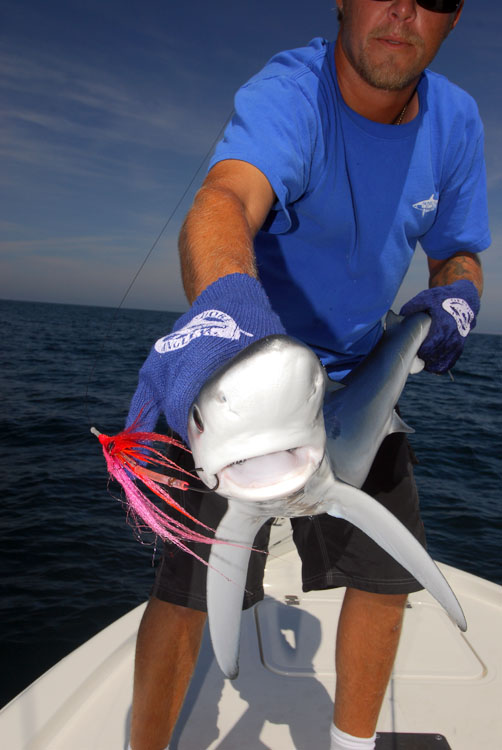
(4) Glare doesn’t just pop off the water; sometimes it comes off of gear as well. Anything shiny which will be shot outside can be held in its proper place by throwing a polarizer on, even on a macro lens.

(This was shot on an open boat deck).Personally I have a pair of Hoya circular polarizers which work just fine, and a much nicer Nikon circular polarizer for my 77mm lenses; the thinner polarizer becomes a lot more important on ultrawide angle lenses like the 12-24mm G, since at its widest setting the lens can see the edges of the polarizer hardware sticking out in front.
Zach
The Itinerant AnglerDanny –
I am going to try to program my DVR to catch a re-run.
The Itinerant AnglerNo, this board won’t be represented.
The Itinerant AnglerBernard Ramanauskas, but only if we fulfilled his plans of rappelling into the Black Canyon’s unfishable sections.
The Itinerant AnglerNice shot.
The Itinerant AnglerAll waders eventually leak, just like all shoes eventually wear out and all cars eventually need new tires.
The Itinerant AnglerAnd… Morsie still crushes all competition.
The Itinerant AnglerLando –
Um, that just sounds like they made a mistake.
-
AuthorPosts