






Tim Schulz

Forum Replies Created
-
AuthorPosts
-
Tim Schulz
MemberI have a Mac.
The software is essential.
Color cameras use small color filters over 2×2 pixel regions to acquire color information about their images. By doing so they trade spatial resolution for color information.
“Shoot Now, Focus Later” cameras use small lenses over small pixel regions to acquire depth information about their images. The software then processes the data to focus at the desired focal depth. By doing so they trade spatial resolution for depth information.
We’ve had students build these in our labs, so I’m anxious to see how well one works that has been built for consumer applications.
MemberMaybe this would be better for a new topic, but has anyone found a good solution for the special sun-glass problem that accompanies the onset of presbyopia, or “elder-sightedness”?
I have myopia (near-sightedness) also, so I can still tie a fly onto a leader without my contacts or glasses. But, because of that, I find it convenient to wear glasses instead of contacts. If I wear contacts, I have to have some sort of cheater system to attach a fly. Here are the things I’ve tried:
1. Giant Harry-Carey-style sunglasses that fit over my regular glasses. With those I can still look around my glasses and tie on a fly, but when I wear those gargantuan glasses I feel like I should take a break from the river at about 4:15 and use my AARP card to get the early-dinner special at the nearest Ponderosa.
2. Polarized clip-ons for my glasses. I can look around the glasses to tie on a fly, but all of the clip-ons I’ve found have been fairly cheap, both in cost and quality.
3. Contacts with quality sunglasses. With this system I have to use either reading glasses or some sort of magnifiers to tie on a fly. I have a pair of sunglasses with bifocal-like magnifiers, but that only works well until the sun goes down. After that I have to hope I remembered to bring the cheaters.
I usually go with the glasses and clip-ons because I don’t have to worry about bringing additional glasses. This is probably the poorest quality solution, though.
I haven’t tried prescription bifocal sunglasses yet, nor have I tried bifocal contacts.
I’d be grateful to learn how others have coped with this situation. I miss the days of wearing high-quality sunglasses.
MemberSpectacular.
MemberHere’s a link to what appears to be a careful study of polarization performance versus cost for lens filters:
http://www.lenstip.com/115.4-article-Polarizing_filters_test_Results_and_summary.html
Based on their plot of performance points versus price, I suspect there is something like the Pareto principle in play here: a large proportion of the performance comes from a small proportion of the cost. You may, of course, find value in that last bit of performance, though.
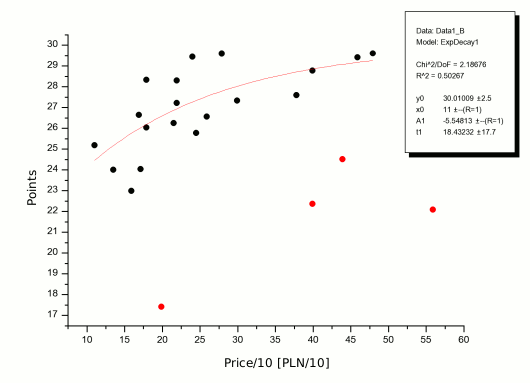
And the best performance isn’t associated with the highest cost, but as fly fishers we should be used to that. 😉
MemberJack: you might enjoy this short post with some photos of John Gierach at Frenchman’s Pond:
http://uptrout.com/2011/07/01/we-said-we-were-going-fishing-and-we-did/
MemberThanks Dave. Here’s a good starting point for the music:
MemberThanks for the nice words guys. I’m glad you enjoyed the video.
Gary: As Voelker once wrote about gates,
—
“The best trout fishing is always on the far side of the moon, of course, and getting there and back naturally consumes a good part of the fisherman’s time, patience, and ingenuity — not to mention his capital assets. Normal hazards and obstacles encountered along the way include . . . owlish souls who maintain locked gates and steel cables and put up quaint welcome signs inviting all fishermen to keep the hell out.”
—MemberInteresting observations Brian.
About 15 years ago a friend and I were watching a hockey game in a bar along the San Juan river after a day of ‘theme park’ fishing. Seated at the table next to us were about 5 guys: 4 who had recently discovered fly fishing, and a friend of theirs who hadn’t fly fished before that day. I still remember the ‘newbie’ lecturing his friends: “I know you guys think this is special, but you are just fishing worms and bobbers.” The hot pattern that day was a San Juan worm drifted below a yarn indicator. The new ‘experts’ seemed a bit ticked off, but the new guy said something like “relax, guys, fishing is fishing.”
MemberExcellent chart Brian. It is interesting to see how abruptly the spike dropped back to the underlying growth trajectory.
MemberThanks for those excellent insights Zach.
Great suggestions throughout, but this one in particular made me smile:
“nymphing for stocker snit rainbow trout is going to be at the bottom of that list.”
MemberThanks Eric and Jeff.
Jeff — Modern cameras are technological marvels. With a little practice and patience you can take photos like these. On the other hand, taking photos like JayMorr and some of the other photography wizards, well, . . .
MemberThanks for the nice words, guys. The rod is spectacular.
Rolf — yes, my wife has let me know that this is not good. 😉
Cheers.
MemberThe camera makers will need to start calling these large MP sensors “diffraction limited” and explaining what that means; otherwise, they’ll be dealing with a lot of people complaining that the edges are “soft” at even moderate f/#s. Between aberrations at the small f/#s and diffraction at the larger f/#s, there won’t be any setting at which an edge will look sharp under the scrutiny of a zoom.
MemberI use the Canon PowerShot D10. I love not worrying about the camera getting wet, and I think it does a nice job on macro shots:


 Member
Hi all,
A few of you are correct about the person, but only Cameron knows the spot. The spot is Frenchman’s, the small pond where the writer John Voelker (a.k.a. Robert Traver) built his modest cabin.
You can read a little more about John’s visit and view a few more photos here: http://uptrout.com/?p=11
Here is another shot of John casting from the dock at the pond:

Cheers,
TimMemberHi Jay,
Great work, as usual.
Can you expand on your last post? What about the processing of those images required you to need CS5 instead of LR3? What did you need that LR3 doesn’t provide?
Thanks in advance for anything you can share with us on this.
Cheers,
TimMemberAny truth to the hype?
Short answer . . . yes.
(Here is the NYT story: http://www.nytimes.com/2011/06/22/technology/22camera.html?_r=1)
Here is a medium-length answer:
Conventional cameras use all of their pixels to detect the spatial intensity of light in the image plane of the camera. Depending on the f/#, focus setting, and relative distances to the objects within the field-of-view, some parts of the scene will be in-focus, and some parts will be out-of-focus.For the past decade or so, several researchers in the fields of “computation sensing and imaging” and “computational photography” have been developing ways to encode depth information into the data collected by a camera’s detector. The Stanford group that Lytro’s founder came from modified a standard DSLR by placing a tiny array of lenses directly in front of the camera’s detector. By doing so, they gave up some of the spatial resolution, but were able to encode depth. By processing those data, they could selectively ‘focus’ the image to different depths.
Other groups have worked on replacing a traditional lens with a distorted lens. The distortion in the lens is designed in a way that essentially blurs the image the same regardless of range. The blur can then be removed through post-processing resulting in an extended depth-of-focus with a small f-number. In short, you can obtain large depth-of-focus with a fast lens. (Sound good for macro?)
Nothing is free, so all of these approaches have a down-side. The biggest being a relative loss of spatial resolution. This is the issue raised by the Columbia University professor in the NYT article. Because Lytro is a commercial venture, it is difficult to get all of the details about their technology and the manner in which they are improving on and/or eliminating some of the down-sides.
I do believe that advances over the next decade in the field of “computational photography” will change the way we think about and use cameras.
MemberThanks Neal. By the way, here is a sign for one of the better ‘roads’:
 Member
Cool pics.
MemberI snapped about 50 frames around #5, and they all have that same look and feel. I was almost shaking at the time because I knew that the light and fog were very special. For those of you who recognize the cabin, the ‘model’ in these photos is John Voelker’s grandson. A great model and a great person.
-
AuthorPosts