






Tim Schulz

Forum Replies Created
-
AuthorPosts
-
Tim Schulz
MemberSad news about the loss of a good man.
He touched many lives in a positive way, and I hope that fact brings comfort to his family and friends during this difficult time.
MemberJust to be clear . . . I didn’t make this video. Someone sent me the youtube link, and I thought you might enjoy if you haven’t seen it already.
Cheers.
MemberFor fun, here is an example of the sort of images that these satellites could collect. It is from these that the image processing wizards would need to work their magic.
Here is my license plate:

Now, let’s turn the Hubble Space Telescope toward Earth and take a picture of this. The Hubble is orbiting at 550 km and has a primary mirror that is 2.4 m in diameter. Here is what it would see:

Hard to imagine much luck with processing, so let’s bring the Hubble down to 225 km. This is a very low orbit, and this is what we would get:

Still tough. Let’s get crazy and bring that bird down to about 100 km. Now we would see this:

Processing could probably help with this, but I’d still be skeptical about getting at the sticker in the upper right.
Just for fun, let’s see what happens at 10 km, which is about the cruising altitude for a commercial jet:

Now we’re talking. Of course, the ‘lens’ on this camera is about 8 ft in diameter, so you couldn’t take this picture from any of the plane’s windows.
This gives you some idea of the challenges that the signal processing experts face when trying to recover lost resolution from satellite photos.
Cheers,
TimMemberThinking about reading a registration sticker from space . . .
A satellite in low-earth orbit is typically more than 200 km from the earth’s surface. (Space station is about 300 km and the Hubble is about 550 km, I believe.) The shortest wavelength for visible light is about 400 nm. Reading those tiny stickers probably requires about a tenth of a centimeter resolution. So, the telescope’s lens would need to be about 80 meters (nearly a football field) in diameter to overcome the limits imposed by diffraction. If we relax the resolution to about a centimeter (might be able to read the big numbers on the plate), then the telescope’s lens would need to be about 8 meters in diameter (about 26 feet).
It’s early in the morning, so I might have messed up some of the math here, but these would be impressive pieces of glass and mirrors. It seems like that kind of resolution would call for a sensor on a plane or drone that was just a few kilometers from the ground.
MemberDave,
Here is a screen shot from Hook and Hackle’s online shopping tool:
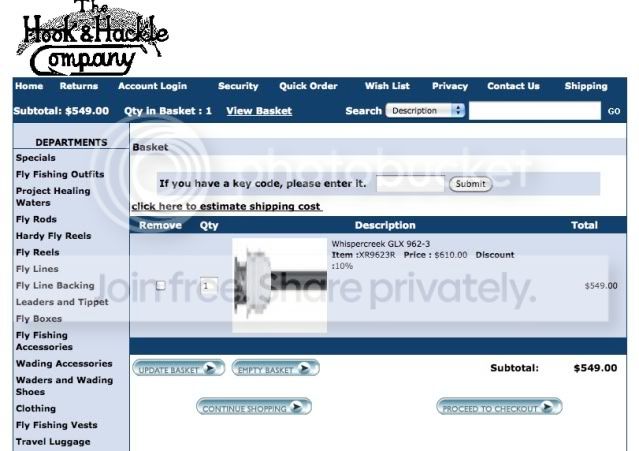
Their policy states that some manufacturers prohibit the discount, but this one appears to be a go. Several of their other rods (TFO, for instance) do not show the discount when you place them in your basket. Could be an error with the tool, though.
I do believe I purchased a St. Croix rod from them with the discount a few years ago, but I could be mistaken.
Tim
MemberZach,
Hook and Hackle provides a 10% discount for on-line orders. As an example, the G. Loomis Whisper Creek GLX 962-3 is $549 instead of $610.
Tim
MemberCorey, is your first shot from a tripod with timer? How about the third shot?
All: Thanks for the excellent and informative replies.
Cheers!
MemberZach,
Here is a course offered at Michigan Tech:
PE 0103 – Bait and Fly Casting
Bait and fly casting skills. Each student must have a valid current year Michigan fishing license. Trout stamp is optional. Equipment is available if needed. Requires some additional hours outside of class. May be use once as a general education co-curricular course.
Credits: 0.5; Graded Pass/Fail Only
Lec-Rec-Lab: (0-0-2)
Semesters Offered: Fall, SpringSend me a PM if you would like some help learning specifics.
MemberZach — thanks for the interesting post. That is an excellent way to categorize the high-profile fly shops. Do you have a sense for how sales split between on-site and on-line at the destination and big-city shops?
Also, is there an easily accessible source for a list of the top fly shops by sales?
MemberFly shops sell to fly fishermen, so most shops are near the fishermen. This often coincides with proximity to good fishing, but not always. Fullerton, California has an excellent full-service fly shop; Marquette, Michigan does not. If you think Fullerton is a better place to fish from than Marquette, I won’t try to convince you otherwise. “No fish here,” as they say. 😉
This brings up another thought that is probably better for a new topic thread. I’ve often wondered how an individual assesses good fishing. There are many factors that contribute to this, but two of them are the number of fish in the river and the number of fishermen in the river. Some people will accept a large number of fishermen for an increase in the number of fish; some people will accept a small number of fish for a decrease in the number of fishermen. For most people, though, I suspect it is something in between. Everyone is different, of course, so there are no right or wrong answers.
Cheers,
TimMemberI was thinking about Shannon’s question. The nearest fly shop for me is about a four-hour drive, so I have to shop electronically. I do have a favorite, and, as I would with a local shop, I give them my business first. They have free shipping for orders over $25, always send me a personal email (not an automated one) as soon as the order ships, and the orders typically ship the morning after I place the order. When I place an order on Monday night, it is typically in my home on Wednesday. Of course I’m not constrained by geography, so it is easy to remain loyal in this situation because I was able to do some ‘shopping’ before deciding which store I would adopt as my local store.
In thinking about my distance from a fly shop, I remembered a map I had seen that was used to determine the place in the continental US that is farthest from a McDonalds:

Evidently, somewhere in South Dakota is the ‘McFarthest Spot’. Good or bad depending on your point-of-view.
I wonder where in the continental US is the place that is farthest from a ‘full-service’ fly shop?
MemberMike,
Thanks for sharing this.
MemberMike,
Great trip.
MemberBruce,
Thanks for the pointers.
MemberWow.
I’ve been buying and reading books on photography, but this board is incredible.
MemberPerhaps a glow-in-the-dark flyline would help?

This is an excellent line and is very useful for fishing the Hex hatch, or for other night-time fishing.
MemberCount me in. Large, gray.
Tim
MemberMany of you will be familiar with this, but I believe this is the best answer that anyone has given to this question:
I fish because I love to; because I love the environs where trout are found, which are invariably beautiful, and hate the environs where crowds of people are found, which are invariably ugly; because of all the television commercials, cocktail parties, and assorted social posturing I thus escape; because, in a world where most men seem to spend their lives doing things they hate, my fishing is at once an endless source of delight and an act of small rebellion; because trout do not lie or cheat and cannot be bought or bribed or impressed by power, but respond only to quietude and humility and endless patience; because I suspect that men are going along this way for the last time, and I for one don’t want to waste the trip; because mercifully there are no telephones on trout waters; because only in the woods can I find solitude without loneliness; because bourbon out of an old tin cup always tastes better out there; because maybe one day I will catch a mermaid; and, finally, not because I regard fishing as being so terribly important but because I suspect that so many of the other concerns of men are equally unimportant – and not nearly so much fun.
John Voelker
(aka Robert Traver)
from his books Anatomy of a Fisherman and Trout MagicThis has special meaning for me because I have fished many of the same waters that the good judge fished.
MemberGrant,
I’m about to head out for the evening.
MemberIf you have a chance, listen to Zach’s podcast interview with Kelly Galloup. Kelly believes that big trout rarely — if ever — strike short of a streamer fly. Instead, they attack near the head with the objective of swallowing the fish head-first. One of the reasons that Kelly and others have transitioned to articulated streamers is to shorten the front hook.
I heard Kelly or someone once say that big trout don’t miss your fly. They sometimes decide at the last moment to reject your offering, but they don’t miss.
If the big fish are striking short, you might try changing your retrieve. I favor Kelly’s jerk-strip retrieve, but anything that makes the fly look alive helps to trigger an instinctive strike. You don’t want the fish analyzing the situation while following the fly.
-
AuthorPosts