






Morsie

Forum Replies Created
-
AuthorPosts
-
Morsie
MemberLast weekend I watched a workshop delivered on this very subject by FFF Master Instructor and great Tasmanian guide Peter Hayes. Much of Peter’s fishing is in lakes and often with 3 dries. He didn’t go into the rig he used as the subject at the time was retrieves but this is a rig I use…….
Use a short tapered leader about 5 feet long as a butt section then connect your tippet to this. best to avoid f/c as this sinks TOO readily. Use a triple turn surgeons knot with long tags and once the knot is tight tie a half hitch (using the fly line end tag) around the leader pulled up tight against the ttsk – this will set the tag out at a right angle – leave this tag at around 12″. Allow approximately 4-5 feet between tags. Don’t bother building a taper into it just keep adding sections.
Peter fishes 3 dries and almost always uses a retrieve, especially when there’s a chop on the water and he’s drifting in a boat.
You want a fly line with a reasonable front taper, nothing too fine and long in the front as you want to transfer the energy into that leader. Suggestions re casting are correct – you will need to open up the loop and power that thing over – the untapered leader and multiple dry flies will prevent a too splashy touchdown. “Belgian” or constant tension cast is good, roll cast not so good with 3 dries as they’ll get waterlogged very quickly.
The poms (English) are really good at this stuff (I guess they have to be good at something) ;D ;D ;D 😀 😎 ::) That’s an old Australia v England love hate issue guys. 😉
Morsie
MemberNice one Joel, thanks mate.
Its a small world too, Tony and Helen at Overland are who I always rent a vehicle from, great people.
That Chu guy’s not a bad sort of fella either, snappy dresser too…… ;D ::) 🙂
Morsie
MemberJarrad, In my opinion that’s a big fly on a 6, I’d make it easier on yourself and get the 7. I had a good play with all the TCX’s at Denver and have the 5, 8, and 10, I got these because the 5 and 8 are the most popular sizes and I pass these around a good deal for people to try, and the I wanted a 10 to supersede the 10 TCR which is a weapon of wrist destruction – HOWEVER my favourite two at Denver were the 7 and the 9 which I’ll be getting next.
The 7 is a really lovely rod, light, fast and very sensitive in the tip (it has GREAT feel) – I never understood why they didn’t make a 9 footer in the TCR range. You’ll be able to sling those things all day.
Morsie
MemberLittle Creatures Pale Ale – nothing else in the WORLD comes close.
Morsie 😀 😀 😀 ;D
Member
Morsie
MemberI think Rio have a great (as in very useful and informative) web site. The taper layouts and the spey rod/line references are excellent.
Some companies certainly don’t take it as seriously as I think they could. There are some substantial opportunities being missed.
Morsie
MemberSome more unmodified casting shots, just choosing the right light and bg. Finally worked out how to watermark too ffs. Not much fun being an older digital geek.


Morsie
MemberSteve there’s some pretty interesting stuff here and you’ll find exactly what you want to know.
http://www.flyfisherman.com/skills/jbleaders/
Morsie
MemberWill when I was in the US a few years ago I visited the Sage factory and there was a group of guides from Silver Creek Idaho there at the same time. We all went out to dinner that night and the Sage guys had asked me to do a talk and a slide show on Australia for these guys. It was a long night and at the end of it I asked for any questions. A guy in the front row, sitting back, arms crossed, empty beer glass in front of him said, “Yeah do it again, this time in English”………..
Ha! ;D ;D ;D 😀Morsie
MemberThe real trick to shooting fly lines was taught to me some years ago by a guy who should know a bit about it – Lefty.
Apart from location, which is absolutely crucial, and a bright line, set your shutter speed at 250th. This fast enough to just freeze the line but slow enough to give it some blur to “fatten” the line a little. Then of course you will need to adjust your exposure compensation to take into account the dark background.
This was a shot taken to illustrate “overhang” when using shooting heads – it was published with a Dan Blanton story on the subject. Caster is Sydney guide Justin Duggan.
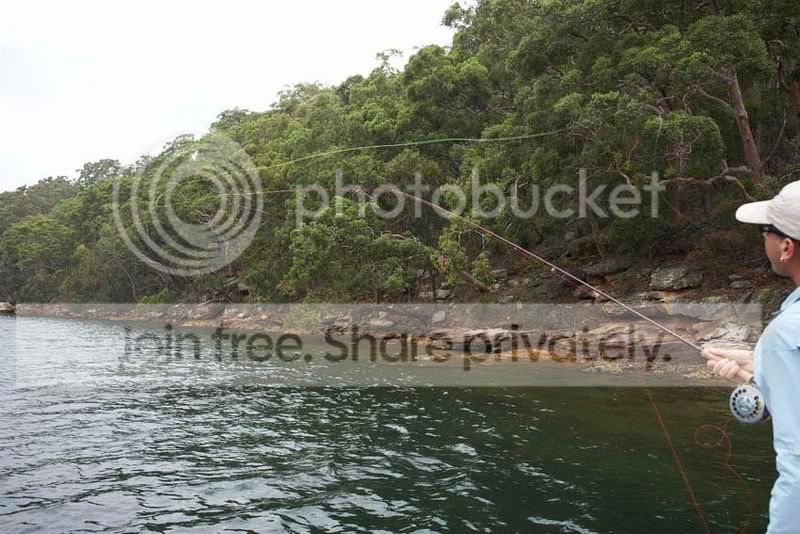
Its all about recognising an opportunity to get the shot, you can’t just get them anywhere.

This is an old shot taken on slide film and scanned. The line is a Rio Clouser, it has a good thick head. Picture was taken by my son.
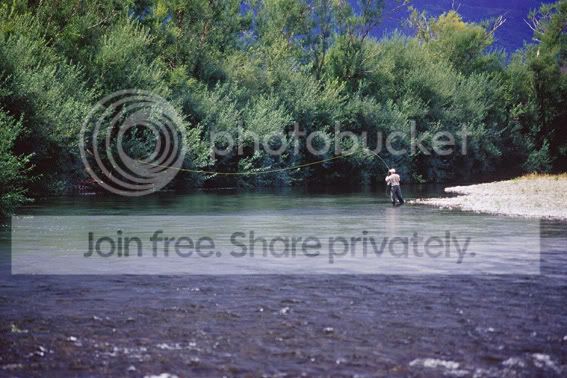
I would rate this as one of the great lost opportunities of my life – the light lasted less than a minute (film camera days – again shot on slide) and rather than throw a couple of good casts with clean loops the guy went into a casting frenzy and tore his normally good loops open. It pays to have a really good caster in front of the lens, crappy loops remain crappy loops unless you want to spend days in front of a computer fixing them.

Morsie
MemberI started out as a writer and pretty quickly realised that its much easier to sell stories if you can back them up up with images. I bought a Nikon FE2 second hand from a friend and its the camera I learned with. Nothing quite like manual techniques for a good grounding. Progressed through F601, F801’s and eventually F90’s then to Canon when I went digital.
Published in the US, Europe, and Australia in magazines, books, and newspapers.
I would not classify myself as a technical photographer but have a pretty good eye and I think that’s more important than anything. Train your eye and for this stuff (fly fishing) learn to put the rod down, or even better leave it at home.
Morsie
MemberI’m with you guys. Edit the Raws to how you want them to look, after all you were there at the time the image was taken and know what it was really like.
I submit large tif files and have never had a magazine complain.
Morsie
MemberWhere did the material break – at the knot or in the section of tippet?
Knots are critical in the fine stuff. If a knot in material that light loses 10 or 15% you’re in trouble.
Morsie
MemberAl they’re probably overfilled and just need a specialist to do a recovery job on them.
Morsie
MemberRio’s use of relatively detailed taper diagrams on their web site and on their packaging is a useful reference.
Morsie
MemberDepends on what I’m doing. If I’m walking I’ll leave it at home (which is most of the time). One battery in a 5D is sufficient for a day. If I’m boat based and shooting lots of continuous stuff ie. as in looking for jump shots, or lots of boat to boat shots I’ll definitely fit the battery pack. I don’t like opening the camera up at sea even on a 50 footer.
Morsie
MemberBeautifully simplified Bob.
Thanks,
Morsie
MemberSteve, I reckon you need to ask around some of the Mom’s in the neighbourhood
MemberZoom in on the press tower in mid image and check out all the CANON lenses………. ;D ;D 😀 😉
Morsie
MemberYou may already have it Zach, but Bruce Richard’s Modern Fly Lines from Lefty’s Little Library series is a great source for anyone interested in fly line design and construction. The chapter on tapers and their effects on casting, and of course fishing, is a real head spinner….. 😮 😀
Morsie
-
AuthorPosts