






zac sexton

Forum Replies Created
-
AuthorPosts
-
zac sexton
MemberNot really a contradiction. It is awesome, but not the best. There is a state much better access and more public land (accessible to the public instead of locked by private land), especially after revamping regulations this year. When I attempted the Cutt-slam several years ago, Wyoming had no genetically pure Colorado River Cutthroat trout (according to the biologist I talked to). He suggested I try a stream that would have CRNs that “looked”) like Colorado River Cutts. Not sure on the genetic purity currently as restoration work has taken place since then, but unless it’s 100 percent Cutthroat, I don’t consider it a Cutthroat.
The only protected native fish I am aware of, are in the Snake River drainage, with a limited catch-and-keep regulation(s). However, again, most of that population has been introgressed with hatchery Rainbow trout. There are some limited catch-and-keep regs. trough out the state, however, most populations of genetically pure Cutthroat trout are not protected from being killed by anglers or industry. Most fall under the general regulations which allows killing at least five trout, with no age class (size) limit.
Again, this matters to me, and does not need to matter to you or anyone else — though it should. I was playing a bit off your suggestions that Wyoming sucks for fishing (obviously meaning it doesn’t). Some of my favorite places are in that state — genetically pure native fish that anyone can hike to, and all.
MemberVery good question on what we look for in our favorite fisheries. Interesting that most waters mentioned aren’t too far from a highway — even in Yellowstone.
That is of course where our variation will always be; we are all looking for a slightly different slice of angling heaven.
It seems I look primarily for native fisheries. These places take me away from development, and most often on public land. Which is another issue: access. Kinda why my home state of Wyoming isn’t in my #1 slot. Also why less-populated states are my favorite locales.
Solitude, and native fisheries with genetically pure fish. Those places have all I could want. Catching fish is of course wonderful, but I NEED the ability to sit on a rock, look around the quiet, sip scotch and think of nothing but where I am and what is going on around me. Often those places are small waters with smaller fish — unless we’re talking warm-water (Alligator Gar!). But, that is native and what I chase when I can find it. I paddled all up-and-down the Black Warrior river looking for Alligator Gar. Just found trash, Bluegills and Bass.
And had a great time.
Finally, I need open seasons. I don’t care if it’s pinched-barb, catch-and-release fishing, but let me fish ALL YEAR! Then I’m in Valhalla.
MemberWho else agrees with Mark that Yellowstone NP does not have noteworthy fishing?
OK, I will give you Yellowstone, but the rest of that God-forsaken state sucks.
Yes, Wyoming sucks. And Yellowstone isn’t really Wyoming (neither is J-Hole…), different license and everything! The fishing shop I worked at in high school used to get a bunch of tourists heading to Yellowstone. I told them to grab some Parachute Adams and have a good time. Don’t worry about anything they saw along the way….
MemberAny advice on: guides , places to stay and any other pearls? Or other places to fish in the Sheridan,WY area?
The only guide I know personally moved back to Paradise Valley. You should have great fishing…….hoppers, streamers, pmd’s…….it is all good. As for fishing around Sheridan, you can spend an entire lifetime in the Big Horn mountains.
Nice report Mr. Landerman I! And the fishing is quite a bit better the closer one gets to Cody or Fort Smith… 😉
MemberBrian: You are sure to have a wonderful time! I fished all around the Boundary Waters, but not technically in them. I did, however do a week-long trip canoeing and surveying lakes in the BWCAW. I was tagging along with a state fisheries biologist who also guided fishing trips, primarily for Walleye. I asked about a million questions while we paddled through a dozen or so lakes that week. Below is a bit of what I learned from him, as well as personal experience fly-fishing in the Northwoods.
Below is my favorite pattern for all “Pikey/Bassy” water. I use heavy dumbell eyes and add quite a bit of wire weight to the hook shank, to get it to dive as quickly as possible. I use the marabou-tailed fly when I expect primarily bass (usually Smallies), and the rabbit tail if I expect more Pike/Musky action. I might do a stinger hook on a longer tail, but with this size tail (about 5 inches long), most Pike engulf the whole thing, anyway.

Chartreuse and Orange Sparkle Grub variationsI use this color combo, along with black, and that is about all you need. I prefer straight 20 – 25 lb. tippet/line for a leader. Usually, about 7-8 feet, if using a floating line, and 2-3 feet on sinking lines. Then I use about 20 inches of fluoro shock tippet around the 40 – 50 lb. range. The straight line allows the fly to sink more quickly and gives you a more direct connection to the fly, so you can feel a take more easily. They will often hit as the fly drops and if you can’t feel it, they can let go before you react.
Cast out, let the fly sink ’till it’s near the bottom, then retrieve with two short, quick pulls and let it sink. Two more pulls, let it sink, etc…. Vary the retrieve if needed, but usually it’s a matter of letting it get deeper, and/or finding a better place to fish.
The biologist I was with on the survey trip, kept pointing to shoals, humps of cobble/boulder that rose from deep water, to within a few or several feet of the surface. He said Walleye and bass really liked those shoals, and he always fished them, from the top – down, letting his lures (flies in our case), bounce down the slopes until he found where they were suspended.
You will likely find Pike in the shallows, where reeds, grass and lilies are, but also bring a thermometer or fish-finder, to find the thermocline. Fish just above the thermocline, and you will be a happy man. That is the main place larger fish often feed. We found the thermocline to be around 12 – 25 feet down, in the lakes we surveyed, depending on dissolved solids, temps. and lake depth.
I generally like to find a point of land where deep water meets a shallower bay, and fish the deep drop off the bay. I almost always find something there — just maybe not the biggest fish, or the most.
The Sparkle Grub pictured above, with a few Clouser Minnows and a floating/popping bug of any sort should be all you need. Have a bright fly and a dark fly, and you should be good to go. Good luck!
MemberDave: Very sorry to hear about your pup. Setters really do fascinate their owners to be sure. Mojo also had quirks that would make me grumble, but really they were pretty funny. Fifteen wonderful years with your pup = fifteen of the greatest years you and your pup could have had, no matter the circumstances, I’m sure 🙂
Peter and Dave: Also, thanks for the suggestions on a partner. Though it isn’t actually scripted in to the show, there will often be a guest, though I don’t think always. A lot of the show is in backcountry/wilderness locations and I will be in the field for up to a week to shoot one episode. It’s hard to find someone else with that kind of time to fish on a whim. The show is a bit of a feature of my life as an angler and one who is crazy about catching fish on a fly. So, it will show me meeting people on-stream, talking with fish bios., and other anglers, as I usually do.
This last episode we filmed, I met two guys at the motel we stayed at, which seemed to be THE place to stay for local salmon-fishers. I offered to bring them back pizza from town, b/c they were too drunk to drive, and we B.S.ed all night with a drink or two. The next day, I met them on the river, jumped in their boat and floated down to the take-out with them. It was pretty cool, and oddly how a lot of my trips go. I think it will turn out to be an interesting part of the show — the other people I meet along the way.
Thanks again!
MemberGood thread guys (and thanks to Joel, my wonderful boss for querying ya’ll ;)). And just to correct a misunderstanding: I AM funny; just ask me…. ;D
I started guiding at age 17, with a few seasons’ break surveying fish and streams for the Forest Circus, during college. Guides are pretty much making today, what they did when I started. A slight bump after “The Movie” and another with gas, but not much comparatively. I have been on one actual guided trip that my grandmother won (on the Bitterroot!), and found the guide worked his hind-end off and balanced my love of fishing bamboo and my own flies with my grandfather’s (who went on the trip with me) love of just taking pics. I got the front of the boat most the day and had a great time even though the fishing was slow. I did land a 23″ Cuttie, however…. I will remember that day forever, primarily because that guide made it the perfect day with my Grandpa. And that is, in my mind, what we should do — make the day perfect for our clients. Though perfection can sure include some flawed moments….
To do that, it really helps us to know what you are after: just wanna try it out, enjoy the wildlife, swim, fish dry flies all day, etc…? The more your guide knows the better your day should go. That is one thing I respect about Joel, as he is always asking questions of clients so we can give them an unforgettable day, whether it be catching a new species, or just having a great family get-together.
If we have been with clients before, and they happened to leave a tip — well, we are sure to stock-pile favorite beverages, food, and may even break out some personal equipment we feel they will enjoy and tie some flies we feel give a bit of an advantage, among other niceties. Maybe I’ll even stockpile a few extra, really funny jokes….
I have only been on the one actual guided trip, but often fish with guides, who are my friends. And they are guides, because you seem to get treated as a client. You get told where to fish, what fly to use, when to set the hook, and they always seem to insist on rowing ::). Guiding surely gets in your blood and becomes a part of how you live your life. I expect myself and other guides to know more than a few ways to approach a given body of water, and to help their clients learn to fly-fish, as well as appreciate the outdoors. My priorities on the water are, in this order: 1) Safety 2) Fun 3) Fish.
What you get for what price can be iffy. But, by asking the right questions, telling a prospective guide what you want and listening to his/her responses, you should know what you’re getting in to. Prices vary regionally, and maybe picking a guide/outfitter in the middle price-point for that region is a good starting point. Personally, since I’m a broke-arse guide mostly, I look for the seasonal specials, like in the spring/fall, when guides may reduce prices. Sometimes a trip that is usually $450 will go for $350. I use these off-season rates to get in on some of the spring creeks in Paradise Valley, on the Yellowstone river. 😛
Just my 2 cents….
MemberI don’t know Joel, can your guides Guarantee fricking huge fish all day?! Then I’ll take a 12-hour trip!
MemberWe at Rock Creek had the same question about “what the hell is a Steelhead Salmon?” I asked our chef. Turns out, it’s a farmed, Rainbow trout, delivered frozen by Sysco food industries. It’s really neither Steelhead nor Salmon, but it is listed on the product sheet (order form) as “Steelhead Salmon.” That’s why the menu lists it as such. Frozen fish will never beat the taste of fresh fish!
MemberThanks for the feedback guys. Yes, more energy would be good, I agree. But, we filmed this after I had been on the road fishing for about five weeks. It was the first filming for the show, also, and I was not exactly sure how things worked or what exactly we were filming. I was doing research for my book on fly-fishing for Cutthroat, and we were kinda filming a bit of that, too. I was playing more of my “science-guy” character. I’ve changed it a bit for the latest filming, and hope I’m a bit more entertaining in future episodes!
Mojo, the white/orange dog was a Llewellen English Setter, who passed away two months after filming this episode. He was a great dog, and I miss him quite a bit. Ariell, is a Large Munsterlander, and has turned in to a great bird and fishing dog.
The Lahontan is in fact still with us. They apparently found a strain of the original Pyramid Lake Lahontans with the genetics for attaining their historically monstrous sizes. A biologist in Oregon found them in a small tributary there. I’m not sure what the final report concluded, as when I heard about them, they were newly discovered. But, there are still many strains of isolated Lahontans in small tribs. throughout Oregon, Nevada and California. I can’t remember the lake, but it’s near Reno, that has the last native population of lake-living (adfluvial), Lahontan Cuttroat. The current Pyramid Lake strain is a genetic mix of Lahontans, but from different drainages, as I understand. Also, they may reach the historic sizes, if they could gain better purchase on spawning grounds in the Truckee. They need to make four trips up, I believe, and I think they spawn every-other year, and therefore need to reach ages 8-12 to get to the 40lb. size class. I read a peer reviewed report on it, and can’t remember exact details off the top of my head, but that’s the gist of the problem at the moment.
MemberThanks for pointing that out, Zach! Oops. I wish I was a hot brunette… I left the link, anyway, in case someone wants to see a hot brunette, instead of my ugly face! I posted the correct link now.
Member…What I’m interested is, since the rod making conditions are the best they have ever been (best available tools, internet making sharing info a breeze, best synthetic glues available, etc.), how good a rod are the current crops of bamboo rods these days? Can they be a true alternative to modern graphite rods?
However before getting to that level of discussion, I guess we/I needed to know what the experience on bamboo rod our forum members have so far. As soon as the ones that really have tried (and still trying) the best modern bamboo rods made come through, we’ll probably be talking about to what level the modern bamboo rods are capable of fishing the way we do today. What are their limits, what are these rods good at, does the nostalgic ‘sound’ of bamboo add to the fishing experience, etc.
I’m not sure if this kind of thoughts and discussion gets a chance here? At the Clark’s bamboo forum, it gets too much caught in ‘I just prefer bamboo no matter what’ kind of discussion.
Am I making any sense here? ::)
I have been holding off on this question, and thinking about it a lot. I hope I can answer these questions.
About me: I am sponsored by the Sweetgrass Rod company, so I will likely say nice things about their rods. However, I am also a journalist, and try to provide some facts to go along with my opinions, and hope my thoughts are useful. I have been making bamboo rods from the culm, for around five years, and refinishing/building bamboo for about 10 years. I have written about rods and interviewed many well-known makers/designers, published in newspapers primarily while writing an outdoor column for the Lewiston Morning Tribune, Lewiston, Idaho. Some makers I have interviewed and B.S. with on a regular basis: Glenn Brackett, Jerry Kustich, Sam Drukman (carbon fiber, but a genius rod designer), of Sweetgrass rods, Tom Morgan and Bill Blackburn of Morgan Rodsmiths and past owner of Winston, Bernard Ramanauskas of Eden Cane/Scott, Jeff Walker retired Winston/Sweetgrass Rods, Jeff Hatton of Gnomish Rodworks, Harry Boyd, Denver Dave Collyer, Wayne Macca, Matt Schliske, Mike Clark, Joe Arguello, Steve Kiley, Brian Morrow, Mike Peck, Thomas Simarud (Norway), and another carbon fiber guy: Tim Rajeff, and bamboo personalities: AK Best and John Gierach.
There are others, I’m sure, but these are most of the people I know and are friends. I have cast every one of these maker’s rods, and fished most of ’em. I have worked in both the Sweetgrass and Matt Schliske’s shops as an apprentice maker.
I first started fishing bamboo at around age 16. The first main event that got me in to fishing primarily bamboo was breaking/bending hooks and tippet while fishing the trico/caddis hatch on the Bighorn river in Montana. I was fishing a custom-made G Loomis rod, and it was the finest rod I owned. The other was an 8 wt. Eagle Claw… Then I got an old bamboo rod from a local sporting goods shop ($85), took it to the Horn, and started setting the hook to 20+ inch Brownies with 5x tippet, and #22 flies landing the bruisers successfully.
My main concern with fly rods is their performance for actual fishing conditions. I don’t care if you can cast 100′ with it, if you break your tippet trying to set a hook. My experience lately with carbon-fiber rod design is mostly from what I’ve learned from Sam Drukman, and a bit from Tom Morgan. Morgan was the first to insist to me that the material doesn’t matter. What matters is the maker’s ability to understand the characteristics of the material and design rods using the certain qualities of the chosen material.
Sam has mentioned that graphite is better in some instances, such as bigger rods, due to it’s high modulus, but that you can still make a bad rod if you don’t design around the modulus correctly. Same with fiberglass, which he and others makes a better trout rod. Sam has also been designing rods with graphite/glass hybrid blanks to make what he sees as some of the best rods out there. That being said, every rod I’ve designed in the past couple years (5 versions of three rods), I’ve given to Sam to try out, and he points out weak and strong points in the taper. The taper. THE TAPER. I’ll say it again — the taper.
That being said, what I’ve learned in the last several years has been from professionals building commercially, some as a hobby, and some as the prototypical maker in the garage. I have taken all these perspectives in to account, combined with my own rod-making experiences with those of the clients that I guide in Montana.
Many makers and users of bamboo rods feel it is best as a trout-water rod for medium to small streams and lakes. I would have to agree with that for the most part, but have made a rod that is just shy of 9′, weighs under 5 oz., and can throw double-streamers with accuracy and authority. I have fished it in the salt many times, I have yet to catch anything bigger than 8 inches in the ocean however :'( It’s a killer rod and an example of how bamboo can make a great big-water tool. But, I didn’t build it using common techniques, but also didn’t vary too far from what has been made in the past.
The reason for trout-water preference seems to be the weight issue. Bamboo is the heaviest material used, but not by much. Wayne Macca makes bamboo rods as light as and as strong as many graphite rods, but custom-made to a customer’s preference — including bass and salt. Some of his rods are even completely hollow through the tip. Crazy.
I don’t see weight in and of itself as an issue. I have these things in my arm called “muscles.” Maybe you’ve heard of them :D. The more I work them, the bigger they get. Thing is, they don’t have to get much bigger to handle an extra 2 oz, which is about the biggest difference from comparable carbon-fiber and bamboo rods. That being said, what matters is where the weight is! Some rods can be “tip heavy,” and truly are a pain to cast. How do I know this? I have carpel tunnel in both my hands, 1″ missing from my right clavicle, and a displaced left clavicle. There are a few historic rods I’ve cast that kill my hands after a couple hours, and are “too heavy,” b/c of the weight primarily in the tip section. This has only happened on 9′, solid rods. Then, again, I’ve cast 9′ rods that didn’t hurt my hands. It’s in the design.
One way I get around weight issues is by using our modern glues and hollowing in some areas, keeping solid in others, and using components (ferrules, reel seats, guides) that are lighter than “normal.” Many makers do the same thing. Many historic makers have done this as well, since the early 1900s.
I went away from carbon-fiber rods, because they started to ballyhoo how far they could cast. The faster-action the better. This to me, made them a pain to use with delicate fishing techniques, and for casting in close, which is where most trout anglers fish. To me, a rod needs to react in close, as well as out to farther distances, at least 50-60 feet for most trout fishing. I have lots more thoughts on distances fished and how rods should react, but will have to leave that for later.
After talking with Morgan and Drukman, and casting their rods, I have found a new love of carbon-fiber! Yep. Some carbon-fiber rods just turn me on — Sam’s especially. Also, a few models in general production for graphite makers are pretty nice. The thing I love about Drukman’s and Morgan’s rods, are they have delicate tips that transition to powerful butts, making them useful for casting in close and far out.
Bamboo does this naturally, especially rods with swelled buts, or steep changes in taper in the butt section. Especially rods with mortised rod grips — bamboo and hardwoods laminated to form the grip. Bamboo has about the same (slightly lower) modulus as fiberglass. But, they must be designed differently to get the performance we desire. A rod has to flex to get that performance.
This is where bamboo gets interesting. There are 2 strip (of bamboo)/4-sided rods, 3 strip/4-sided, 3-sided, 4-sided, 5-sided, 6-sided, 7-sided, 8-sided, 9-sided and 10-sided rods available today and many from more than 100 years ago. Carbon-fiber rods are round and hollow, and original blanks are difficult to find, as they are expensive to make. Therefore original tapers and wrapping of carbon-fibers is less common. Many rods available come from the same maker, then re-painted and built with different components and labeled for whichever company. There is one instance where a graphite company used the exact same rod then labeled it for four different models. Same blanks, same lengths. Only thing different was the label, I believe they labeled 4 to 7 weights the same. It took a lot of complaining from dealers, but they eventually changed those models.
And bamboo rods are available from 100s of makers around the world: Colorado, Montana, Oregon, Pennsylvania and Michigan being some notable Meccas. This variation in models and makers makes bamboo an interesting fly-fishing tool for sure. And, say you find that sweet little (or big) rod that fits your casting style perfectly, you can get the taper and have a near-perfect replication made by any one of these makers. Find your favorite carbon-fiber rod, break it five years later or wanna get another, and you are likely out of luck. Those blanks are long gone, and you will never be able to fish that rod again. Not so with bamboo — as long as you have the taper.
Speaking of tapers, this is the change in dimensions from big to little in 1-inch increments. The bigger the change in dims., the faster the action. Those looking for their first bamboo rod will likely want to fish a progressive-actioned rod with a “fast action.” This is a steady change in dims. from butt to tip, maybe with a couple steeper areas in strategic places. A traditional maker example would be Lyle Dickerson, and a more modern maker would be Matt Schliske or the Sweetgrass company, or Bernard Ramanauskas. I have fished their rods and know. Sweetgrass is overall faster than Winston, but likely a medium-actioned design if you have been fishing carbon fiber.
If you can get the taper of a rod (likely in 5-inch increments), find the difference per inch, i.e. if you have dims.: .280 and .270 at two stations, five inches apart, your taper per inch is .002 inches. In my opinion, this is a satisfactory change in taper for a progressive rod design, at a minimum. I build my rods with a couple places that drop a bit more steeply, especially in the top 15 inches near the tip.
But a rod doesn’t need to be fast to be a joy to cast. This is something fiberglass aficionados know. Just wait a little longer on your back cast and you will discover the magic of your rod working for you. Once you get that slightly heavier rod moving, the inertia keeps it keepin’ on, and “casts for you.” That is a description you will hear from a lot of makers/users of bamboo. They cast for you. They cast for you because the bamboo fibers transmit energy stored in them. So does a carbon-fiber rod. BUT, they transmit it quicker (higher modulus and lighter weight). A rod-maker can adjust the materials and rod design to get the action they want. But, overall bamboo is easier to work. You don’t have to jar it to get it going. The mass in the rod transmits the energy in a fluid motion — in most rods.
And price? You can find amazing rods from anywhere in the $400 price range on up. Even notable makers of $1,500 to $2,000 rods have prototypes available at a fraction of the cost. Some will sell a blank for a comparable pittance, and you can build them up to a wonderful rod for less than $50 in materials. I have even cast “bidi” rods that were very nice fishing/casting tools. These rods are the top two sections (usually) from a 9′ rod. So, say you find an old South Bend rod with plastic reel seat, cheap components, and painfully tip-heavy action. You can get these rods for $50 or less. Again, for about another $50 in materials, you can use the mid and tip to make a sweet 6′, 2 pc. rod that will likely throw a 4 to 6 weight line with delicacy and ease. I know because I’ve done it and cast other makers/builders’ rods that did it. Of course, maybe you don’t like small rods…
In summary, it is the variation, durability, effectiveness and beauty in bamboo rods that make them a joy to fish. Yes, they are durable. Brackett often will throw a bamboo rod on the concrete floor, stop on it with his booted foot, then hand it to someone to fish with. The support of the several strips bound together help protect against hook dings and general abuse. The one weak spot really is metal ferrules (generally and not always). Here, the stiff metal joint meets the more flexible bamboo, and is one of the most common places for breakage, besides the tip. To protect against this, the angler should fight fish with an obtuse angle rather than an acute one. What? Well, instead of heaving the rod back, over your head, putting a sharp angle (less than 45 degrees) bend in the rod, keep an “open” angle generally greater than 50 degrees to fight fish. You may have to get a longer-handled net or wade back to shore more often, but it will reduce the chance for failure at the ferrule.
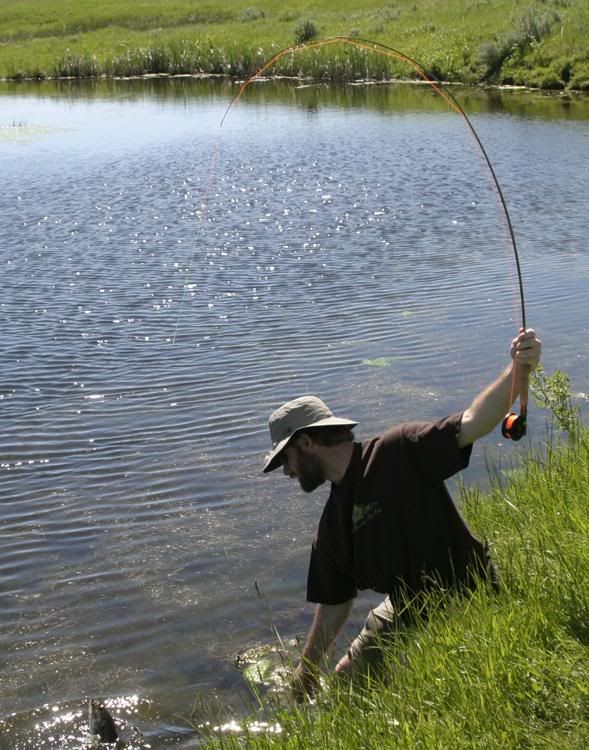
Landing a Largemouth bass with a 4 weight PMQ (Poor Man’s Quad), a rod I made with two strips of bamboo to make a quad rod, with no forms. A micrometer, plane, measuring tape, glue, varnish, clamps and hardware are about all you need. A pencil helps. Note how I’m keeping my hand back to keep the angle more open and not stress the ferrule as much. It’s still a steep angle, but only for a brief moment.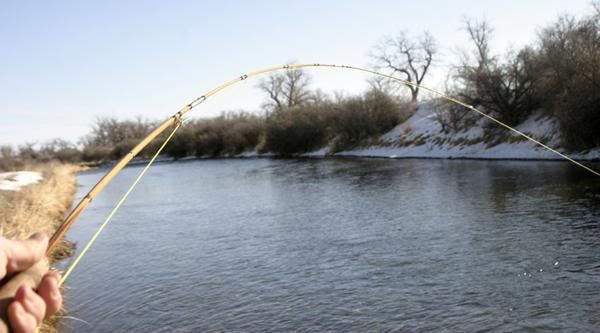
Fighting an 18-inch Brownie on Montana’s Bighorn river on my birthday with my first bamboo rod made from a culm. It’s a nodeless Leonard copy, 7’6″, 4 weight, hex rod. Again, note the open angle that successfully brought the beauty to my hands.
The blanks I used a couple years ago for my prototype big-water rod of my own design. Note the hollowing in the butt section — completely threw the grip, to reduce weight and quicken the response in the rod’s flex. I’m still working on the design of this rod, but it is a killer rod even enjoyed by a buddy who HATES bamboo.
http://www.sweetgrassrods.com/index.php?option=com_myblog&Itemid=24">
http://www.sweetgrassrods.com/index.php?option=com_myblog&Itemid=24
A link to my blog for Sweetgrass rods. You might be surprised at the size of one particular fish… Maybe not….At any rate, I love bamboo. I also love properly designed carbon-fiber rods. And while I’m on it, not all bamboo rods are “properly” designed. I have cast rods that I didn’t really enjoy, and others that simply had poor tapers and did not produce proper loops. And bamboo in no way has a “dead” action. If bamboo does, then fiberglass does.
If you have any questions, comments or concerns, please let me know.
In Wild Waters,
Zac Sexton
MemberI will have to check out those two shows; thanks for mentioning! I have been working on my own show for Comcast Sportsnet NW. They have been increasing outdoor programming and doing a very good job, in my opinion. Below is a link to the show I’ve been working on, and am currently filming. I would appreciate feedback, keeping in mind, this is just a 5 min. teaser, and may not air. Also, the show is still working titles, so I can’t really tell you it’s name. But, it is based on fishing for native/wild species in the Northwest. Lots of back-country trips to remote places. We are still looking for sponsors, also, so if you know anyone wanting to reach new audiences…. 😉
http://vimeo.com/16257112
pasword: comcasthttp://www.vimeo.com/9709039
Example of marketing at Comcast… Oops! ;DMemberGood luck, and hold your mouth right! I think you’ll enjoy the 7 wt., when the wind kicks up, and you decide to toss double-streamers;-)
MemberDan: Good on you for the ethics lesson for students, and the discussion here! I am impressed. The discussion reminds me of a few stories — unfortunately. However, I have found I do better fishing popular waters in the middle of the week, in the middle of the Winter, and hiking my hiney off in the summer, to reach more remote waters. That just keeps me in a better place :D.
That being said, I think the suggestion to watch what others are doing is a very good one. I transferred to the U of Idaho in my early 20s, and really wanted to Steelhead on the big, inland Northwest rivers. I joined the local fishing (FFF) club, and got one particularly pertinent piece of advice: “Zac, just go down to the river and watch the other guys. You’ll see what they’re doing, and how they’re fishing it (a particular hole), and you’ll learn.” That was it. Go and watch. So I did.
I watched people fish this one hole, near a populated area — for Idaho, and saw how it was done. They rotated through the hole, starting at the head, casting and swinging flies down and across, wading downstream. I checked on this with my advisor, and he reiterated that is how you fish those holes. So, I learned to ask permission to join the group fishing a hole, and “merry-go-round” through as part of the group. No one ever got upset, and any day could find several anglers fishing the same hole from one side, by taking their time, and giving everyone a chance.
And I only fish the Pan in the dead of Winter…
MemberGreat stuff guys! The only thing missing is my mug in that motley crew, ha ha. Looks like a great time and I’m bummed I couldn’t make it. db
Corey, it sounds like you need to do a road trip with Douglas…
Douglas: Don’t worry. You didn’t miss much not hanging with Ron and Joel — really, you didn’t ;D You are generally better off just reading a fishing magazine 😉
OK, so I’m a little jealous I wasn’t able to make it. Hoppers in Rocktober… Hmmm…. Live ones it looked like…
Oh, and Corey — your pictures Rock Rocktober!
MemberMe walking through a bit of brush, after fishing for more than 24 hours straight, with an 8’8″, 6 wt., bamboo rod that casts double-streamers with ease and dry flies like thistle down, that I made for around $150. The reel was a bit more…
 Member
I use the internet to gather info. on rare and native fish, like I’m trick-or-treating. Since most government agencies have started posting their seasonal surveys online, I have been “Googleing” a certain fish, finding the scientific reports on them, along with any relevent habitat info. and maps, print them, put them in a binder, and use them for reference while exploring new waters. Along with that info., I use Google Earth, forest/BLM and local maps, even hand-drawn maps from shop owners. Most of my trips start with scientific info. gathered via. internet, but end with me asking questions to a local shop owner, or another angler.
The internet will never be an end-all source for info., but it surely helps many anglers find anything they want for a fishing trip. That being said, a lot doesn’t end up in reports, that only first-hand experience can show.
That’s a thing I do, that hasn’t been mentioned, yet.
MemberMaryJane’s Farm dehydrated food beats Mountain House 10xs over! It’s my favorite backpacking food, and I take it with me on every trip. You can also order in bulk, save some $, and mix things up. http://www.maryjanesfarm.org/categories/food-pantry.asp. Love it.
Also, the dehydrate-everything idea is a good one!
MemberI’ve had two dogs since high school. Both were great fishing dogs and went with me everywhere. It helps to take the time to just practice travelling, and staying in a confined space. I think that helps keep nervousness down, and they relax a bit more. Once they learn they go cool places and get to get out once in a while, they love to ride in a boat or canoe. It just takes time and practice. Each dog is different.
Pictured above is Roy, a buddy’s French Brittany, and Ariell, my Large Munsterlander. Ariell did her first float trip this April, and hated it. By her third float trip, she loved it, and I feel comfortable bringing her on trips with others. I’ve even had clients ask for me to bring her along on wade fishing trips! Kinda cool.

-
AuthorPosts