






Neal Osborn

Forum Replies Created
-
AuthorPosts
-
Neal Osborn
Memberthat is a good report – 3 in 1, nice.
MemberTom, great post and thanks for sharing the pictures – that’s what makes the trip reports so great. One of the pictures is right downstream from the PhD hole – so called because the big trout there are so smart you need a PhD to catch em. I’m surprised that your pictures don’t have more people shown because the Davidson has become a “shoulder-to-shoulder” river and the crowds can be unbearable sometimes.
BTW, the Galvan Torque is one of my favorite reels.
MemberSante…welcome! You have a podcast? Is it on iTunes?
Cameron (and others) – Zach did a podcast with Sante (FishnBanjo) called “The Cane Mutiny” The Itinerant Angler Podcast Season One, Episode Seven. That’s what I was referring to above. Sorry if I caused confusion.
MemberSante,
I have been dying to get a peek at your collection of bamboo. That is inspiring. I will keep these pictures in my head next time I re-listen to your podcast.
Neal
MemberMark – based on your initial pictures I’m sure your collection is quite extensive, can’t wait to see additional pictures.
Cameron – “Gear Closet.”
MemberJay – great pictures.
MemberWill, thanks for the pattern! Looks great. Do have a link to any information on this fly? Did you take that picture?
MemberAndrew,
Since we live in the same town I can guess that we are fishing similar waters. Your question will of course have lots of answers depending on each persons confidence patterns and skill level. However, you specifically asked about “small” “dry fly” “floatabilty” and that hones in pretty specifically. Here are some thoughts . . .
A little trick I learned at one of the conclaves. Use a foam post for your parachute patterns. It is very visible and floats well. I use these guys on “medium” fast riffles.
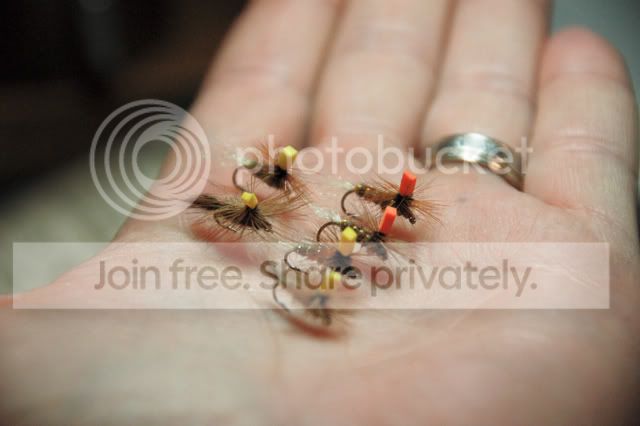
The Trude style dry fly was originally designed for Western rapids and by tying your wing back in this style you gain significant floatability. The trudes hold up very very well in “moderate” fast rapids. You can tie them small as shown here (size 16-18). This is the Jack Cabe hopper, one of my favorites. Problem is they are a real bitch to tie and require a bit of advanced technique to keep the thread/hackle from slipping and crowding the eye. I drink at least two scotches before going at it. A great trick is to jam a bunch of CDC under the wing so it floats even better.
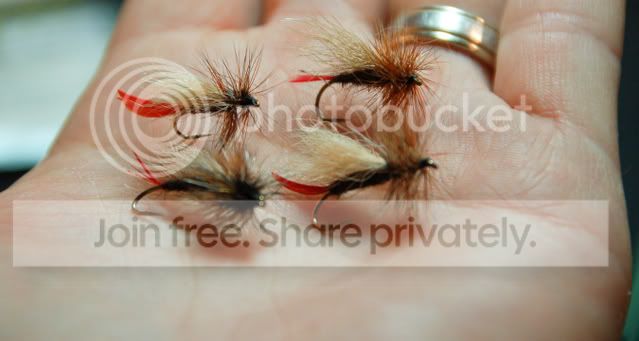
Here is a quote from a link on the history of the Trude fly, “. . . foot-fur is nearly as visible as white calf tail, but has the advantage of providing additional buoyancy. The structure of the hair makes it float like a cork without adding floatant.”
http://www.fishingwithflies.com/Hare-wingRoyalTrude.htm
You can always tie on a foam popper as the point fly (indicator) and drop a dry fly or emerger about 12″ back. Sometimes you get lucky and they take the foam indicator fly.
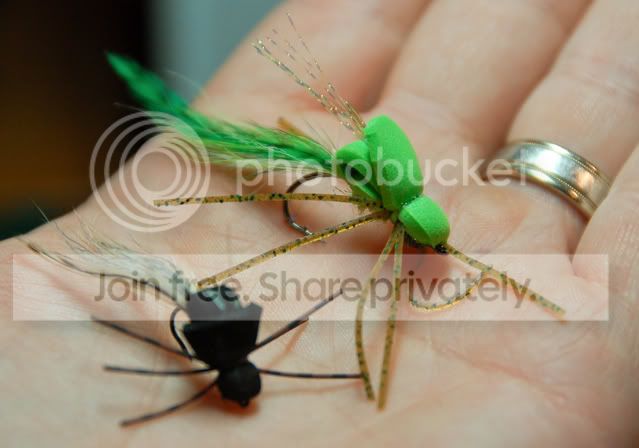
Nothing wrong with stimulators (they are really just a variant of the Trude style with the wing placed toward the back, common theme for high floatability). These are size 18 and float great.
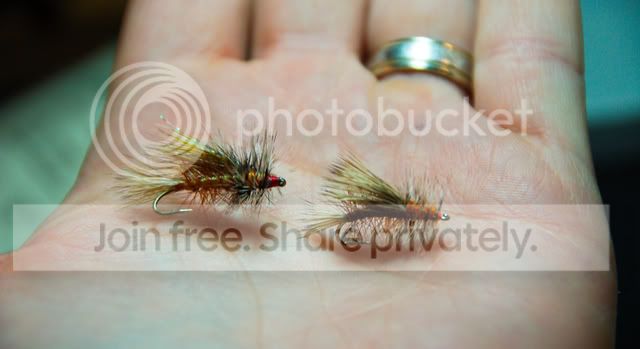
On a side note, I have recently been fishing wet flies on the swing much more frequently in riffles/rapids. Once I learned the technique of the swing and got good at tying wet flies my hook up rate went up dramatically. Wet flies can be tied very small like these size 17’s (English wide gap hook) which are more like a traditional size 20. I call these Mini-Kevin-Powell’s, hahaha.
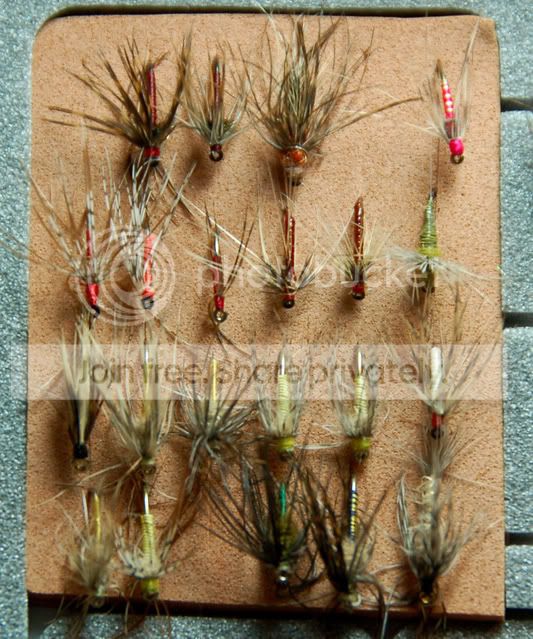
Let’s go fishing and find out what works. Maybe you can show me some of these spots you fish 😉
MemberFound this picture of Deep Creek Valley in the GSMN shot in October. Now I’m getting pretty excited!
Lauren, we are planning on hanging out at the campsite for sure. I will contact you guys later with list of our cooking equipment (and a list of fine single malts for the menu).
MemberLODGING
FYI – it appears that most people are planning on camping on this trip but we found a great deal on cabins by the campground. We booked one for just $88/night and there are cheaper cabins for about $55/night. Here is a link below.
Main site http://www.deepcreekcamping.com/Camping.html
Link to the cabins (only two left as of today so call quickly) http://www.deepcreekcamping.com/Cabins.html
MemberAaron, Julie is coming so if at all possible make the trip and bring your wife. BTW, Julie is planning on hiking and taking pictures instead of fishing.
MemberWelcome Martin. I wouldn’t worry too much about the names and all but most of us here do tend to use at least some part of our formal names. You can always change your account so that your nickname is under your avatar; see mine on the left says nealpod under my picture. That way people still know you by your nickname.
Great to see more people from across the pond joining in on the ruckus. This is really a great site and the people here are wonderful. Lots of knowledge and experience floating around this site.
MemberCameron –
I didn’t notice until a second look but that is pretty cool having the fiberglass flyrodders logo on your net. Was that a custom logo? How did you get that on the net? I always like the look of that clear rubber
MemberHell Yah . . . Mark that is awesome. Your mug collection rocks. Let’s start another thread and title it something like “what else do fly guys collect”.
Seriously, that is a great mug collection and that chair is a once-in-a-lifetime find.
MemberAny connection between the Tibor reel with the shaving brush and the hollow ground straight razor
Good observation Mark. I collect antique shaving equipment and have an extensive collection of straight edge razors and badger brushes. I actually shave with a straight edge razor, ha. Check out Classic Shaving http://www.classicshaving.com/Home.html. Great web page and resource if you are interested in classic shaving equipment. Fair warning – the classic shaving stuff can be as addictive as fly fishing! If anyone has any questions or would like advice on a good starter setup just PM me.
MemberHere’s how you do it –
Take the tubing and cut exactly in the middle of the thickness with a razor blade (I use a straight edge or even a scalpel). Cut down about 1/4 to maybe 1/3 the length but not more.
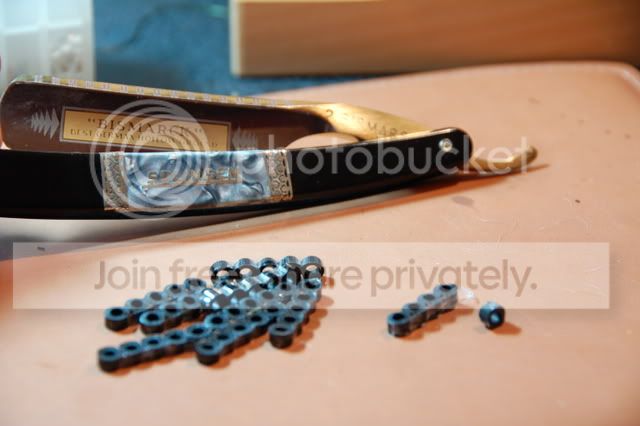
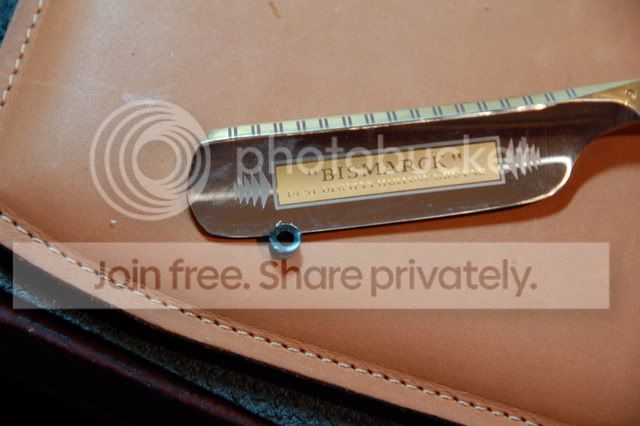
Use strong mono thread (0.006)
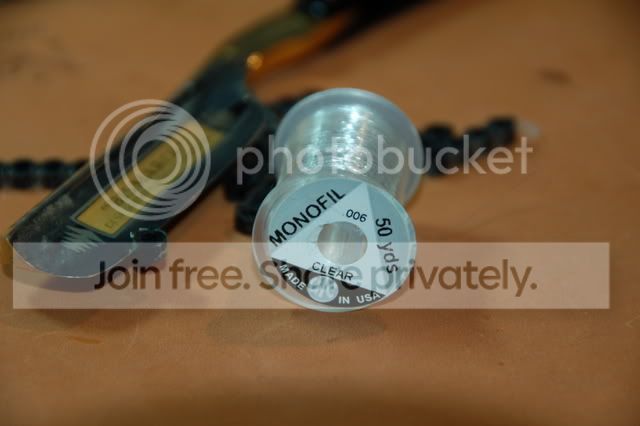
Insert a size 16 sewing needle (get at the craft store or Jo-Ann Fabrics). It must be a size 16 because you want it to be rigid for later when you pull down the rubber to clip it. Anything else will just bend.
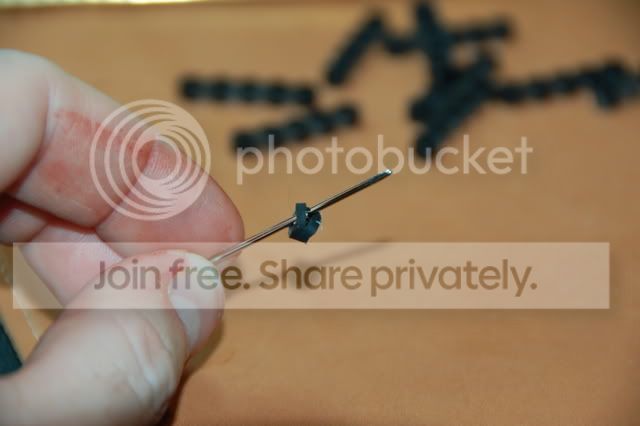
Start the mono thread on the hook and then you stick the needle through one side of the cut in the rubber and then run it UNDER the hook and then through the other cut in the rubber.
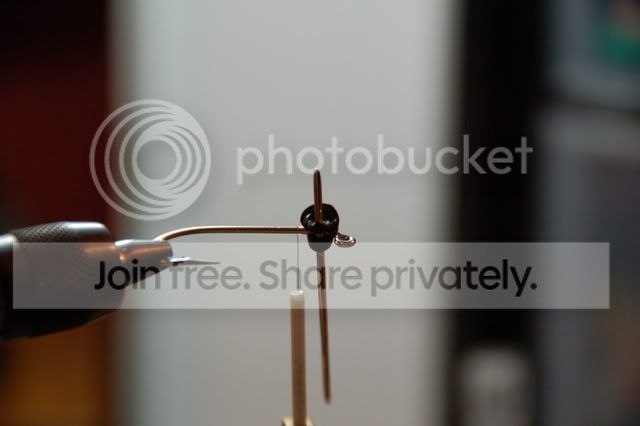

I will have to wait until I get my new lens before I can post some clearer pictures. Can’t get the close-up detail and lighting correct at this time. Essentially you just helicopter wrap the mono thread around the rubber on BOTH the top and bottom of the hook but always staying above (or on top) of the needle! Then once the wraps are all tight you pull down on the needle and the rubber stretches and then you clip it off without clipping your thread. Touch of superglue and your done. It’s actually fairly tricky to do this and takes some practice.
MemberHere are the details on the rubber. I am almost 100% sure it is peristaltic tubing and I got a nod and stern look from the guy when I mentioned this to him. I was around a dialysis unit one day and noticed that this medical tubing is basically the same stuff. The measurements are as follows . . .
1/4” OD (outer diameter), 1/8” ID (inner diameter), 1/16” wall thickness.
Peristaltic tubing (OMEGAFLEX® Santoprene Flexible Rubber Tubing), black or tan.
http://www.omega.com/ppt/pptsc.asp?ref=tysp&Nav=grel10
http://www.store.cleanair.com/Tubing/9012.phpAnd if that’s not enough, I found this great link http://www.nexgenhose.com/Products.aspx. You can actually buy the stuff in COLORS! I have not purchased any yet because I have plenty of samples but we could all pitch in buy a bunch for next to nothing. I would especially like to have the tan color for saltwater (you could make Crazy Charlies that could be both weighted and unweighted!!!).
Here is a shot of how he processes the tubing. Probably employing a high grade micro saw cut to size by placing 5 tubes together then taping then securely and cutting.
I can put a bunch in my multi-compartment eye-material holder
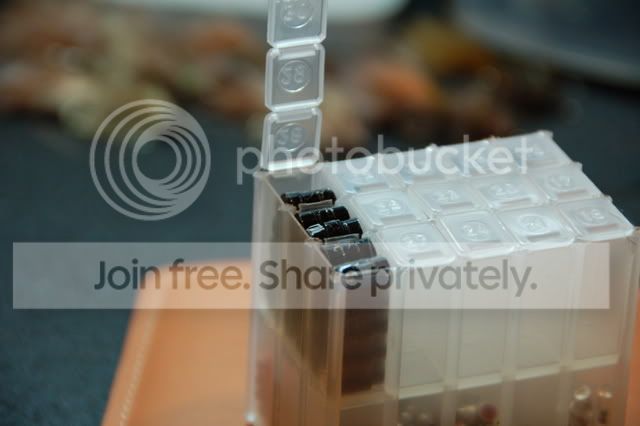
Other pictures
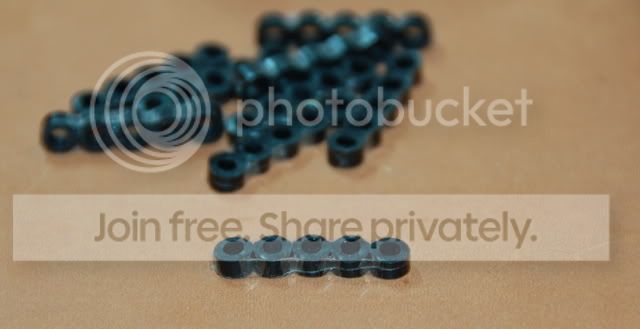
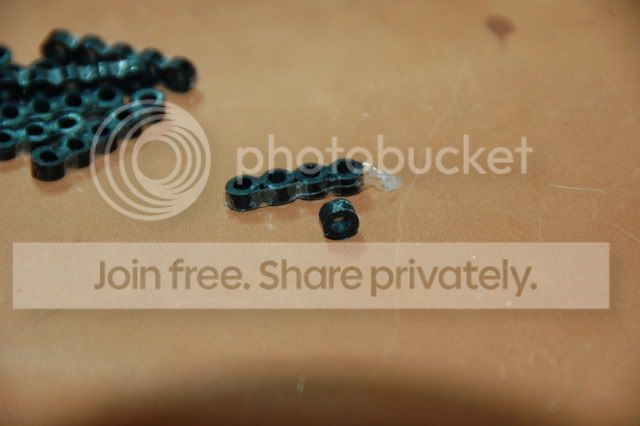
The real trick is learning how to cut them with a razor blade and then tying them on the hook with Mono thread and superglue. More later.
MemberDusty – do me a favor and cut the tubing and show me the tubing in cross section. Please measure the inner and outer diameter as detailed below, let me know if it is the same (this is important, kind of a Goldilox thickness if you will).
FYI, it is actually peristaltic tubing! I don’t mean to be so evasive on this material but I kind of said I keep it a wisper until it can be marketed. However, I was told that it looks like it might be a while so let’s go ahead and start doing some research ourselves.
MemberCameron –
You are a master at telling a fishing story through pictures. You captured the entire mood of trip brilliantly. Thanks for sharing not only pictures but the memories.
BTW, you guys have some of the nicest looking gear out there.
MemberThanks again, Zach. That was a great day . . . what a long 2 days this has been. That was some technical fishing. Seriously, my knees are bruised and that damn splinter won’t come out. We need to hit that place again, maybe in the spring when we have a better chance at the brookies.
Cameron, the fiberglass rod got a very respectable workout today.
-
AuthorPosts