






Zach Matthews
Forum Replies Created
-
AuthorPosts
-
Zach Matthews
The Itinerant AnglerGood info, Jon, thanks.
The Itinerant AnglerJon –
I’m aware of all of that. My trim tabs are going to cost under $40, while those are three times more. I’ve made everything else on this boat so I may as well make these. I had considered the wooden wedge idea; we’ll see. As Chris said a lot of this is going to be dependent on what the jackplate does.
Chris I have a little bit of an option in that I can mount the actual “transom” plate either to the front or to the rear of the back of the aluminum angle bracket. Given that weight distribution is already a problem, I’m trying to keep the motor as tight as possible so as not to weight the teeter totter any further.
The Itinerant AnglerMike Fielder –
Your question is pretty hotly debated, mostly by reps for the competing tackle companies using plan A (thick walls, thin diameter) versus plan B (thin walls, thick diameter).
I don’t know that there is a consensus but if each side is being honest, they will usually hedge and grumble around the general idea that the thin wall, thick diameter blanks make for more responsive trout-sized rods, while the thick-wall, thin diameter blanks make for more powerful distance casting and fish-pulling rods. It should be noted that the differences here are pretty minute; you could figure out which company is which by taking a micrometer to a fly shop but probably not with your eyeballs.
Breakage with fly rods isn’t the best way to measure, however. In *theory* the thicker blank wall should be the more durable rod, because scoring of the carbon fiber (via clousering) is one of the principle ways to snap a tube of graphite. However that theory very rarely gets put to the test, because something like 90% of rods are snapped by user error. Putting the rod on the ground and stepping on it, sticking it in a ceiling fan, car window, car door, or simply “crossing the beams” while fishing in a drift boat are all waaaay higher up the list of breakage causes than simply fighting a fish. (I personally snapped one of Jim Klug’s rods by being careless and casting across his territory in a boat with him in Brazil.)
Even when a rod does break on a fish, that’s usually just the endgame from an earlier user error. (I have demonstrated that a couple times with my striper rods in the last two years).
Sometimes certain series get released which have abnormally high breakage rates, such as the old GLX. That oftentimes is due to the manufacturer really pushing the envelope on what the available resins can handle. Generally speaking the stronger the resin the less carbon fiber you need and therefore the more responsive or “high performance” the rod will be. But when manufacturers get ahead of the materials curve, try to make a blank wall too thin for a given diameter, then yes, breakage rates go up. I know of two series more recent than the GLX that had short live spans due to this situation, from two different manufacturers. On the plus side, at least it shows they are really trying.
Zach
The Itinerant AnglerNice tip Mike.
The Itinerant AnglerJon –
Allan got closer to my intent, I think. After letting this conversation run for a bit I was going to ask people to characterize their rod of choice according to the chart above and see where everyone stuck. Based on the poll results so far I think this board is better educated and more honest about what they are “feeling” and expecting than I would expect to see in the general public, for whom “fast action” means an enormous range of things. That’s not the public’s fault; it has to do with how wide that term has been spread by advertisers. Any time the buying public learns that a term like “fast action” is equivalent to “good,” you can be sure that as many products as possible are going to scramble to use that term.
Incidentally here are excerpts from a very well-thought-out response from a manufacturer who’s been tracking this thread about efforts to “categorize” action, specifically via the Common Cents system:
The CCS is an interesting subject, and one that often generates quite a bit of controversy. I’ll address ERN specifically, although some of my comments can be addressed to the system as a whole. While I admire the intent of the CCS in trying to capture the intangibles of fly rod action, it’s my belief that the system does fail to account for some of the necessarily subjective attributes of fly rods.
As an example, if you were holding two six weight rods – one intended for use in saltwater, and one for trout, I would expect those rods to behave in a very different manner, and I would use each rod for a different purpose. A saltwater six weight would require greater stiffness for casting at longer distances, generating higher line speeds, and picking up longer lengths of line. A freshwater six weight would be expected to load at closer range and provide better tippet protection. Are both of those rods six weights? Their ERN rating would probably differ by a full line weight or more, but both would load and deliver a fly with a true six weight fly line for our estimation of their intended use.
I do believe that there’s value in using the CCS to better understand the nature of fly rods, particularly in developing a consistent vocabulary to describe a rod’s action. Where the CCS stumbles (in my opinion) is that it fails to take into account that rods are not fished in a vacuum, and that subjectivity in rod rating is a reflection of their varied use.
To circle back to what I assume was implied in [the correspondent’s] question, many have the belief that rods are designed and then cast with a selection of fly lines to determine their rod rating. In reality, the rods are designed around a fly line and an intended fishing range. Choosing to over or underline one of our rods will effectively move this range in, or extend it. While I haven’t run an ERN test on any [rods in a particular series], it wouldn’t surprise me to find that their ERN differs from our line rating.
I thought that was very instructive and it shows you how much thought goes into this from a manufacturing perspective.
Zach
The Itinerant AnglerJon –
I have some unusual resources and this is a continuation of conversations I’ve had with actual rod designers.
So far I think we’re seeing some pretty accurate assessments of what people are fishing with.
In speaking with my rod design friends and writing articles about this stuff, the thing they all stress is what a dark art building a fly rod can be. They will tell you over and over that this is more art than science, and more about feel than quantifiable or measurable factors. They also will highlight the fact that each rod in a line must independently be “dialed in” to the overall feel the designer is going for. So for example if you design a fast action four weight at one end of a line and then an 11 weight at the other, it’s not like you can just take the four weight taper and ’embiggen’ by seven steps. Both of those rods essentially have to be designed from scratch with a single target point in mind. The designers get pretty hush hush about this but I have the distinct impression that the hypothetical four weight and its 11 weight brother might not even use the same graphite, and certainly not in the same configuration/layout.
You have considerations like blank wall thickness and diameter, for example. If you’re rolling graphite rods you can achieve some of the same effects by either (a) making the diameter larger but the blank wall thinner (for a given rod weight) or (b) making the diameter smaller but the blank wall thicker. You can achieve similar degrees of hoop strength with either method, but each is sort of its own “school” – Sage fly rods does the thinner diameter/thicker wall, while Scott fly rods does the thicker diameter/thinner wall, just for example.
Then you have actual taper design, meaning how much you’re going to change that diameter and wall thickness as the rod tapers to its point. This is very very complicated, especially when you’re talking about multi-piece rods. One of my friends told me when he designed his first fly rod the pieces didn’t even seat together properly because of a very tiny math error, and he had to start over.
Limberness versus stiffness is a function of the type and *amount* of material you use. The holy grail of rod design is a rod that flexes very easily (i.e. highly limber) but also returns to straight very quickly (i.e. very fast). This theoretically gives the caster the maximum potential ability to generate line speed while also protecting light tippets, and the rods that achieve this profile tend to be super-high-end feeling and can usually be sold for top dollar (and of course they also take the most expensive resins and carbon fiber mixes, so they’re expensive anyway). The downside to that profile is that it’s a little like a sports car: in experienced hands it’s special, but if you give it to Justin Bieber he is going to run into an interstate overpass. Because those rods are both flexible and fast, they magnify tip tracking errors and can be very difficult to cast.
Most “fast action” rods marketed today are probably in the medium fast recovery/stiff category, such as a Sage XP for example (to take a rod that is safely off the market for discussion). The stiffness of the rod resists allowing the tip to run out of plane, literally making most people better casters, while the speed of recovery is fast enough to generate fairly high line speeds but not so fast that it overruns people’s ability to react to it. This profile of rod used to be very difficult to make but in the last ten years the materials available and the techniques required have become commonplace enough that even a bargain basement Cabela’s or Bass Pro rod can fit this profile. Which is one reason why rods in general have become so much better in the last decade (with most of the movement being on the bottom end).
Zach
The Itinerant AnglerGary –
Very interesting.
The Itinerant AnglerClay –
Tying flies like the ones above is extremely simple and cheap.
The Itinerant AnglerBob –
I avoided using the term “action” on purpose, actually. I think that has become a catchall category that no one really understands.
“Power” I can see as a rating but for these purposes let’s assume we’re all talking about the same weight of rod. (Obviously some peoples’ preferences may change depending on the rod weight we’re talking about, but I am getting at the rod you feel most comfortable with for whatever fishing you do).
I really don’t understand what you (or rather the Common Cents guy) means by “resonant frequency.”
The Itinerant AnglerBryce is right!
The Itinerant AnglerTheoretically Clay you should be able to catch crappie on crappie jigs (also known as beadhead wooly buggers) and sinking lines. All you really need is a bit of structure like a sunken christmas tree to fish over. This time of year the crappie should be congregating in relatively shallow water (say 12 feet or less) near creek mouths.
Old timers troll for them at like .7 miles per hour. You can’t do that and be legitimately fly fishing, but I have caught plenty of crappie while fishing for other things using a slow strip near brush. If I were going to target them specifically I would tie a hybrid wooly bugger with bead head eyes, a pink chenille body, and a a fluorescent pink plastic wiggle tail, to imitate this:
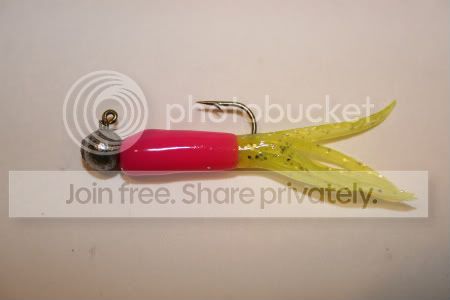
I wouldn’t necessarily use a sinking line; I’d just use a reasonably long leader.
You could also buy some of these; they’ll cast just fine on a fly rod:

http://www.gonefishinpa.com/servlet/the-1176/fishing-lure-marabou-jig/Detail
Zach
The Itinerant AnglerVery helpful, thanks Travis.
The Itinerant AnglerClay –
Does your plane have a trailer hitch?
Zach
The Itinerant AnglerPaul!
The Itinerant AnglerIt didn’t taste too bad, a lot like California Condor or Whooping Crane.
Ha!
The Itinerant AnglerNice job Travis.
The Itinerant AnglerBernie –
Each show represents around four hours of work total.
The Itinerant AnglerDuncan –
I think Ed was doing his best to explain that subject in understandable, lay terms, but that link is very helpful.
The Itinerant AnglerThey’re stable enough for athletic people with balance to do a number of very inadvisable things. They’re not so stable that I would want my grandfather with balance problems trying to stand on the deck while I move about the boat.
The Classic Highsider (15’4″ model) is a poor choice for a poling platform; everyone I know uses a cooler. This is because the transom is too narrow. However there are several larger models of Gheenoe which are plenty stable enough for a platform. The full blown LT25 model is stable enough for a center console and an elevated front and rear platform.
My main beef with my Gheenoe is that the sides are low enough that it is not really a safe open water boat, including lakes, unless no other craft are around. If you’re wanting to be out on Lake Lanier look more towards the Carolina Skiff.
For marsh fishing, the Gheenoe is almost ideal. It is also an ideal project boat. I have a truly slick boat with less than $2500 in the whole thing.
Mike Anderson knows more about boats than anyone I know.
The Itinerant AnglerThe consensus for striper fishing my area seems to be the Wilderness Systems Tarpon 12 or 14.
-
AuthorPosts