






Mike Cline

Forum Replies Created
-
AuthorPosts
-
Jul 7, 2014 at 12:18 pm in reply to: Ross Reels brings back Gunnison, will re-introduce San Miguel #87815
 Mike ClineMember
Have not been impressed since Ross got sold several years ago, perhaps they can regain my interest, we’ll see.
Its my understanding from a close friend in the industry that Ross went to Orvis with the SA deal and then Abel bought them from Orvis. I have several Evolution LTs and am very pleased with them.
Strategy without Tactics is a Slow Route to Victory, Tactics without Strategy is the Noise Before Defeat - Sun Tzu
Mike ClineMemberI’m so excited right now.
Mike, it sounds like you are getting pumped for the experience, that’s good. But I would be remiss in not warning you that fishing the park streams, especially the Firehole can have its disappointments for the uninitiated. I’ve fished the Firehole and Madison off and on for 42 years. There are three things you really need to think about/understand when fishing in the park to avoid disappointment, and none of them involve angling skills. The fish in the Firehole, Madison and Gibbon are actually very easy to catch with moderate skill and there’s lot of them. Here’s what you may encounter.
Weather: These rivers are at an altitude of 6500’-7000’. For the first few hours in the morning, especially after clear nights, it is cold, sometimes below freezing. Ice in guides, cold fingers, etc. are par for the course when you fish early and especially if it is windy, deal with it. However, once the sun rises and things begin to warm, it can reach 60 degrees pretty rapidly. Don’t over dress as you may be comfy early, but you’ll be roasting later. Additionally, at altitude, in windy conditions and away from the road, getting seriously wet is dangerous. Don’t wear any cotton when fishing. Underwear, socks, thermals (I use cold gear 1.0), pants and shirt should be synthetic and quick drying. Everyone gets dunked sometime, and in the Firehole, Gibbon and Madison it can happen quickly because of the irregular streambed. I’ve been on my ass a number of times. Wearing quick dry material, lightly layered ensures your safety if you do get wet. A note about the wind. You can almost guarantee that the wind will blow 50% of the time you are on the river. The winds in the open meadows can seem like gale force at times. Doesn’t effect the fishing one bit, but it sure does making casting difficult and tedious. The Firehole and Gibbon are ideal streams for 3 and 4 weight rods. I fish them a lot with 3 and 4 weight glass rods. However, if it is windy, leave the light rods home and stick with a fast 5/6 weight. It is more rod than you really need, but in wind, it will make the experience so much easier. If it is really windy, stay out of the trees. Dead, but still standing lodgepole pines are dangerous in wind. One poor fellow has already been killed by a falling tree this season.
Wildlife: Wildlife in Yellowstone is on the move in the morning hours. If you fish early, especially away from the road, you will most likely encounter wildlife. In Yellowstone, once you leave the roads, you’ve violated the sign on the bus that says: “Don’t get out of the bus inside the Safari Park”. Yellowstone is a very wild place and two animals require diligence when you are away from the roads—Bison and Grizzly Bears. Bison are not aggressive and essentially ambivalent to humans unless you get too close. In the spring and early summer the big bulls leave the herds and forage one and two at a time. They are everywhere in the park. Until they bed down during midday, they are moving. When you are on the river focusing on the fishing, they will appear from nowhere out of the trees, etc. Always be alert for them as if they want to cross the river where you are, they will. You just need to stay out of their way and try and not get boxed in somewhere you can’t leave from easily. Grizzly Bears are another story. They are truly dangerous. I’ve encountered two this year on the Firehole very close to the river. They too can just appear from nowhere as you fish. But they move fast and like Bison, they go where they want to go. They will shy away from humans, so if you see one, make your presence known and above all carry, have immediately available and know how to use bear spray. Take the safest route to slowly create distance between you and the bear. If your wife is with you, she should have bear spray as well.
Congested streams: This is probably the biggest disappointment for new anglers to these rivers. The good spots can get crowded, limiting your angling opportunity. Starting early is the best solution, but invariably you can arrive at your favorite spot and someone is already there. Find another spot. The worst campers as I call them are guides with their dudes who will take over several 100 yards of river by putting the anglers along the river and working in between them. I’ve seen guides and their dudes hold on to a stretch of river for more than three hours. The other situation that can cause angst is this. You are diligently swinging buggers, etc. along cut banks on the opposite side of the river. You are catching fish and have another 100 yards to go with very productive banks in front of you. One, two or three dudes come pounding down the opposite river bank. They stop and ask how the fishing is before continuing downstream along the river. Unfortunately you are too polite to tell them they just screwed up your fishing by scaring all the fish holding along the bank. It can be very frustrating at times. We have to tolerate crowds and clueless anglers in Yellowstone, but starting early, especially on a weekend like the 4th, will mitigate some of that.
Again, good luck, get prepared and keep the excitement up.
Strategy without Tactics is a Slow Route to Victory, Tactics without Strategy is the Noise Before Defeat - Sun Tzu
Mike ClineMemberDo you expect the fishing in this area (Madison/Firehole) to be slow this year during the first week of July? If so, do you have any recommendations for other areas that are nearby?
Thanks,
MikeMike,
The Firehole and Madison will fish fine during the first week in July, especially in the morning. It really depends on water temperatures which can tend to rise to unacceptable levels in late July and August. I’ll point out some go-to water on the Firehole and Madison a bit later. As you are staying at Madison Campground, you have an advantage of proximity. The real thing that most visitors to Yellowstone don’t understand is the road system. There are no four lane roads, there are no “passing zones”. Midday, it can take four hours to get from West to Old Faithful because of traffic. The road(s) to the Lamar Valley and Slough Creek from Madison can be very congested at times. The Norris/Mammoth road is under construction and won’t even open until 7AM. After that its big time congestion. Lesson one, start out early—before or at dawn. You will see more wildlife and get to your destination without a lot of anxiety.Although I would encourage anyone to go see the Lamar Valley during their visits to Yellowstone, Slough Creek in the first week in July this year is an iffy bet: http://www.parksflyshop.com/news.html and quite a distance. A much better fishing experience would be had on the Gardner River for the Salmon fly hatch. If I had 4 days in Yellowstone the first week in July, here’s where I’d fish. All of these locations are within a 20 minute drive of Madison Junction:
Firehole River: (in order of preference: Biscuit Basin, Goose Lake Meadows, Muleshoe Bend, Fountain Flats (just above and below the first Iron Bridge (Ojo Calienti Spring).)
Madison River: Seven mile bridge downstream to Riverside drive (cross the river to grass hopper bank at Riverside Drive or at the islands just upstream)
Gibbon River: Entire river below falls, 2 miles of river just above Gibbon Falls
What would I use?
On the Firehole, Madison, and Gibbon below the falls, a woolly bugger with traditional soft hackle (think partridge and anything) trailer is a can’t miss approach. Fished on a 4 or 5 wgt floating line, swung through rising fish or along cut banks, this is a killer approach. You can use bigger #6 or #4 buggers on the Madison, while #10, #8 are suitable for the Firehole. The only real dry fly you might need in July is an Elk Hair Caddis or Sparkle Dun. An Elk Hair Caddis or Stimulator would be an excellent choice for the Browns immediately above Gibbon Falls.
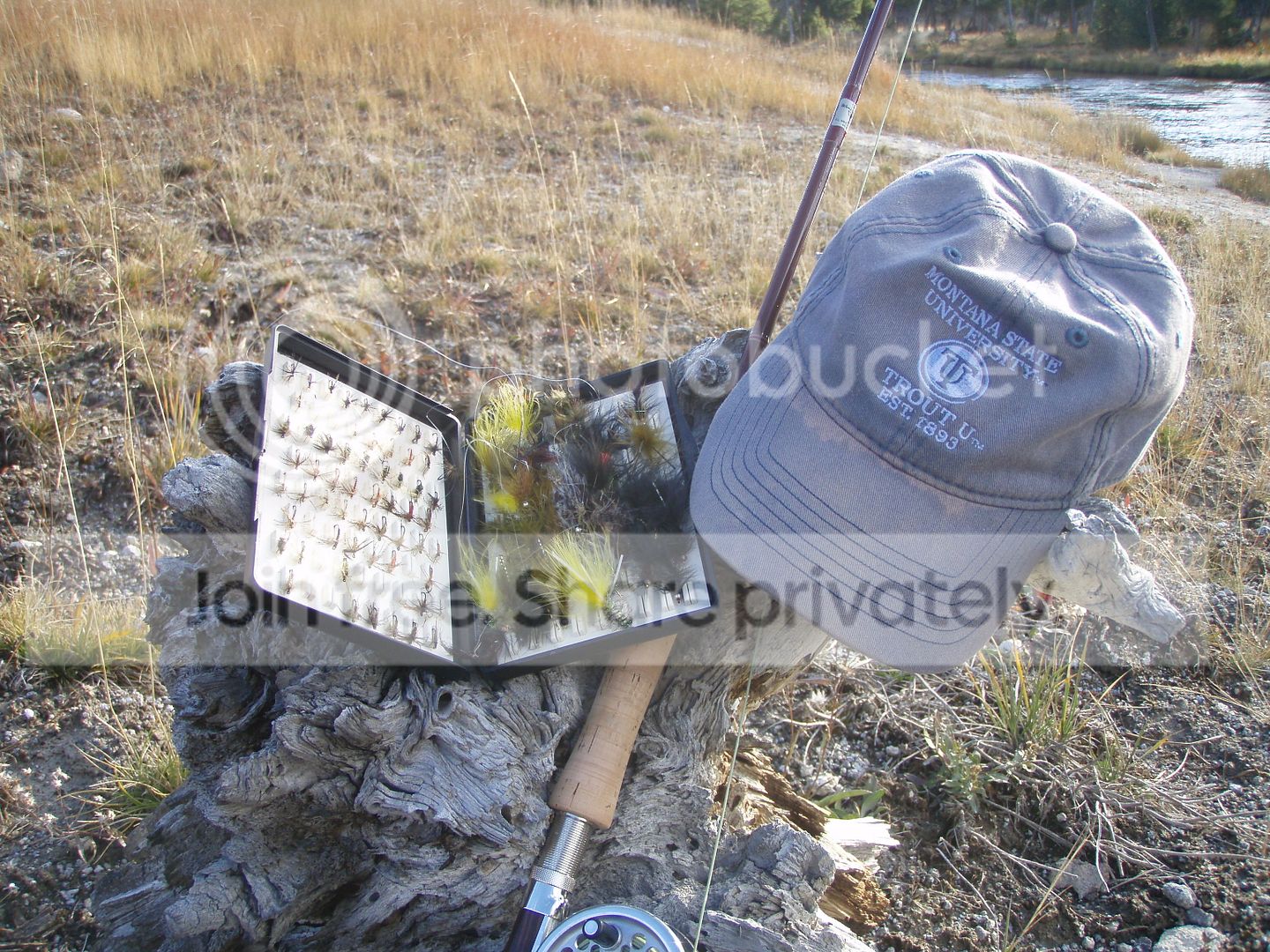
If you bring up a map of Biscuit Basin, you will see the river braids just below the Biscuit Basin parking area. The largest fish in the Firehole system above the falls are found in the braids and meadows below this parking area. To fish this area park at the turnout just north of the entrance to the Biscuit Basin parking area. Walk down to the very narrow, but deep channel on the south side of the meadow. Fish this channel down to its confluence with the other channel (wider but much less flow). If you want to fish dries in challenging water, cross the Firehole at the confluence and fish up the wide channel for a couple of 100 yards. Otherwise fish downstream until the river leaves the meadows. This area is just loaded with fish, especially along the undercut banks.

If I had just a few hours to fish the Firehole in the early morning or late evening, this is the stretch I’d fish. Biscuit Basin just downstream from the Biscuit Basin parking area.
Good Luck and I’ll be looking for a report.
Strategy without Tactics is a Slow Route to Victory, Tactics without Strategy is the Noise Before Defeat - Sun Tzu
Mike ClineMemberBTW, the blue bag in this shot – do you know who makes it ?<br>
Looks perfect for my new kayak ..Cheers.
That was Blake’s bag, so am not sure of the exact model, but it looks like a SealLine Black Canyon Pack, probably 35L. I’ll ask him for the specific model.
Strategy without Tactics is a Slow Route to Victory, Tactics without Strategy is the Noise Before Defeat - Sun Tzu
Mike ClineMemberIt’s interesting to me how much brown trout vary. To some extent it’s predictable; I feel like I can tell an Eastern European brown from an American brown based on how they look, and I’ve guessed correctly in photos before. But here in America I think the genetic lines are so mixed up … Zach
To paraphrase Robert Behnke, Brown trout in America are the result of hatchery breeding of all three major strains of European Browns–sea-run, lake forms and stream resident forms. In Europe, each of these forms have their own appearance, although all are the same species Salmo trutta, all genetically the same regardless of outward morphology. Very few true subspecies of Salmo trutta have been identified (mostly isolated populations at the extreme eastern and southern extents of its native range). What is most interesting is that a lot of study being done on introduced populations around the world has revealed that as one scientist put it–a sea trout is a brown trout is a sea-trout. Brown trout adapt to their habitat and go where the food is. Stream resident fish will migrate to sea and sea-trout will migrate to fresh water and stay there if the food supply is adequate. As for coloration, I don’t think there’s any real key to what colors signify where the fish originated from.
There are several books that are very interesting reads on Brown Trout.
* Heacox, Cecil E. (1974). The Complete Brown Trout. New York: Winchester Press. ISBN 0-87691-129-7.
* Graeme Harris, Nigel Milner, ed. (2007). Sea Trout: Biology, Conservation and Management. Wiley. ISBN 9781405129916.
* J.L. Bagliniere, G. Maisse, J. Watson (1999). Biology and Ecology of the Brown Sea Trout. Springer Praxis Books. ISBN 1852331178.
* Elliot, J.M. (1994). Quantitative Ecology and the Brown Trout. Oxford, UK: Oxford University Press. ISBN 0198540906.
* Newton, Chris (2013). The Trout’s Tale – The Fish That Conquered an Empire. Ellesmere, Shropshire: Medlar Press. ISBN 978-1-907110-44-3.Elliot, Bagliniere and Harris are fairly technical, scientific works while Heacox and Newton are more conversational and focused at the layman level. Newton’s book tells the fascinating stories around all the introductions of Brown trout around the world.
Strategy without Tactics is a Slow Route to Victory, Tactics without Strategy is the Noise Before Defeat - Sun Tzu
Mike ClineMemberBTW, that’s a beautiful brown trout – what awesome markings !<br>
Is that the norm on the Yellowstone ?Do Browns look different from this? They are probably a bit paler in the Spring, but from September through early November they are bright, big and plentiful from Corwin Springs to Big Timber. Caught this guy below Livingston in late September last year on an afternoon driftboat trip I was hosting for some business clients.

Strategy without Tactics is a Slow Route to Victory, Tactics without Strategy is the Noise Before Defeat - Sun Tzu
Mike ClineMemberMy suggestion would be to get one of the good references on Bamboo Rod construction and restoration. My favorite is: The Fine Bamboo Fly Rod-A Master’s Secrets of Restoration and Repair, Stuart Kirkfield, 1986. Here’s a link to some available copies: http://www.abebooks.com/servlet/SearchResults?sts=t&tn=The+Fine+Bamboo+Fly+Rod
Of course if you want the bible, get hold of a copy of A Master’s Guide To Building A Bamboo Fly Rod by Garrison, Everett, with Hoagy B. Carmichael (1977). http://www.abebooks.com/servlet/SearchResults?sortby=1&tn=A+Master%27s+Guide+to+Building+A+Bamboo+Fly+Rod&x=66&y=12 Its been reprinted a few times.
There may be more recent works on Bamboo rod restoration, but these are the two I have in my library.
Strategy without Tactics is a Slow Route to Victory, Tactics without Strategy is the Noise Before Defeat - Sun Tzu
Mike ClineMemberZach,
That’s what happens when you contribute to the commons. You never know when or where your photos are going to show up. Imagine my surprise when I picked of a copy of Nate Schweber’s Fly Fishing Yellowstone National Park (2012) and turned to page 260 to see a photo of my gloved hand holding a Brown Trout and a bugger at Muleshoe Bend. Schweber didn’t credit Wikimedia (didn’t have to) but at least the pretty girl gave you credit. A couple of your photos are now in the https://en.wikipedia.org/wiki/Rainbow_trout article. It’s undergoing Featured Article review at the moment and should be rated the highest class of WP article sometime in the next couple of weeks. Thanks again.
Strategy without Tactics is a Slow Route to Victory, Tactics without Strategy is the Noise Before Defeat - Sun Tzu
Mike ClineMemberMike feel free to browse through some of mine as well. If you find some you want I’ll have to send them to you.
Mike, many thanks. I’ve gone through the albums and identified 4 images that I can use. Please drop me an email at mikemac1@sprynet.com and I’ll get you the specifics. Thanks
Strategy without Tactics is a Slow Route to Victory, Tactics without Strategy is the Noise Before Defeat - Sun Tzu
Mike ClineMemberZach, they are uploaded and I’ve sent you an email.
Thanks again.
Strategy without Tactics is a Slow Route to Victory, Tactics without Strategy is the Noise Before Defeat - Sun Tzu
Mike ClineMemberZach, Thanks. A quick review of the trout pics looks like we can use 3-4 of them. I will download from the blog, upload to commons.wikimedia.org with a Attribution-ShareAlike CC BY-SA license attributed to you. Once that’s done, you will get an email from me with some language that you must send directly to Wikimedia via email stating that you agreed with the licensing. It’s painless. Thanks again.
Strategy without Tactics is a Slow Route to Victory, Tactics without Strategy is the Noise Before Defeat - Sun Tzu
Mike ClineMemberDavid, I am 66 in a few weeks and started having the same problem you describe years ago. The best investment I ever made was a pair of Orvis sunglasses with RX progressive lens several years ago. Of course, there’s other brands than Orvis, but getting prescription progressive lenses makes for a much better on-the-water experience. Without them, I could barely handle any fly smaller than a #8 let alone see it floating on the water. With the glasses, 6X tippet and #16 flies are still small, but manageable. Whatever your near or far vision requirements are, a high quality pair of progressive lenses will definitely improve your ability to handle small flies on the water plus give you a overall better vision experience near and far. Also, since I tie my own flies, I quickly recognized what materials and colors were the most visible on the water and tailored my tying to them. Gook luck.
Strategy without Tactics is a Slow Route to Victory, Tactics without Strategy is the Noise Before Defeat - Sun Tzu
Mike ClineMemberZach,
I will make three suggestions that might make for interesting podcasts if you could arrange them.1. Catherine E. Comar (Executive Director) or Yoshi Akiyama (Deputy Director) of the American Museum of Fly Fishing: http://www.amff.com/index.php to discuss the various collections, events and such associated with the museum.
2. Kim Allen Scott (Special Collections Librarian, Burlingame Special Collections Library, Montana State University-Bozeman) http://www.lib.montana.edu/trout/ about the Trout and Salmonid Collection of literature and the Bud Lilly Trout and Salmonid Initiative (http://www.lib.montana.edu/trout/budlilly.php)
3. Dave Kumlien (Trout Unlimited’s Project Lead on Invasive Species Awareness) Dave is a long time Bozeman guide, outfitters and fly shop owner. He can tell some amazing stories. (http://www.linkedin.com/pub/dave-kumlien/7/396/61a)Strategy without Tactics is a Slow Route to Victory, Tactics without Strategy is the Noise Before Defeat - Sun Tzu
Mike ClineMemberToo many rods and reels to pick just one. Tough question. I might say my favorite piece of gear is my kayak, but its not with me on every trip. What is? This box of flies.
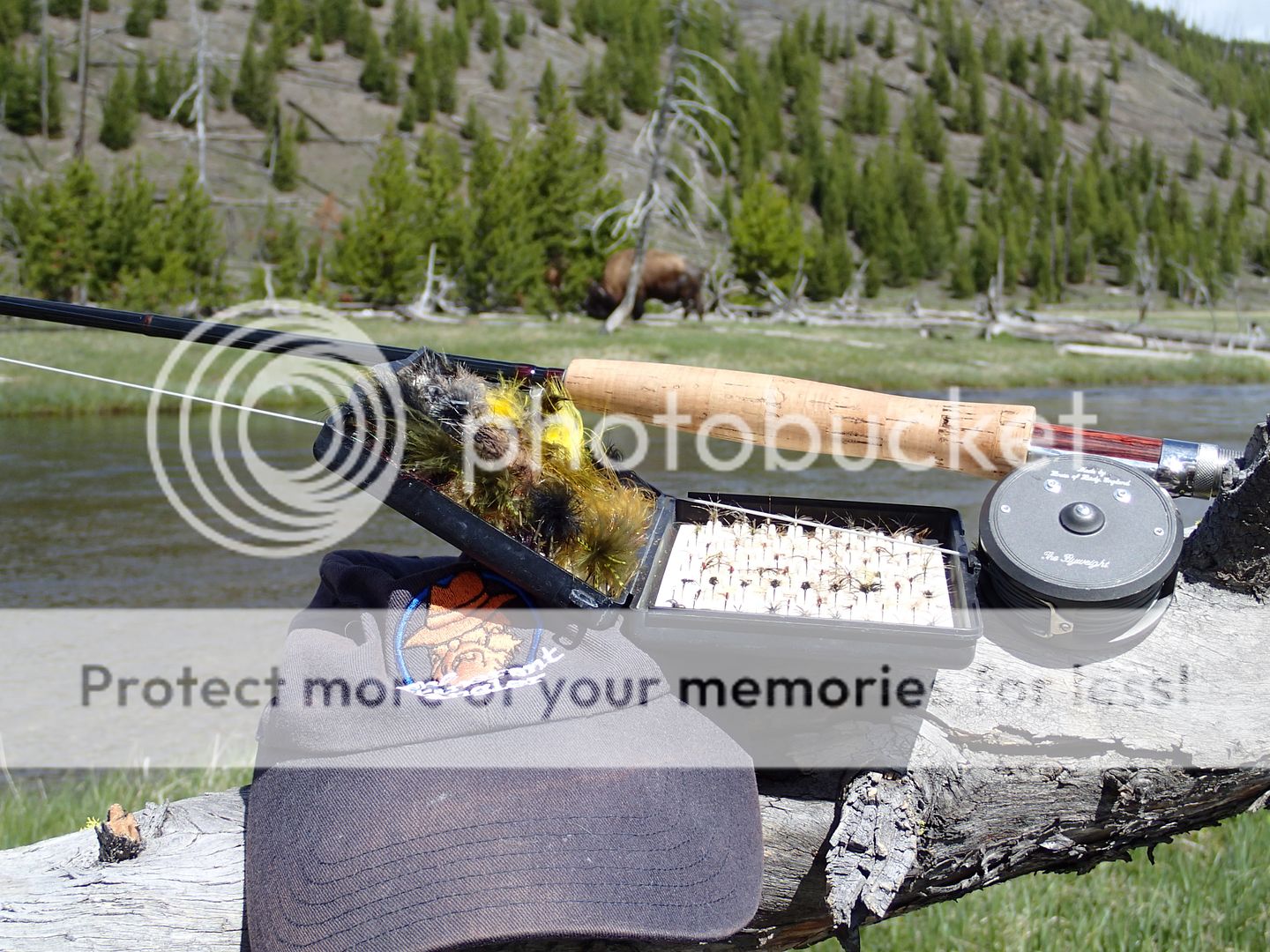
Buggers and soft hackles. I never leave home without this box. These are go to flies in just about any condition–spring, summer or fall. It really doesn’t matter what rod I am using, what line or what the fish are doing. You can always chuck buggers and soft hackles anywhere and catch fish.Strategy without Tactics is a Slow Route to Victory, Tactics without Strategy is the Noise Before Defeat - Sun Tzu
Mike ClineMemberis there a pretty decent population of pheasants in that area most years?
I suspect the pheasant population in the Gallatin Valley is pretty strong, especially along the East Gallatin which runs ~ 42 miles through the valley. It almost all private agricultural land. We see pheasants in good numbers all the time in fields across from our house in Bozeman. As for hunting opportunities, I suspect you have to know some one or pay $$$. Here’s an article that describes upland bird opportunities in Montana nicely: http://www.cowboyhvn.com/pay/Pheasant.asp
Strategy without Tactics is a Slow Route to Victory, Tactics without Strategy is the Noise Before Defeat - Sun Tzu
Mike ClineMemberBird season,the fishing……what job? Mike Livingstone

Put about 4 hours on the East Gallatin on Saturday morning a midst the parade of duck hunters floating the river and lining the banks. Saturday was the waterfowl opener and as usual the teal and mallards on the East got hammered. I did my part by driving birds upstream as I fished. Generally, the duck hunters don’t pose much threat as they have a good view of the river. Whereas in two weeks when the pheasant season opens, I will almost certainly get peppered with falling shot as the ranchers harvest pheasant along the river.
Strategy without Tactics is a Slow Route to Victory, Tactics without Strategy is the Noise Before Defeat - Sun Tzu
Mike ClineMemberWe drove up near the East Gallatin a few weeks ago when we were out, but did not have a chance to fish it. As we passed it at the interstate, it looked very low. Mike Livingstone
Mike, if you observed the river from I-90 then that was the Gallatin (or West Gallatin as some call it). The East comes nowhere near the interstate. Generally the East doesn’t have the low water problems that the Gallatin experiences because the East is fed by dozens of spring creeks in the valley. If you ever want to give it a try, I can point you in the right direction.
Strategy without Tactics is a Slow Route to Victory, Tactics without Strategy is the Noise Before Defeat - Sun Tzu
Mike ClineMemberGreat article, but it misses one important point. Be careful to time your marriage properly with the right person. If the wife doesn’t become an avid angler then anniversaries and birthdays can become obstacles if they coincide with prime fishing seasons. Spring and Fall are prime times in the northern hemisphere and when available days to fish are scarce, you don’t want an anniversary or birthday in the way. There’s a bit of a window out here in the northwest in June-July during runoff, but since timing and duration of runoff is variable, anniversaries or birthdays during this period can be risky. I always advise young fly fishermen to marry someone born in the dead of winter during the dead of winter. Even if the wife becomes an avid angler, it’s much easier to forego a December midge hatch than it is that Mother’s Day Caddis hatch or Streamers in the Fall. I know this from experience. After 42 years of marriage, that May 2nd anniversary and Sept 7th birthday still sometimes gets in the way of an opportunity for a good fishing trip.
Strategy without Tactics is a Slow Route to Victory, Tactics without Strategy is the Noise Before Defeat - Sun Tzu
Mike ClineMemberVery nice
Strategy without Tactics is a Slow Route to Victory, Tactics without Strategy is the Noise Before Defeat - Sun Tzu
Mike ClineMemberFor me, it had to be this sunrise:

Strategy without Tactics is a Slow Route to Victory, Tactics without Strategy is the Noise Before Defeat - Sun Tzu
-
AuthorPosts