






T. Wiles

Forum Replies Created
-
AuthorPosts
-
 T. WilesMember
According to my brother…walleyes are thick in the rivers, and finally beginning to feed at dusk into the night until the bright moonrise slows the bite.
Here’s his catch from wading the other night. All measured around 20″.
 T. WilesMember
It gives no advantages to running in shallow water. I’d damage that housing in no time in the 4-6″ water I’m running. The only advantage I see is that if you had a prop motor and you did not want the hassle of getting a traditional jet foot conversion kit, where you would have to raise the motor for the intake.
T. WilesMemberVery impressive, Tim. Perfect, isolated gin clear water….gorgeous fish with a high protein diet. Bucket list trip for me one day, hopefully.
Here’s what your missing in the US tailwaters….
 T. WilesMember
My brother has been after walleyes in the feeder rivers of our mtn lakes. He says they’re about a week away from moving shallow with a few locals catching them at night in the slow backwater/ river mouths…they haven’t quite pushed up the shoals yet.
About 3-4 weeks ago, there were some great walleyes being caught from the bank of the mid lake with the bite starting right at dusk. Despite the freezing temps, the prespawn fish we’re cruising the banks and aggressively feeding. About 4 of my patients confirmed this.
T. WilesMemberThanks everyone. I was very lucky to get a chance at that fish, and luckier to land her after a weak hook set from being startled so bad. Joe, I’ve never musky fished North of Kentucky, but I look forward to trying WI or Canada one summer when our temps are too warm. I may be lucky enough to get another shot at them tomorrow in the rain before the rivers swell.
T. WilesMemberI’m right at the corner of TN,NC,VA,&KY. I fish musky waters in all 4 states. Hoping to try WV this summer.
T. WilesMemberWhen are you inviting us to the Itinerant Angler fish fry?
Nice slabs! Almost walleye time up here…just another week or so.T. WilesMemberI DO think a 60/40 jet would be better. It is only about 30 lbs heavier than the 40/30, and the extra boost to get you on plane would be a bonus. My only challenge with this is the boat is CoastGuard approved for only a 40hp or below…not every professional installer may be comfortable with the assumed risk. Also, I did not have the luxury of trying out the heavier motor—I wish I did though…I would have probably opted for more power.
Hey Phil, I was thinking the same thing on the 2 vs 4 stroke engines. The only trouble is that most of the lighter 2 stroke engines are older model, and they have to be converted to a jet by a post-market kit. I didn’t want to hassle with the hunt for the perfect, reliable used tiller, longshaft motor, then find a marine mechanic to add the jet foot, and get the height set right.
I strongly considered the Evinrude Etec motors, but they were all in the same weight category as the 4 stroke Yammis. Plus, I hate having to add the oil and deal with the mess. Changing the oil is the only hassle with the 4 strokes–and it’s quite simple, plus they are just so Darn quiet— I really prefer to idle by other fly fishers with super quiet hum of the 4 stroke. I have heard a couple of older 2 strokes that are just plain loud and annoying, not all of them, but some have a “hollow howl” that I would rather avoid.Here are some links I used to compare the motors:
Evinrude Etec 40 hp 2 Stroke–(this would require a postmarket jet foot add-on)—weight: 232 lbs
http://www.outboard-engine.com/enginespecs.php?recordID=58Yamaha F40/30 Jet 4 Stroke: ready to install–227 lbs
http://www.yamahaoutboards.com/outboards/Jet-Drive/specificationsYamaha F60/40 Jet 4 Stroke (have to custom order as a tiller handle–a bit heavy to steer)–weight 259 lbs
http://www.yamahaoutboards.com/outboards/Jet-Drive/specificationsHope this helps out guys.
T. WilesMemberI hope Tracy knows what she’s in for!
Way to prepare and put a great trip together…and what a fantastic memory to begin your next chapter. I’m guessing 2014 will begin some big planning. Congratulations and God Bless.
T. WilesMemberThanks everyone. Can’t wait to chase these fish in the warmer seasons on a paddleboard.
T. WilesMemberThat rainbow release shot looks like a Taimen swimming off. Great fish!
T. WilesMemberWow. Where in TN is that if you don’t mind my asking?
TN NC Border…a couple miles downstream after the AT crosses the Nolichucky after the Gorge.
T. WilesMemberThefly fishers up my way wait for windless cloudy gray days on the reservoirs. From what I’ve hear…on the flat surface, you can spot giant fish casually gulping the dying winter threadfins, with some nice brown trout in the mix. 1-2″ crippled shad patterns have produced 20 to 40lb stripers and browns over 10 lbs..I’ve seen some nice photos to prove it.
A buddy and I tried to find these winter stripers 2 weeks ago, and this was an unexpected 5 lb bycatch.
 T. WilesMember
Hey Zach…I wish the answer was yes…but if so, I think it will be several years before that design is doable by Hog Island. The best alternative would be to consider a UHMW high density plastic jetfoot that is milled similar to aluminum. I have heard different rumors of these plastic jetfoot designs being available for smaller outboards. So far, the only ones I have seen for sale are the larger ones on the Rockproof super jets.
Despite the jet being angled 1-2 inches in the water below than the hull; the boat still drafts pretty good. On plane, I estimate 4 inches draft. I can skate up some zig zag rapids climbing up plunges on rock ledges. The main challenge is going back down, you have to keep momentum to stay shallow–if you ease off the throttle/ you bump. Usually if I see an unavoidable downstream rock encounter, I turn off the throttle and push the tiller handle down to raise the motor out of water, and let the hull take the bump. It’s real nice having the motor lift to push it out of harms way. I also raise and suspend the jetfoot out of the water when rowing back down some bony shoals.
T. WilesMemberYou beat me to it, Zach…work keeps interupting my post.
The Hog Island skiff is a very unique craft.
Pros:
You can take it anywhere (as long as there is a ramp) and it takes the paranoia of banging the hull on rocks. Unlike aluminum and fiberglass that make a God-awful screeching sound when you crunch a rock..this plastic makes a pleasant soft skid and it’s very quiet when you drop something or step heavy.
The plastic is supple, and has some give/flex when you drive it up on rocks or a concrete ramp. It stays relatively cool in the bright heat of midday sun. You still may get a little hot, but I can fish barefoot on the floor on a sunny 90 degree day without major scorching of my feet (unlike an aluminum boat).
The boat weighs about 500 lbs, but surprisingly it slides over rocks quite well enough that 2 people can drag it up a skinny shoal over dry exposed boulders..
Very stable–unlike some canoe-shaped craft, this boat barely rocks when you shift weight or stand on the gunnels.
The poling platform is high quality and can be removed by one person in about 15 minutes.
SPACIOUS–there’s TONS of room. You can run it empty and have tons of open space, or you can accesorize it with Yeti’s or my choice–a large Contico truck box from Lowes. The bench seat and the Transom space also have ample room for gear.CHALLENGES:
I’m not sure about now, but when I ordered my boat, The skiff was in it’s early development, and this required long waits of uncertainty for the welders to fabricate the parts. John takes on alot of tasks, and for several months the demands for the boats outnumbered his ability to make them.You have to build or coorinate a trailer order to acquire the boat.
It becomes the burden of the owner to coordinate motor installation and transom weld changes/bilge pump/electronics, trolling motor platform.
It rows OK, a little slow to turn, but after a bit of heavy digging it can be swung to avoid major boulders.
I havent done a plastic repair..but it takes a little finnesse to make it melt correctly. HI’s website shows a soldering iron technique.
The boat is customizable with options of pushpole holder/rod holders etc…but this takes some creative engineering and drilling of Fastenal taps to srew in anchors into the hull plastic.The boat is weight sensitive and the jetfoot sits a bit lower in the water than desired. The passengers must ride on the bow in order to counterbalance the jet and keep it from bogging down and losing power. A more desirable design is a “rockered” hull like a Supreme that keeps the jet foot flush with the water with a slot tunnel cut into the hull to protect the rectangular jetfoot intake.
I have nailed a shallow rock shelf and already broken a chunk of the jetfoot plate off.
It you choose a prop, you have to choose a long-shaft motor for proper length.Im still very impressed with this boat, and it has all but replaced my SeaArk.


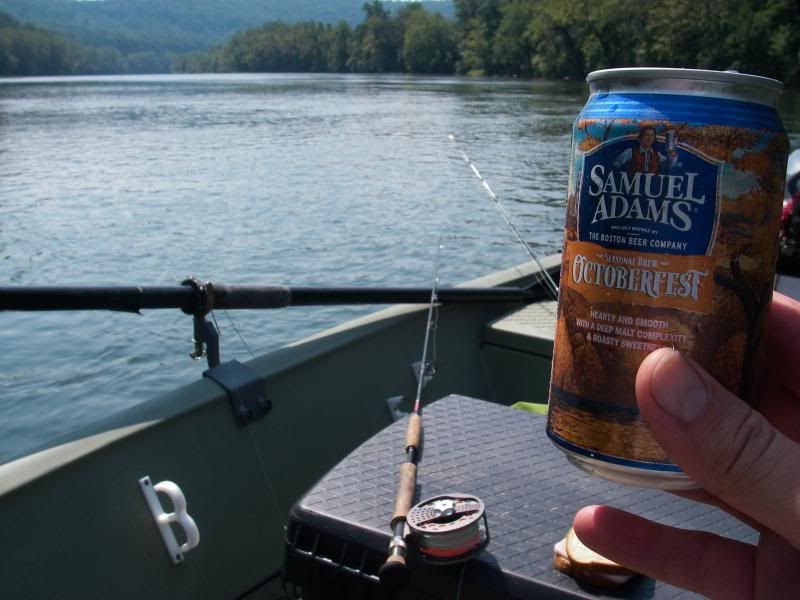
Here are some videos of the jet running:
Last thing…here are some pretty decent shoals that I ran around Christmas:
T. WilesMemberNow for my favorite…Plastic Boats.
My Coleman Crawdad and Hog Island Skiff are two of the most versatile boats I’ve ever used.
I’ve had the Crawdad in about every river scenario imaginable. No boatramp needed, just drag it down a bank, carry the battery/35lb trolling motor/2.5hp kicker ina sled and drag it in next. I’m working on a way to stack it on the Hog so I can take both to remote waters when a ramp isn’t available. It does take on water in larger rapids, but most time, I just drag it on the rocks to dodge the large waves.


 T. WilesMember
From my Experience on shallow water boats, here’s what I found:
16 ft SeaArk. This boat was my passion for a couple seasons. Advantages: super shallow draft. You can customize a Tin boat in numerous ways adding rodholders, casting platform, removable bracing bar, tunnel, pods….etc.
I had Flat LED lights incorporated into the bow, a 24V double battery for a 80lb thrust MinnKota Riptide, onboard 3 bank charger, and a casting deck with “key-like” removable lean bar fabricated by a private welder.
I loved this boat, and I still do, but I found the 2 stroke 25hp Yamaha was a bit underpowered, and the extra bow weight caused the front to plow during heavy waves. The high power trolling motor would stay charged for almost 2 entire days of hard fishing.
Bottom line, the boat was quite heavy, and it made me VERY nervous when motoring around rocky shoals, or floating around shallow current obstructions like mid river rockpiles. If you hit something, you plowed it, and the chances of denting and piercing the aluminum became a major safety factor in making it back to the ramp.
IMO, an aluminum boat is good, but you either keep it simple, light, and hollow, or you get the super pricey rock-proof hulls and strong HP if you’re gonna run in shallow rivers.

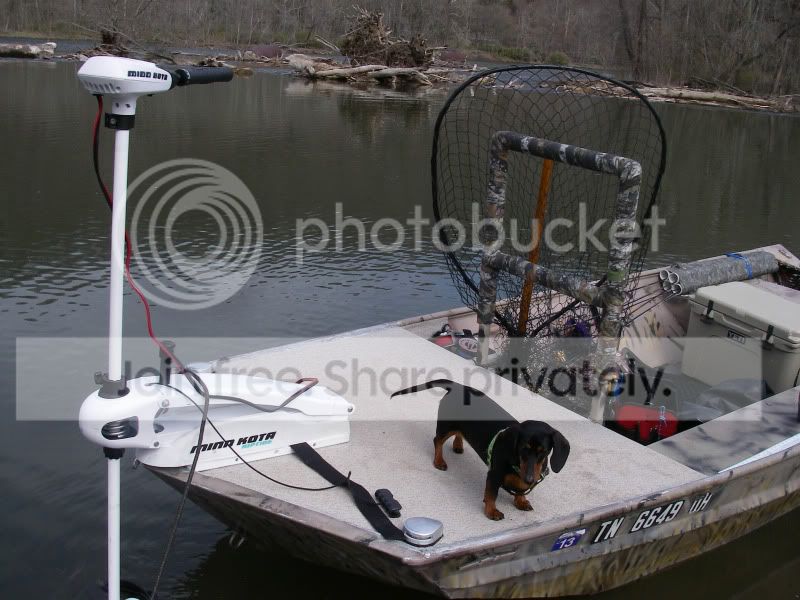

For camping out and reaching skinny water fish…This combo worked out real well:
 T. WilesMember
Most waters I Fish are quite clear, and usually there is a response time where I see the fish charge before a strike. I’d say 60 to 80 % of my fly annihilations occur within a rod’s length of boatside. Not always does this mean I spun the fish around chasing on several turns to get the bite, but Often, I tuck the rod in close and begin a fast sweeping arc through the water that leads the curious follow to a kill. I’ve had a couple pursuits last over 2 minutes, before the chasing fish finally bit. I’ve fumbled a lot of figure 8’s before my technique improved. Still, most fish will veer off if they don’t bite after the first turn.
In murky water, The strikes are more random and surprise moments without as much stalk, anywhere in the cast.
T. WilesMemberHey Zach, I’ve never used a Spey rod extensively, but my initial impression is that it would not be an ideal tool for muskies. The flies are bulky, waterlogged squirrels when you sling the first half cast to fling the water out. I brace the fighting butt into the muscular part of my forearm and use very rigid casts(mostly backhanded) to keep the high velocity casts low and parallel to the water. Most of the time, you’re landing right into bankside overhangs.I prefer a 400 to 500 gr sinktip to keep the flies deep throughout the retrieve, and I’m not sure how those rods would load the heavier tapers.
Most importantly, is the figure 8. I like a very fast action on a rod to slice fast turns when a fish comes in hot. If the rod has any flex in the middle, it will wobble as your digging it 6ft underwater trying to fire up a strike. I’ve seen several catchable fish not eat because the fig 8 turns were too lazy and slow…then the fish loses interest. I feel a limber Spey rod may handicap the boatside game which is where most of my fish are caught.
All that said…if you had a lighter hollow/reverse tied fly with a large profile but collapsible for long casts…I could see a niche for speyrods in open water scnarios. Aggressive fish on summer weed lines hang in the main channels, and a long cast would be an advantage.
Hope my 2 cents helps.T. WilesMemberI realize its not realistic in December…but I believe a more relevant test would be to see which one keeps ice in 80+ degree temps in bright sunlight. You would likely get similar results; but if one stood out as a winner with those parameters, I believe the test would reveal the superior product.
-
AuthorPosts


