






Rod Actions
Blog › Forums › Fly Fishing › Rod Actions
- This topic has 37 replies, 14 voices, and was last updated Apr 13, 2008 at 2:12 am by
bob bolton.
-
AuthorPosts
-
Jan 23, 2008 at 12:23 pm #2992
keith b
MemberI am wondering how to tell the difference in actions and how I should approach the different actions.
Jan 23, 2008 at 1:56 pm #24761Rich Kovars
MemberWelcome to the board!
Rod action is simply something to describe how much a rod will bend during the cast. A fast action rod is pretty stiff and usually only bends near the tip during a cast. A medium action rod is more ‘soft’ and will bend through the middle of the rod during a cast. A medium action rod is a ‘classic’ rod in most circles. A slow rod will flex all the way to the handle (great for roll casting).
There is a ton of stuff on the web about rod action.
This one is pretty good:
http://www.flyfishinggear.info/buyers_guide/fly_rods_action.shtm
And you are correct, your casting stroke will change with rod action.
Jan 23, 2008 at 4:02 pm #24762MemberThank you that helps a lot.
If there are more explinations out there I would appreciate it.Jan 23, 2008 at 6:20 pm #24763Neal Osborn
MemberNu2Trout,
The science behind rod design and flex/bend is important to understand but I recommend keeping it simple at first. Think about a lazy day with no wind and casting a small parachute adams in a calm pool, hey you might want a simple slow stroke and lazy presentation (slow-medium action rod). Then think about bonefishing in the ocean flats with a brisk breeze and a heavier fly, you want to rip it out there quickly/accurately (fast action rod). These are just visual descriptions and don’t actually describe flex per se. I actually use a 4wt Z-axis fast action rod for my dry fly fishing because my casting style is better suited with fast action rods. Thus you get all kinds of opinions from others but they are really just talking about their own casting style matched with a rod action. Remember, cast all rods before you buy, especially as a beginner, get to know what you want and why you like it. Faster does not necessarily mean better ($3,000 bamboo rods are usually medium action rods).
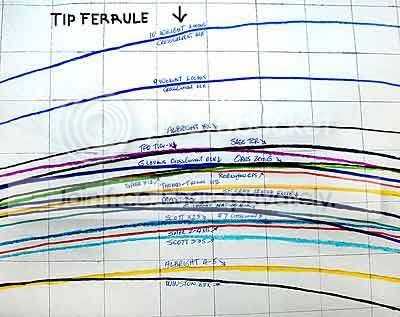
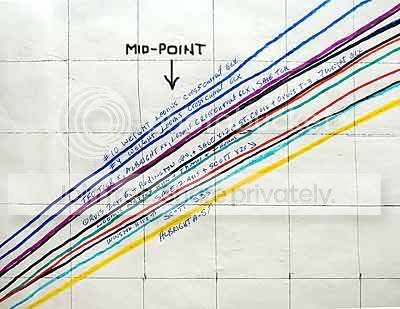
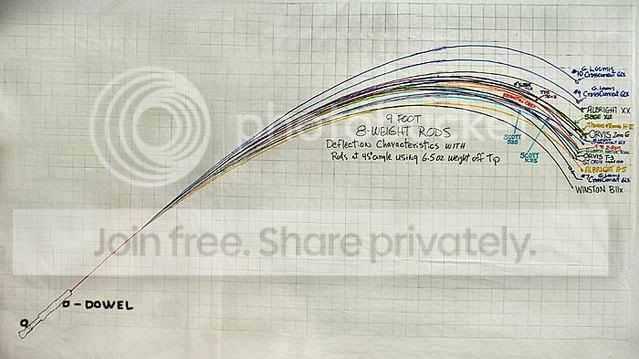
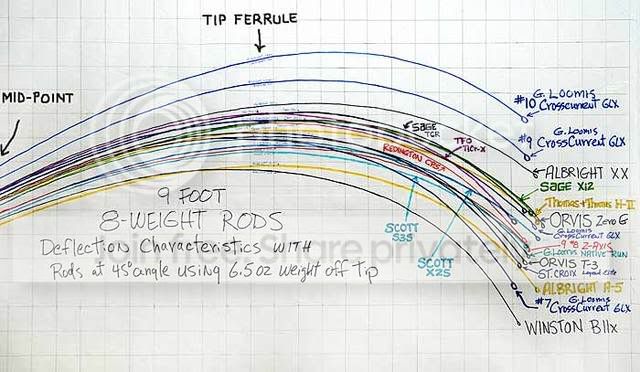
Here are a few graphics to help understand how “geeky” some people get about rod action. This is actually a good visual on what tip flex is all about and how it is measured. These are all fast action rods in this study but you can see how tip flex can vary dramatically within a certain class.
 Jan 23, 2008 at 7:36 pm #24764Member
Thanks for the visuals, did you draw that your self?
It helped me understand a little more.Jan 23, 2008 at 8:44 pm #24765Membersorry, link for the review where I got these graphics (certainly not my own work) http://www.itinerantangler.com/cgi-bin/yabb2/YaBB.pl?action=dereferer;url=http://yellowstoneangler.com/FlyRodComparisonon8weightrodsAlbrightG.LoomisG-loomisOrvisScottTempleforkTFOThomasandThomasSt.CroixOrivsZeroGravityOrvisT3RedingtonCPSAlbrightXXSageXi2SageZaxisLoomiscrosscurrentLoomisNativeRun.asp
Jan 24, 2008 at 3:24 pm #24766Zach Matthews
The Itinerant AnglerThe only thing I would add to this discussion is the distinction between flexibility and speed, which tends to get conflated into “action” as a catchall term.
“Speed” of a rod refers to the recovery rate of graphite, or in other words the time it takes the bent graphite shaft to snap back to being straight.
Jan 24, 2008 at 4:14 pm #24767spencer ballard
MemberZach, I understand what you are saying but have a question.
Jan 24, 2008 at 4:33 pm #24768The Itinerant AnglerA very flexible rod can certainly be fast actioned.
Jan 24, 2008 at 6:33 pm #24769Mike Anderson
MemberZach fast and slow as long as I’ve been around rods has always been about how much of the rod bends and has nothing to do with speed of recovery. In fact speed as in Recovery speed is a term I’ve only recently started hearing.
Jan 24, 2008 at 6:50 pm #24770The Itinerant AnglerMike –
I’ve had these discussions with a number of rod designers, including at Orvis, Scott, and TFO.
Jan 24, 2008 at 7:26 pm #24771MemberHey Zack,
Here is where I am getting confused:
A Zero Gravity with a ‘mid-flex’ profile is going to be a faster rod than a Clearwater with the same ‘mid-flex’ number, but it will bend to exactly the same amount on the charts like Neal posted above.
If a rod is able to recover faster, it must mean that the force opposing the bend is stronger.
Jan 24, 2008 at 7:32 pm #24772MemberI want to run a study, find rods that bend the same throughout but are made of different materials, release them from the bend and use a timer to see how quick they recover…. Hmmm.
Jan 24, 2008 at 7:36 pm #24773MemberBear in mind that allot of my knowledge of blanks is also from a conventional standpoint. If you’re talking conventional blanks, recovery speed has no value. For those rods fast and slow blanks have always been determined by how far from the tip the blank bends. It doesn’t surprise me that fly rod companies are twisting the term and using it as a selling tool. Gota do something to sell a $700 stick of graphite.
Jan 24, 2008 at 7:51 pm #24774Carter Simcoe
MemberThis is easy, the more expensive (trout) sticks with the better looking and trendier advertisements are faster.
Jan 24, 2008 at 8:00 pm #24775The Itinerant AnglerHey Rich –
You are getting into levels of engineering that I can’t respond to.
Jan 24, 2008 at 8:27 pm #24776The Itinerant AnglerHere you go guys, right from the horse’s mouth (Jim Lepage, chief designer at Orvis):
Hello Zach,
I read through your post and I can see one area that might help explain recovery better by including relative mass.
A simple example of flex index vs. recovery would be to include mass when speaking about the difference. Fiberglass rods vs. graphite or graphite vs. bamboo. Loading a rod with a known weight to calculate the flex profile of the rod does indeed mean that it needs fall into the same area of the load board. That same rod if extremely light and reactive (high modulus fibers allow rods to be built with less mass to reach same flex profiles) than recovery of rod has less mass to move back to neutral, creating a faster recovery and therefore what some call a ‘fast rod’.
Here’s the straight definition:
I think it is fairer to say that a fast rod is one that is light, responsive, casts well in close and has a progressive taper that can handle long lines, yet has a fast recovery, and therefore a shorter stroke while casting.Hope that helps.
Best, Jim
Thanks Jim!
Zach
Jan 24, 2008 at 8:30 pm #24777MemberNu2Trout, welcome to fly fishing :o. This is what we do with most any question, the more you scratch the deeper the itch. And you thought your question could be easily answered.
Zach, great comments and the last explanation really helps.
Jan 24, 2008 at 8:34 pm #24778MemberI want to run a study, find rods that bend the same throughout but are made of different materials, release them from the bend and use a timer to see how quick they recover…. Hmmm. This is going to get really complicated. 😮
It can get really complicated. I’ve been reading a lot of papers by Noel Perkins on modeling the fly rod and line during a cast. The physics are pretty amazing. (Noel perkins developed the Sage casting analyzer). It becomes a simpler problem when you treat it as two separate systems, but there is still a lot of math to cut through.
Zach,
I am not sure that it can work that way (I’m pulling out some VERY rusty statics and dynamics here). i think acceleration is directly related to force (F=MA) and velocity (speed) is related to acceleration (V=At given the initial velocity is zero). The force bending the rod is in opposition to the force keeping it straight. In order for it to recover quicker it has to either straighten over a shorter distance or the force against the bend must be greater.
Can you tell I’m an engineer? 🙂 I can really chew on this stuff.
I guess this is really just a discussion of terms. For me the action of a rod never described the physical characteristics as much as the ‘feel’ of the rod when cast. A fast rod takes more force to get it to bend making it feel stiffer even though it is still flexible (flexibility being the ability to bend a certain distance).
I’m not too far from Orvis country. I’ll have to pop into the rod shop and ask some questions.
Jan 25, 2008 at 12:10 am #24779yuhina
MemberA simple example of flex index vs. recovery would be to include mass when speaking about the difference. Fiberglass rods vs. graphite or graphite vs. bamboo. Loading a rod with a known weight to calculate the flex profile of the rod does indeed mean that it needs fall into the same area of the load board. That same rod if extremely light and reactive (high modulus fibers allow rods to be built with less mass to reach same flex profiles) than recovery of rod has less mass to move back to neutral, creating a faster recovery and therefore what some call a ‘fast rod’.
[/b]Thanks Jim!
Thank you Jim, perfect explanation from Pro!…just want to express a little bit my thought about
-
AuthorPosts
- You must be logged in to reply to this topic.