






Rusty Spinner SBS
- This topic has 1 reply, 2 voices, and was last updated Nov 27, 2012 at 8:07 pm by
Juan Ramirez.
-
AuthorPosts
-
Nov 1, 2012 at 9:04 pm #6813
Scott P.
MemberI really like Charlie Craven’s Hi-viz Rusty Spinner but felt it needed to be beefed up a bit to use in some not-so-gentle water I fish in the summer, so I added more hackle fibers for the tail (skipped the split tail entirely) and an extra turn or two of wound hackle. The combination hackle/Congo Hair wing really stands out in lower light conditions, something I appreciate when trying to pick out these flies with the weird silvery sheen the water takes on at twilight. Also prefer goose biot over stripped quill for the body, mainly because I have a lot of them. I’ve used this in sizes 12-18 for everything from Hendrickson-PMD-Epeorus and it’s been pretty productive; being easy to tie makes it a winner, for me, on all counts.
hook – Dai Riki 320 #12-18
thread – Uni 8/0 rusty brown
tail – hackle fibers ginger
body – goose biot rust
thorax/head – beaver dubbing rust
wing – Congo Hair white
hackle – Golden BadgerMash barb and start thread at 75% point on shank

wrap thread back to shank right above hook barb

spin bobbin to tighten up thread and make a couple wraps to create thread bump (if you prefer a dubbing ball have at it), then wrap forward about one hook eye length

take a feather for tailing (this is a scapular – got a whole bag of them from Charlie Collins years ago and will never use them all up; if it’s not as good as prime spade hackle, it’s the next best thing)

pull a bunch of fibers off and even up the tips

lay the fibers on top of the hook to mark for length (for spinners, I like a longer tail and use the whole hook length; for duns, I usually use shank length only)

slide back to the tie in point

switch hands

a couple soft wraps

grab the fibers again and start wrapping back to the “bump”

when you get to the “bump” snap the bobbin downward at that wrap and, if the tying gods are smiling on you, the fibers should spread out and cock at an upward angle (helps the fly land and float properly)

trim the stub ends

take a moistened goose biot (turkey works well, too, but I think the goose provides better looking segmentation); the moisture makes them more flexible and less prone to cracking while winding; putting the notch side down makes the segmentation stand out – if you’d rather have it smooth, make it notch side up

tie in at the back and wind the thread back to the initial tie-in

grab biot with hackle pliers and wind forward; here’s the segmentation I was talking about – fish don’t seem to care either way, I just think it looks cool

tie the biot down and trim

take a bundle of Congo Hair (or whatever hydrophobic fibers you care to use) about the thickness of the hook gap; I like to melt the ends of the bunch to keep them together – makes it easy to tie up 5-6 flies at once

tie wing in at 75% mark (keep the length oversized; you’ll see why in 2 steps)

do the figure-8 thing to get the wing to stand out perpendicular

grab the ends of the wing and twist them – keeps the fibers (which tangle with just about everything) out of the way for the next few steps

prep a hackle feather – for this spinner I oversize the hackle by one (a #14 hackle for a #16 hook)

add a bit of dubbing (keep it thin)

untwist/separate wing, dub a bit behind, through and in front of the wing

wrap the hackle (4 turns behind for a #16)
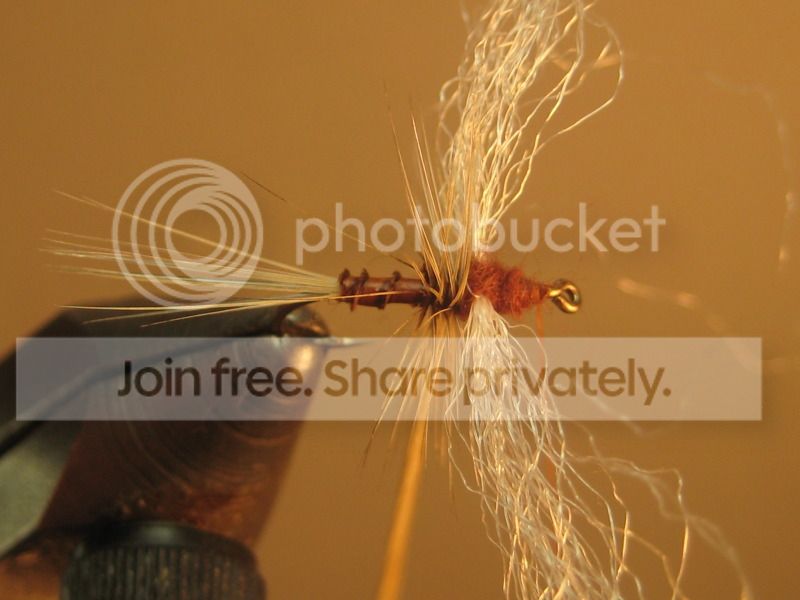
and 4 in front

tie down/trim hackle tip, add a bit more dubbing and half-hitch x 2

grab wing and pull back

trim wing even with hook bend and stand ends out again

trim hackle underneath fly flat (leave it on top, it helps with the visibility thing)

add a drop of Sally and you’re done; front view

profile

Lots of pics and lots of steps, but it’s really a simple fly to tie, it’s visible (especially in the low-light conditions when a lot of these suckers come back to the water), floats like a champ and catches it’s share.
Regards,
ScottNov 27, 2012 at 8:07 pm #59354Juan Ramirez
MemberGreat as usual Scott.
-
AuthorPosts
- You must be logged in to reply to this topic.