






Low light question
Blog › Forums › Photography › Low light question
- This topic has 21 replies, 7 voices, and was last updated Sep 3, 2008 at 7:25 pm by
 Ben Cochran.
-
AuthorPosts
-
Aug 25, 2008 at 1:34 pm #7695
mtnman2888
MemberHello all, as many of you know, light can be surprisingly low taking pictures deep in the woods underneath a tree canopy, especially early and late when the light is optimal. I find myself having to use a very slow shutter speed and maximum aperture to get the proper light, but the problem with that is the slow shutter speed. Just wondering what were some of y’alls tactics during a situation like this? I have thought about investing in a flash since i don’t have one but i’m not sure. Any advice would be greatly appreciated, thanks.
Aug 25, 2008 at 1:56 pm #64506Zach Matthews
The Itinerant AnglerThis is a constant quandary.
The only solution is higher ISO and better glass.
Aug 25, 2008 at 2:10 pm #64507anonymous
MemberHi
Photographically your playing on the outer edges .
Aug 25, 2008 at 4:51 pm #64508 John BennettMember
It also depends on what exactly your trying to photograph. Are you trying or need to stop motion? Static shots? Imply motion?
As Zach said, flash will help in some instances but not all. Also, the higher you raise your ISO the less range your flash will have.
Higher ISOs, wider aperatures, flash, support (from Tripods and monopods to beanbags and a host of other things), IS/VR are all potential things to utilise. Which to choose laregly depends on the indivual shot and that can change shot to shot and each has its trade offs
Higher ISO…could mean higher noise
Wider aperature….less DoF..Fast glass is nice but try shooting a Doe at f2.8 with a medium to long lens.
Tripod/monopod/other….expense, weight, cumbersome
IS/VR…expensive….only helps with avoiding shake
Flash…has its limits (range) to not to mention weight, cumbersome etcOn any given day I may use some or all of the above depending on where I am, what I feel like carrying and what my “expected” target/subjects are.
Aug 25, 2008 at 4:51 pm #64509MemberYeah i figured i needed to invest in a good lens with an aperture of 2.8 or even 1.4, i just don’t want to spend the money right now.
As far as a graduated neutral density filter goes, i’m impervious to what that will do as i’m fairly new to photography.
Aug 31, 2008 at 2:00 am #64510 David AndersonMember
The problem with flash in low light is it’s hotter on the forground and doesn’t do much for the dark areas in the background and you end up with a mixed exposure that kills any natural feel.
(man, that’s a condensed version of a long conversationwww.dsaphoto.com
A picture is thousand words that takes less than a second while a thousand words is a picture that takes a month.
Aug 31, 2008 at 11:13 am #64511Buzz Bryson
MemberBetter lenses actually gather more light for a given aperture setting by virtue of having larger front elements and less glass in between the film/chip and the subject.
Zach,
Are you saying that a better lens (say one with a max aperture of f/2.8) set at f/8 will give a “brighter” image than a less expensive lens of the same focal length (but with a max aperture of say f/5.6) when that lens is also set at f/8? That you can either use a faster shutter or get more light on the film/sensor at the same shutter?
And that better lenses have less glass (fewer elements) in them?
Sep 1, 2008 at 7:48 pm #64512 Ben CochranMember
Ah, the true essence of photography, it is all about interpreting, controlling and directing the light.
There are many different ways to handle low light but the first has been mentioned above, fast glass! Other than that, it all depends on your composition and the amount, as well as direction, of ambient light. Once that detail is better known, there are still many ways to light and shoot it. Also, you can move 10′ to the right or left and have to shoot it completely different. This is what makes photography an ongoing and continuos learning process.
I know this doesn’t help much but if it was all that easy, every single photograph viewed would look like cookie cutter photography. First priority for good consistent low light photography, fast glass!
Sep 2, 2008 at 12:31 am #64513The Itinerant AnglerBuzz –
Yes, I am saying that, but I better explain.
Sep 2, 2008 at 1:13 am #64514MemberZach – I have a feeling you may be confusing the Quality of
Sep 2, 2008 at 1:41 am #64515Ben CochranMemberI like this thread [ch9786] If I may join in; my understanding is that it is a combination of both Zach and Will explanations. A lesser quality/slower lens will not always transfer that same amount of light to the sensor due to the reasons that you both stated plus: The sensor does not capture, nor does the lens transfer lights as a singular whole. It transfers the frequency width of different colors of light, with red having the longest/strongest wavelength. The better prime lenses will transfer a better grouping of the three primary colors with the lesser quality lenses creating a larger bend and drop off in the signal independent strength’s transferred and arriving on sensor. A low quality lens may transfer far more red than blue to the sensor due to extra elements and/or occlusions on the elements, as well the material make up of the elements. A larger front element helps to transfer the strongest frequencies possible into the lens body but the build and make up of the interior of the lens can make a huge difference in the frequency bend between 2 lenses, both at f8.
Sep 2, 2008 at 2:35 am #64516The Itinerant AnglerI don’t think so, Will.
Sep 2, 2008 at 2:58 am #64517The Itinerant AnglerI’ve had some PMs and emails, so here’s another analogy.
Say a given shot is metered properly at f/8 and 1/125th.
Now add a polarizing filter with two stops of darkening to the front of the lens.
Sep 2, 2008 at 2:33 pm #64518David AndersonMemberI work in low light on set and at shows a fair bit and fast lenses are a must, but it’s important to note that just because a lens is faster it doesn’t make it better.
As an example the two canon 70-200 L’s are 2.8 & f4, the 2.8, while a great lens, is not as sharp as the f4 and costs a lot more.
You’re paying for the fact it will get a shot in places the f4 falls down.
The 50 1.2 cost 4 or 5 times what the 1.4 does for very little extra in the way of sharpness, though below about f2 it’s the king.Prime lenses focus better in low light, are sharper and have less issues with design over the zooms.
The trade off is they don’t zoom and if you have one body you will be changing lenses a lot.A good cheap way into low light photography is a fast standard lens like the 50 1.4 – most are very good in low light and have great feel when wide open.
(anyone with a crop frame will be getting an excellent portrait lens)Here’s a sample from a 50 1.4 (on film- in the stone ages)
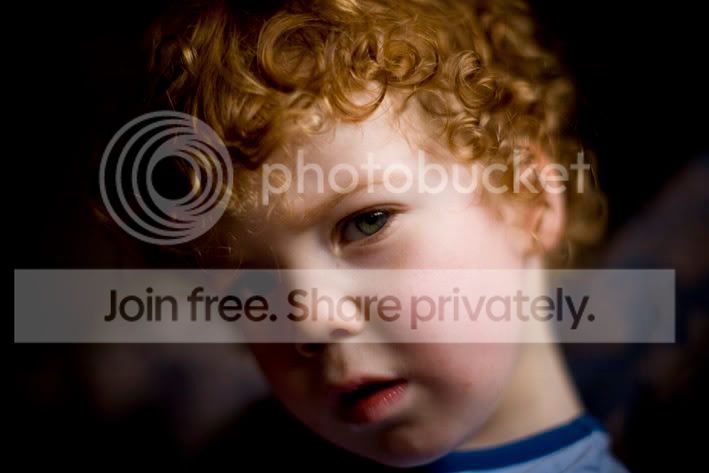
And here’s the new 1.2 in very low light in my living room.
www.dsaphoto.com
A picture is thousand words that takes less than a second while a thousand words is a picture that takes a month.
Sep 2, 2008 at 3:28 pm #64519MemberMy Mom was right – I should have paid more attention in that
Sep 2, 2008 at 10:36 pm #64520MemberFundamentally, let’s say that if the light falling on a subject is fixed and the ISO is fixed, then the only variables for exposure are the shutter speed and f/stop. Cut the shutter speed in half, say from 1/60 sec to 1/125 sec, we have to double the amount of light reaching the film if we get the same exposure. Say from f/11 to f/8. Doesn’t matter whether the lens has a focal length of 50mm or 500mm, or a maximum aperture of f/2 or f/8. For that scene, the correct exposure is 1/125 at f/8 (or 1/60 at f/11, etc).
That’s how the aperture/shutter speed system is designed. Right?
Sep 3, 2008 at 1:07 am #64521The Itinerant AnglerShew, Buzz.
Sep 3, 2008 at 1:21 am #64522John BennettMemberI actually meant to do a small field test this evening with my 77mm and 62mm and post them. Don’t have any emperical data but I do recall reading all kinds of threads that dealt with similiar lenses but with some being brighter.
Classic example is the 100-400 L and 400mm. Both 77mm, both 5.6 @ 400. I read alot of stuff about the prime being sightly brighter. Not sure if it make a whole lot of difference in your exposure value (mabe its less than 1/3rd brighter).
Also with macros they are always f2.8 at 150mm or less and 3.5 at 180mm and 72mm at 150mm+. Again, its always said that they are “brighter” although that may pertain to whats seen through the viewfinder.
Again I don’t have first hand expereince but also from reading and talking to guys who do own 300 f2.8s and 500 F4s (82mm) they often comment on gaining about 1/3 stop in ISO performance. More light>less nosie.
Hows that for heresay
🙂I’ll see if I can do a quick and dirty with a 58mm or 62mm vs a 77mm tomorrow. Must admit Im curious
Sep 3, 2008 at 10:40 am #64523David AndersonMemberI’m out as well.. 🙁
I will say this though, with studio lighting, using two bodies with different lenses, but at the same settings I do get slightly different exposures, but max a third of a stop.
Not sure if it’s the lens or one of the bodies.
www.dsaphoto.com
A picture is thousand words that takes less than a second while a thousand words is a picture that takes a month.
Sep 3, 2008 at 10:47 am #64524MemberWell it appears the first thing i need to do is invest in a better lense. Currently, i am using the kit lens that came with my canon xsi as my go-to lense while in the backcountry. This is a good lense, but i can definitely see how a f/2.8 would do wonders to allow more light in; it just gets so dark under that canopy. I would love to get a prime lense as i know it would be better but i’m already carrying too much equipment with me as it is i only need to carry one lense.
I will see if i can’t find a good deal on one. Once i’m able to get that i can start focusing in on techniques and practicing, like bumping up the iso (i never thought about that), but i think first i need to get a better low light lense than the kit lense.
-
AuthorPosts
- You must be logged in to reply to this topic.