






Latest warmwater creation
- This topic has 8 replies, 3 voices, and was last updated Jan 13, 2009 at 11:08 pm by
cole m..
-
AuthorPosts
-
Jan 9, 2009 at 5:11 am #6485
lee church
MemberI’m sure somebody has done this exact pattern before me but I had a thought the other day about tyin up a Sexy Crawfish pattern. I used to catch them off my dock and fish ‘em live when I was kid…killer for wallguys, northern, and bass.
Anyways, this last fall we fished ALOT of deerhair w/ neutral buoyancy on sinking lines. It really offered up a unique presentation depending on how long of a leash you put on that thing you could have the fly floating just over the rocks. Like the rest of my flies they’ll never win a beauty contest but they often fool fish.
CrawDaddy
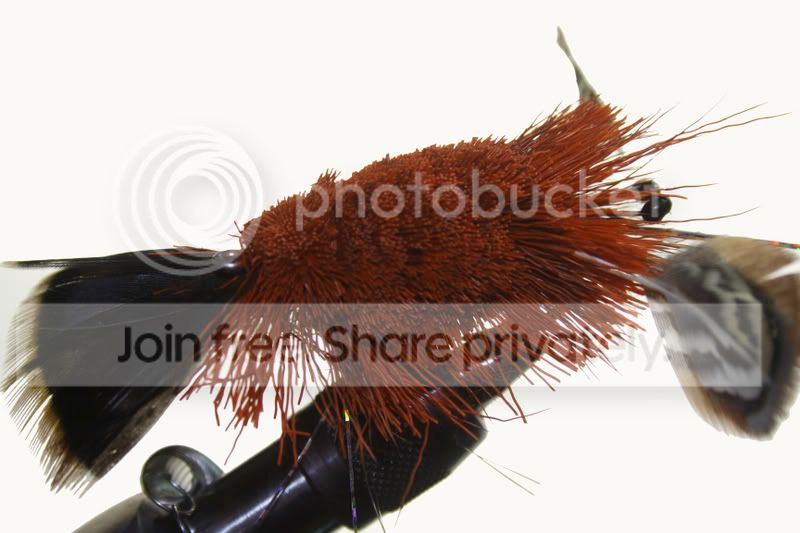
-So its stacked/spun orangish deer hair.
-melted muskie mono for eyes.
-bunch of holographic flash both from the tail and out the front (sorry bad pic.)
-Couple stacked pheasant feathers for claws
-That big turkey feather as a tail. So when you strip it the tail flips down.So what do you think? It obviously a prototype but I wouldn’t mind feedback.
Thanks,
LCJan 9, 2009 at 2:46 pm #56823Neal Osborn
MemberThat is a cool pattern Lee! Looks like it would be a great warm water pattern. I never realized you had mad skillz at the tying bench – keep it up. Did you add some weighted eyes to the fly? I have found that spun dear hair crayfish patterns tend to float unless they have a bit of weight to get them down.
Jan 9, 2009 at 3:47 pm #56824MemberWell to tell the truth its never been fished but I was planning to use the sinking line and that fly float just above the rock…good in theory but we’ll see how she goes.
Jan 10, 2009 at 12:30 am #56825MemberLee – I wanted to add a few comments to your pattern. While I think it is a great design I am concerned it will not create the desired profile when practically fished. This is coming from lots of my own early frustration with deer hair patterns and lessons learned on when and why it should be used. These are just my thoughts based on experience and are in no way a critique of your fly.
For a popper plug head it is a fabulous material and if tied correctly and trimmed properly there is nothing better than a deer hair pattern like bass poppers or divers. They create that pop pop pop sound and trail a bubble pattern when retrieved. However, notice that there is always some billowy fluffy material off the back like hackle or marabou or fibers. Thus they have two parts – the plug and the life-like back portion, both of which combine to create an imitative profile. Your pattern appears to be mostly hair and the claws are stiff so I fear that the fly won’t pulsate and come alive when retrieved. Furthermore, if you pull it subsurface with a sinking line it will probably look like a static block to the fish, rather than a meal.
I almost gave up on deer hair patterns until I met Tim Borski and started tying his patterns. His saltwater patterns opened my eyes for incorporating hair within the general flow of a fly. Look at any of his patterns and you will notice that he blends the hair with other materials to create a foundation while not focusing on the hair itself. I have tied many of his flies and found they work great on warm water. I have also discarded many of hair patterns in evolution because although they look great on the vise they flat out didn’t catch fish. I provide a few examples below of patterns that have been most effective for me. Do a search for Borski flies – I actually bought his DVDs a while back which were invaluable to learn some of the basics I try to convey below.
Sorry about the red wood glow, I shot these pictures in a hurry without thinking about the background distraction.
1. A few of my Borski style bass bugs. Notice how each one incorporates deer hair in the pattern. The difference here is that the tail end has the fibers sticking out and the body has the fibers wrapped but “trimmed” tight to the body as a “foundation” with hackle palmered “through” the hair body. When fully saturated with water the fly has the ability to “come alive” and breath – the hair in the foundation but the hackles move and wiggle and give the fly “life”.

2. This fly shows the general schema with hair sticking out in the tail end and tightly wrapped in the body. Notice all the wonderful arctic fox hair on the tail with saddle hackle; in the water these fibers move and wiggle and breath. The body has deer hair tightly wrapped and trimmed close; the key is the use of big webby schlappen palmered into the hair and up the body. The deer hair does not “overpower” the fly and thus the profile seems natural. This is a killer fly, it sinks slowly and retrieves well.

3. Another similar pattern with synthetic fibers in the body and deer hair for the tail. Tied on a 60 degree hook this fly rides upright in the water. Great fly. Again, I am not an expert, these are just patterns I have found to be most effective through trial and error. It’s the theory of balance that’s important.

4. A crawfish pattern using deer hair similar to above but with the hackle claws in the tail instead of saddle hackle. This is how I would modify the fly you presented above.

5. Another


6. These are bonefish sliders. I have modified them for warm water applications and they are very effective for bluegills and crappie (BTW these are tied on size 8 saltwater hooks so they are actually quite small). These are examples of how to use “a tiny bit” of deer hair to make a soft head but keeping the back profile alive.

 Jan 10, 2009 at 1:45 am #56826Member
I see what your sayin Neal.
Jan 10, 2009 at 3:27 am #56827MemberLee – it appears we are fishing similar setups!
Jan 10, 2009 at 3:40 am #56828MemberOk I was miss quoted…It was Hatches that I was refering to.
Jan 10, 2009 at 3:43 am #56829Member“Hey! It’s all ball bearings nowadays.”
Jan 13, 2009 at 11:08 pm #56830cole m.
MemberWow, great flies guys!
-
AuthorPosts
- You must be logged in to reply to this topic.