






Ideal situation for Carping
Blog › Forums › Fly Fishing › Ideal situation for Carping
- This topic has 10 replies, 7 voices, and was last updated Sep 3, 2008 at 9:55 am by
Morsie.
-
AuthorPosts
-
Aug 31, 2008 at 7:26 am #3424
peter d arcy clynes
MemberHi,
My name is Peter and I live in Canberra, the capital city of Australia. One of the rivers that flows not to far from me, is the Murrumbidgie and is full of big carp, often when you stumble down to the murky water’s edge you are greated firstly by the puff of silt made by a fleeing carp, then shortly by the back of its 15 pound cousin protruding through six inches of water. With all these fish around and the angling preasure being at almost zero, this river makes a great spot to fly fish for these carp, and I realy just want to know how. Australian fy fishing is about 20 years behind what you guys have, so I really know nothing. Any info would be super.
ThanksAug 31, 2008 at 9:59 am #28819Morsie
MemberPeter, a few Aussies get here and I wouldn’t say Australian fly fishing is 20 years behind the US at all, carp have been a very popular target amongst a lot of fly fishermen for a very long time. We made an episode on the Wildfish series on carp and there will be another episode coming up on the Fishing DVD as well.
Carp bite best when the water warms up, they can be very docile in winter. They spawn on November December and can get quite aggressive at that time. My favourite fly is a woolly worm, they love em and the hackle slows their sink rate, get it in their face and watch for the lips to move. They’ll eject a fly quicker than you can blink.
Standard trout equipment is fine – we’ve even used 3 weights although a 15 lb carp on a 3 weight rod is a handful. Use heavier tippets – 8lbs is fine, tie your flies on strong hooks, leaders don’t need to be long – 10 feet overall is fine. A 5-6 weight rod is good.
They are very sensitive to atmospheric noise and heavy footfalls. There’s no sense in blind casting for them, they’re best as a sight fishing target.
Morsie
Sep 1, 2008 at 2:34 am #28820MemberNice, thanks morsie.
Would I hurt my chances if I used a strike indicator, or fished a dropper off a chernobyl ant or some big foamy thing like that? Other than that would I just look for a white flash or would I just know when the things latched on?Sep 1, 2008 at 3:07 am #28821craig phillips
MemberPeter – those carp are probably eating everything the other fish in your river are eating, and more, since they eat algae and other vegetation in addition to insects.
Sep 1, 2008 at 4:10 am #28822Michael Exl
MemberPeter,
First off welcome to the board.
Morsie and Craig have made great points, remember them. Especially about carp being sensitive to footfalls. From what it sounds like most of the time that you are spooking the carp they are at the edge of the water. I like targeting these guys the most, generally half the time they are cruising the shallows looking for food. My biggest concern for your situation is that you stated the water is murky. Carp are generally, not always however, targeted my sight fishing. So more in your best interest to sneak up on these guys that are along the bank. Craig hit it right on the nose about presenting the fly. Some suggestions for flies are large nymphs and crayfish patterns, about size 6-8 hooks are what I generally use. Also have several of the same pattern tied in various weights. You are going to have to play around with this. I have an area where the carp love to hear the fly hit the water, and others where they take off at the smallest plunk. I had some the other spook when a leaf hit the water. Stick with natural colors for flies. Since you said you the water is murky, maybe some patterns with a little, and I mean little bit of flash in them. As far as good carp to target, those that you see tailing are feeding and are the easist to catch. Those that are cruising at a good pace are not worth you time. Again those in the shallows are good ones to target as well. Also check around structure such as log jams and downfalls. Carp will hold here and about half the time I can draw a strike from one. The biggest thing to remember is to be patient. If you pay your dues, you will be rewarded.
-Mike
Sep 1, 2008 at 7:13 am #28823MemberPeter, Lots of great advise there, I haven’t used a strike indicator on them either. I really like the woolly worm because it sinks so slowly to their eye level so there’s no need to suspend it. Sometimes they’ll eat it on the drop and sometimes you have to tease them with it. usually once they’ve seen it they’ll eat it. natural colours are definitely best but sometimes they eat ridiculously bright flies.
Watch for the yellow lips to move, often that’s all you’ll see of the take, just those big lips shooting out.
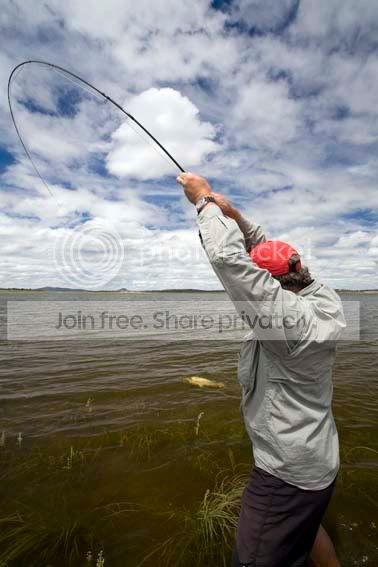
John Haenke, producer of the Fishing DVD and Wildfish series tangling with a good carp at lake Keepit, miles of flats with tailing fish right through summer. The rod is a prototype Sage Bluegill, it was GREAT on the carp.
Morsie
Sep 2, 2008 at 3:51 am #28824Billy Harris
MemberPeter – those carp are probably eating everything the other fish in your river are eating, and more, since they eat algae and other vegetation in addition to insects. So, throw what you throw at other fish, focusing on nymph and other subsurface flies.
Over here, crayfish (little ones, not lobsters) are a favorite food of carp and other fish and I throw a lot of those at carp. I use circle hooks to try to cut down on them spitting it out. Very few anglers I know use strike indicators or a dropper for carp. Maintain good contact with your fly by keeping the slack out of your line, and try to keep a good idea of where your fly is, so you can react when you see them tail on your fly or suck it in. Another good reason for circle hooks, you can gently pull the fly and try to get it to roll into the corner of their mouth.
I’m firmly in the camp of presentation over pattern. A decent looking fly, presented well to a hungry fish, will be eaten more times than not. There are days when the best fly won’t work, and days when a poor presentation will result in a 10 foot run to a poorly placed fly.
Don’t be discouraged if you go after carp. Many good fly anglers have been frustrated by them. Keep after them, change flies often, and make a good cast with a soft landing.
Depending on the visbility of the water, your first cast should be 3 feet away, then try two feet, then one, then hit him on the head. ONce you figure out their comfort zone, make all your casts as close as possible without spooking them.
As was stated, they can sense footfalls and shifting rocks, so walk or wade quietly.
And check out the fly fishing board at http://www.carpanglersgroup.com to listen in on some good electronic discussions by some fine carp fly anglers.
Good luck.
Craig
What are circle hooks?
Sep 2, 2008 at 3:31 pm #28825Mark Landerman
Member Sep 3, 2008 at 1:52 am #28826
andrew connell
MemberPeter, as morsie said we’re doing it
Sep 3, 2008 at 3:26 am #28827MemberBilly – Lando showed circle hooks, but the ones I use are Mustad C51S (freshwater) and C71S-SS (saltwater) circle hooks.
Sep 3, 2008 at 9:55 am #28828MemberCircle hooks hooks were developed by the Japanese for longline fishing for tuna. They wanted to only hook the fish in the corner of the mouth. If they gut hooked them they died on the line and sharks were often attracted making a mess of the other tuna. They also wanted the tuna to remain alive so that by the time they came back to pick them up (often several hours later) they had settled down and dispersed any lactic acid build up in their flesh. The tuna could completely swallow a bait set on a circle hook and as they swam off it would come right back out of their stomach but lodge in the corner of their mouth. The tuna would struggle then settle down and only struggle again as it was being picked up hence only a very brief time to build up any more lactic acid.
Because almost all fly caught fish are hooked in the mouth area on “j” hooks I have never seen the point in circles for fly fishing. When I’ve tried them I have missed fish because of them because of old striking habits. I think carp have such big soft rubbery mouths missing a hookup is pretty difficult, they do however (and I have observed this several times) eject a fly very quickly if you don’t strike. I don’t like circle hooks for any fly fishing.
Also if you build up any tying material in the gap the hookup rate diminishes even further. I like the strike. Only my view.
I once had a bonefish turn a normal “j” hook into a circle hook in its throat crushers.
In Australia carp are consider a noxious species and in some states its illegal to return them to the water, you have to kill them.
Morsie
-
AuthorPosts
- You must be logged in to reply to this topic.