






Help me learn to love this fly.
Blog › Forums › Fly Fishing › Help me learn to love this fly.
- This topic has 10 replies, 9 voices, and was last updated Sep 6, 2008 at 3:36 am by
Aaron Otto.
-
AuthorPosts
-
Sep 4, 2008 at 12:40 am #3436
Abe Mathews
Member
I have a confession. I’ve been fly fishing for 3 years, and I hate the wooly bugger. I have tied (literally) dozens. I’ve given most of them away. Every once in a while in desperation, I tie a bugger on, pitch it for 5 minutes, and then give up.
I don’t get it. I’ve heard it called the one desert island fly. I’ve heard that an olive bugger is cheating. I’ve heard that it resembles everything and nothing at the same time. But I can’t catch a trout on it.
I fish the Clinch, and the common wisdom there is a zebra midge under an indicator. I’ve caught a few fish there, and feel I do OK. About 2 years ago, met a guy new to the area who I sent to the Clinch with a dozen midges I tied for him. He came back and thanked me – told me he’d had a fantastic day and landed about 2 dozen trout, several over 14 inches. I’ve only caught one over 14 inches. Then he told me he never used one of my midges, but instead stripped an olive bugger. So I tried it the next time I was up there, and couldn’t buy a strike.
So what is it about this fly? How should I be fishing it? I’m typically rigged up with a furled leader and a WF line. Can you catch trout on a bugger with a rig like this? Or should I just bag the bugger and stick to what works for me?
Sep 4, 2008 at 12:55 am #28894anonymous
MemberAbe,
1) Make the tail longer–one and a half times the shank length. Try some with rubber legs, beadheads, coneheads, heavily weighted or not, dubbed body, black, purple, brown, sparkle body, variegated chenille, size 6, size 4, size 12, oversized hackle, etc., etc. Change it up and try a lot of different combos. Longer tail and oversized hackle would be my first suggestion.
then
2) Fish it on a sink tip line. ;D
3) Swing it, jig it, or deaddrift it. Any combination thereof.
What’s not to love?
 Sep 4, 2008 at 1:44 am #28895
Zach Matthews
The Itinerant AnglerAbe –
The Clinch has its fair share of stocker trout, and theoretically they should hit woolies, but TWRA usually stocks in there at 4″. By the time those fish hit 12″, they have seen an enormous number of olive woolly buggers, mostly fished poorly.
Woollies are fished best like most streamers; on the swing, over a drop-off or through a channel. If you are simply casting them in shallow shoaling water like at Miller Island, you’re not going to do as well. I would go down below the Weir Dam to the very end of the island and wade out on the rock ledges, and cast across and down.
But the truth is, the woolly is not the most productive fly on the Clinch and never will be. You are 100% right to be using little zebra midges in there. If you must fish a streamer, I would throw a Zuddler Minnow. Most of Scott Rogers’ crew’s biggest fish came on that fly, which they called “whitey,” being thrown most likely on sinking or sink-tip lines at rising water, out of boats.
If you really want to use a woolly to catch a fish, my advice would be to go down to the Anderson County jail and cast them across and down in the area upstream where the river cuts through those little rock ledges. Be the only one there, and stay far enough back that the fish can’t see you on top of them.
Zach
Sep 4, 2008 at 1:59 am #28896Aaron Otto
MemberPM me your address, I want to send you some Simi Seal. You’ll never fish a bugger again.
A
Sep 4, 2008 at 2:18 am #28897 T. WilesMember
I had to convince my brother one murky water day for the same reason, he just didn’t like buggers.
Sep 4, 2008 at 3:44 am #28898Neal Osborn
MemberQuote “I tie a bugger on, pitch it for 5 minutes, and then give up.”
Get a sexier fly! If you can’t be with the one you love . . . love the one you’re with.
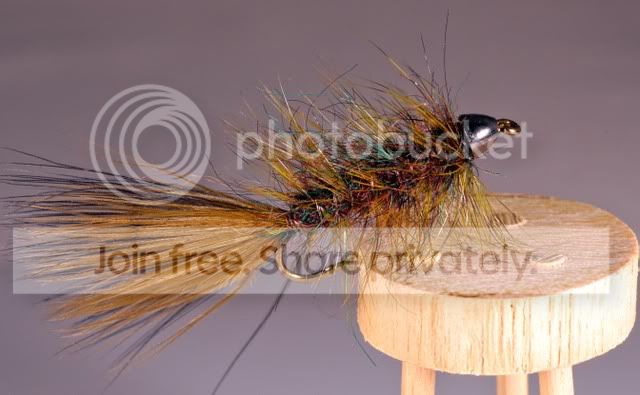
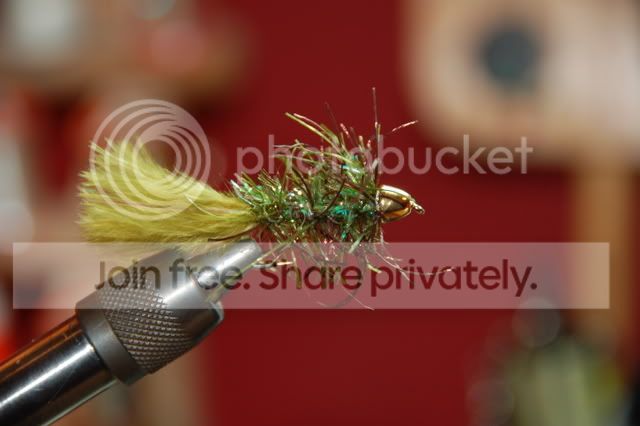
Honestly, the bugger is a very versatile fly but you need to have confidence in the pattern and how it fishes. Once I learned how to “adapt” the pattern to fish in different situations my catch rate and confidence increased dramatically. Also, tie some small WBs like size 12-14 and fish with the wet fly swing down/across and you might be surprised how effective it can be. If all else fails, just tie some crazy pattern with lots of legs and scraps from your tying bench and have a blast.
Sep 4, 2008 at 11:42 pm #28899andrew connell
MemberWe call the flashy ones Christmas trees, this was the first pattern I taught my then 9yo son… number 2 off the line
Sep 5, 2008 at 12:57 pm #28900chris c. crane
MemberMy streamer box is usually half n’ half – Half spey flies and half buggers in three mixed colour combos
Natural – fished in clear conditions – black, brown, olive combos- the tail and hackle are usually darker then the body
Dark – fished when the water is high and stained- bigger sizes 4’s – dark purple , black , red
Light – Fished when either of the two above don’t work – White and sometimes pale pink
If buggers don’t work- it’s probably because I’m not getting the fly in front of the fish not the fly.
 Sep 6, 2008 at 12:12 am #28901Member
Tried a size 10 conehead olive bugger today for about half an hour.
Sep 6, 2008 at 1:00 am #28902bill hall
Memberwhen fishing the clinch
Sep 6, 2008 at 3:36 am #28903MemberAbe,
Not that the bugger isn’t a tried and true bug, but here’s he recipe to my friend’s pattern- the simi seal leach. I dropped the materials in the mail today for you. (to the address you provided via pm). Ping me when you get them, we’ll tie one over the phone together if you need.
A
Arizona Simi Seal Leech
Hook: 3XL streamer Mustad 9672, Size 8-12
Head: Bead- gold, copper, or silver
Thread: 6/0 color to match body
Tail: AZ Simi Seal Black, Olive, Canadian Brown
(lots of colors)
Rib: Wire- copper, red, gold, or silver
Body: AZ Simi Seal to match or contrast body
1. After you have debarbed the hook and placed the bead
on it, put the hook into the vice. Begin tying the fly by wrapping
the thread to the bend of the hook. Take a small amount
of AZSS to use for the tail and tie this in. The tail should be
a little longer than the body of the fly. Next tie in the wire
for the rib of the fly.
2. There are a couple of ways you can dub the body of the
fly: 1) form a dubbing loop, place the AZSS into the loop,
spin it tight, then wrap the body; 2) the way John Rohmer
teaches this fly is to use a single strand of thread for the
dubbing. The trick here is to place the dubbing on the thread
loosely, not tight like you would for a dry fly. To give it the
“leech” look, the idea is to be able to wrap a body that is not
so tight that you can’t pull fibers out of it. When you wrap
the body you can go back and forth over it to form a body as
shown on the right. Then take a piece of Velcro and rub it
over the body to pull out the fibers: be somewhat forceful
with it.3. The next step is to counter-wrap the wire around the
fly about 4 or 5 times for the rib. This will make the fly
more durable. Then tie off the wire and wrap a head right
behind the bead, whip finish, and cement the head. This is
another must-have fly for fishing AZ and many other places. -
AuthorPosts
- You must be logged in to reply to this topic.