






Feedback, please. Neal?
Blog › Forums › Photography › Feedback, please. Neal?
- This topic has 6 replies, 4 voices, and was last updated Mar 4, 2009 at 4:39 am by
bruce norikane.
-
AuthorPosts
-
Feb 23, 2009 at 4:20 am #7947
john ruberto
MemberHi,
I’m new to this board, found it from the recent publicity of Neal’s excellent tutorial. Great community and great podcast.
I’m definitely upping my fly photography game with his tutorial, and reading all the reference links in the other thread. Thanks Neal!
I’d really appreciate feedback on how I can improve these.

For lighting, I’m using 2 desklamps with daylight CFL, with white tissue paper taped over, 1 halogen desklamp with white tissue paper, and the flash with a diffuser. (you can see the lighting setup reflected in the bead). I’m using a Canon XT, with the 100mm 2.8 macro lens. I shot in manual until the exposure looked right, though the soft hackle looks too dark (I used a tan hopper to set the exposure, then shot several flies all with the same exposure)
Thanks!
John
Feb 23, 2009 at 5:24 am #66790Neal Osborn
MemberGlad you are getting excited about fly photography John.
I would like to take this opportunity to make a public announcement of sorts. As many of you know I am not a professional photographer and frankly many of the guys on this board can outshoot me in a second. However, my posting behavior is to post a lot pictures with examples. This has led to general excitement for fly tying photography and I have noticed people mentioning my name in the subject heading.
With this in mind, I have created a new blog, http://www.flyartstudio.com. I moved in this direction to funnel the fly tying photography “help-me” posts to one specific location. They are starting to become more frequent on this board and hopefully Zach and the others aren’t getting too frustrated. Currently, I am devoting my time to learning the blog software and populating the site with some introductory articles on things I’ve learned along the way. In the very near future we will have a section where people can post their fly pictures for general comment and critique.
In the meantime, I would like to remind everyone that this is a great community full of professional photographers willing to openly share their knowledge. I am just a pea in a pod so to speak.
Sorry about dodging your initial question John. Please feel free to email me at nealpod@mac.com and I would be happy to help you out personally. BTW, thanks for the kind words about my posts and tutorials. I miss teaching since I left academics and enjoy sharing what I’ve learned along the way. It’s nice to know people are noticing.
Best,
NealFeb 23, 2009 at 2:13 pm #66791MemberJohn, I can’t leave a question unanswered. Here are a few thoughts for you to ponder to help you in the learning curve.
First image. What do you think about overall “Mood” of the picture? Seems a bit dark and sinister to me. This is a beautiful fly and it wants to be to center of attention – a brighter background might work better. Also, I suspect you were struggling a bit to expose the image in a dark room and probably moving the lights all over during the process. There are two options to help you out; either use a white reflector card or mirror to bring the light back to the front of the fly, or re-shoot during the daytime in a well lit room. Doing the later in combination with a brighter background will produce great results quickly. Also, the composition seems a bit tight, it leaves me wondering what you ended up cropping out of the original image.
Second image. I like this one a lot. Nice blue background contrast to the dark fly. A bit dark but not bad. BTW, “black” anything is always the hardest subject to exposure because black absorbs light. You might want to try spot metering this subject on auto-macro mode if you have that ability. For me black flies are like a street fight, you are going in hitting low, screaming, and spitting, anything to get the shot. You chose a difficult shot for one of your first attempts. Great results, much better than my first attempts at black ants.
Check this out. One of the most important images I can offer. It is published by David Briggs http://www.huevaluechroma.com/index.php. I printed this one out and literally taped it to my studio for about three months. This is art and photography 101. Learn about each topic on the image and then practice as much as it takes until you can not only recognize each of these in your own images but be able to recreate it using a fly in place of the cue ball. Look again at the metal bead head in your first photograph; can you map out these elements on the bead? They are all there – rounded metal on flies is like a microscope in to what the photographer was doing at the time of the shot. Since your bead head is dark with harsh contrasts I guessed that you were struggling a to light up the subject in a dark room and that is why you notice a much more diffused and pleasing bead head if you shoot in the daytime.
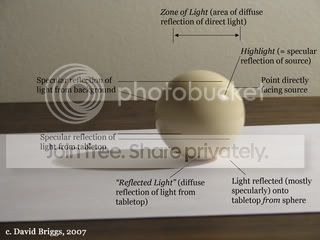
Here are some other webpages to help you get started learning the basics.
http://www.johnlovett.com/test.htm
http://shutterfly.webphotoschool.com/How_Soft_Boxes_Work__Part_I/index.html
http://www.huevaluechroma.com/index.php
http://alzodigital.com/photo_guide/tent_application_guide_white_background.htm
Feb 23, 2009 at 7:05 pm #66792MemberNeal,
Feb 23, 2009 at 8:37 pm #66793 Mike McKeownMember
Neal stop it… my poor heads going to explode… Hell Man, that is awesome info…
Mar 4, 2009 at 4:24 am #66794bruce norikane
MemberThe ant photo is quite good. You got the detail in the black body and white wing.
The beadhead is a bit dark. The abdomen and thorax need more light.
It’s hard to tell from the photos, but your flash is probably overpowering the other lights. They show up as highlights on the bead, but may not be adding a lot of light. Try the same setup without the other lights, then turn them on one by one to see which ones are effective.
You are shooting manual, but are you controlling the flash manually or is the flash power on auto? The manual aperture and shutter speed will change the effect of the constant lamps, but the flash power is another independent variable.
Some general principals on lighting flies. The distance from light to subject makes a huge difference in both intensity and softness.
Light intensity on the subject decreases with the square of the distance to the light. So if you move the light twice as close, the intensity will increase 4 times.
Softness of a light depends on the relative size and distance of the light.
- Bigger is softer
- Big is relative to the subject size
- Closer is softer
Soft light for a head and shoulder shot could require a 50″ softbox, but a 4 inch light modifier could work for a 1 inch fly (if it’s close enough). Even a gigantic light source like the Sun, is totally hard light because the Sun is so far away.
Mar 4, 2009 at 4:39 am #66795Member…
Check this out. One of the most important images I can offer. It is published by David Briggs http://www.huevaluechroma.com/index.php. I printed this one out and literally taped it to my studio for about three months.
…That’s a great link Neal. I’ll be looking at that cue ball for awhile.
-
AuthorPosts
- You must be logged in to reply to this topic.