






Depth of field with a point and shoot?
Blog › Forums › Photography › Depth of field with a point and shoot?
- This topic has 7 replies, 7 voices, and was last updated Dec 9, 2007 at 12:36 am by
 Steve K..
-
AuthorPosts
-
Dec 8, 2007 at 7:31 am #7436
 Simon ChuMember
Longtime lurker, first time poster 😉 :)…this section anyhow ;D
I am a total newbie with the cameraI’m really indebted to Morsie for his tips with head shots and now want to try to create the infocus/outoffocus shots that I see in the mags. Where the foreground is perfect and they background blurred.
Can I do this with a point and shoot. What setting would be recommended?
Is the eye in focus the key?Heres a couple of shots and I am very keen for warts and all feedback please.
Cropping advice too?
 Dec 8, 2007 at 8:38 am #62189
Morsie
MemberSimon the top shot is an absolute ripper, I would be thrilled to have taken it. I think it would make a great panoramic crop – remove the foreground. Also the hair or piece of grass on the gill plate is distracting and I would remove that as well. The bottom shot is good too, very well composed because the fish is balanced by the beautiful reflection on the water underneath it. No need for any cropping there.
To get a shallow depth of field which is what you’re after your camera needs to have some manual controls, either aperture or shutter speed. If it has either of those you’re right – just select aperture priority and set the lowest number (f5.6 or f4 or even f2.8.) make sure you focus on the fish’s eye. If it has only shutter priority set a fast shutter speed (maybe 250 or 320 depending on ISO setting and light conditions) and watch the under/over exposure metering – if you get it just on balanced that SHOULD have you at the largest apperture (smallest number).
If you don’t have those controls set your ISO to 100 and it should (might) prioritise shutter speed over aperture and give you again the largest aperture but watch for camera shake.
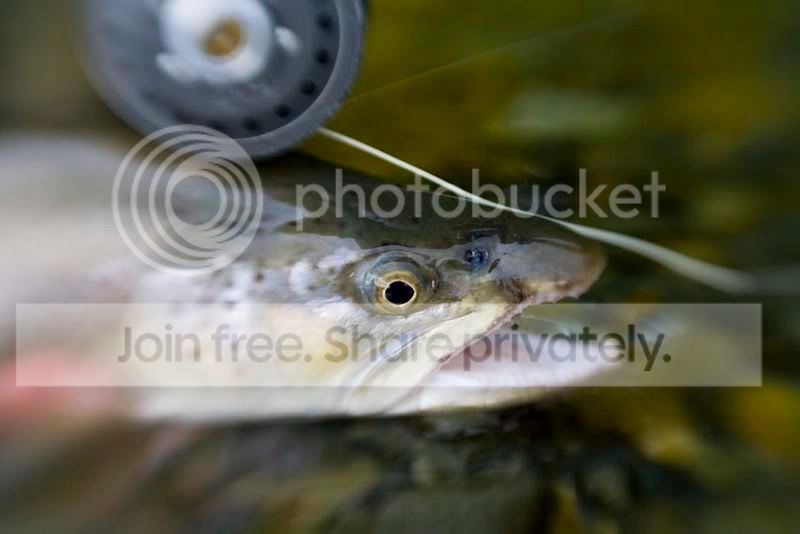
If none of that works sell a couple of those crappy, noodly green rods you used to use and get yourself an SLR. I’ve been playing around with one of these lenses, a Lensbaby and love some of the effects. About a $300 lens.
 Dec 8, 2007 at 12:36 pm #62190
 John BennettMember
I really like playing with narrow DoFs. You should be able to replicate the effect with a digicam (PnS) with some success but be aware that the sensors in digicams and DSLRs are not the same. I forget the exact technical reasons but all else being equal, a PnS set at a aperature of f8 will have a deeper DoF than a DSLR set at f8, or f4 or f2 etc
In order the get the effect your speaking of you want your aperature at its widest setting (smallest number). Keep in mind the more you reduce the aperature (f stop) the more your opening the lens and as such the more light your lletting in. Think of it as sqiunting with the human eye or the same process with any pupil. In dim/dark conditions they are wide and in bright conditions they contract.
So as Morsie said . If you have manual controls set your AV to the lowest number possible ( your lens is wide open) and let the camera determine SS. Until your more familiar with exposure and the “exposure triangle” of fstop, shutter, and iso, best to work in a semi manual mode. He explainedt the other options with regards to Shutter speed and ISO.
If you dont have any manual controls you should almost certainly have “Portrait Mode”. In a nut shell the effect your after is commonly used in portrait photgraphy. Be it glamor shots, wedding portraits or kids school pictues to varying degrees. Any portrait mode on any PnS should open the lens as wide as possible or near to.
Keep in mind that PnSs are hard wired to have more DoF at equal fstops. A bit about DoF to help you. Regardless of what body your using the effective DoF for any given shot is 1/3 in front of your focus point and 2/3s behind. <<< That relationship when used on fish is almost ideal for focusing on the eye. The near 1/3 will or come close to keeping the snout in focus, and the rear 2/3s extends down the body some. Other than that in "wildlife" photography the universal RoT is get the eye in foucus and better yet get some catch light. Two last things.
The amount that the BG is blurred will depend entirely on 1) how wide your aperature is and 2) how far the BG is from the subject. The further it is, the greater the effect.This is my favorite. It was shot at f1.8 and you can clearly see the DoF (about 2 inches) and the transition of focus as you move further into the BG all the way tthrough to trees in the BG which are naught but a creamy green blur
 Dec 8, 2007 at 4:36 pm #62191
Eric DeWitt
MemberAs the other guys have said, it will be harder to do with a PnS than other cameras.
Dec 8, 2007 at 8:35 pm #62192Simon ChuMemberThanks very much guys
The effect you create with that photo John is exactly what I’m trying to achieve and as Morsie has said, perhaps its time to get a decent SLR? ::)I’ll try those things you’ve suggested. Great advice.
Dec 8, 2007 at 10:35 pm #62193Richard Bernabe
MemberAperture and f-stop are not the same thing, even though everyone uses the two terms interchangeably. An f-stop is a ratio. Aperture, focal length, and the physical size of the sensor or film all contribute to DOF. What makes a point-and-shoot so difficult to attain shallow DOF is the tiny sensor. There is too much inherent DOF in those cameras to achieve that shallow, selective focus style you seek.
When I shot 4×5 view cameras, f64 and f128 were not unusual to get the DOF I needed because of the large film size, while cheap disposable cameras don’t even have a focusing mechanism because there is SO much DOF, focusing is unnecessary. EVERYTHING already IS in focus.
Dec 9, 2007 at 12:05 am #62194yuhina
MemberGreat photos gentlemen!
What richard have said is
“…The image format size also will affect the depth of field. The larger the format size, the longer a lens will need to be to capture the same framing as a smaller format. In motion pictures, for example, a frame with a 12 degree horizontal field of view will require a 50 mm lens on 16 mm film, a 100 mm lens on 35 mm film, and a 250 mm lens on 65 mm film. Conversely, using the same focal length lens with each of these formats will yield a progressively wider image as the film format gets larger: a 50 mm lens has a horizontal field of view of 12 degrees on 16 mm film, 23.6 degrees on 35 mm film, and 55.6 degrees on 65 mm film. What this all means is that because the larger formats require longer lenses than the smaller ones, they will accordingly have a smaller depth of field. Therefore, compensations in exposure, framing, or subject distance need to be made in order to make one format look like it was filmed in another format…” from Wilipedia have a great detail about the DOF
http://en.wikipedia.org/wiki/Depth_of_fieldSome P&S have macro function, bring the subject closer to your camera, they will give you similar effect. “But” if your fish is too big! You might end up just capture one eye! that is cool too
Dec 9, 2007 at 12:36 am #62195 Steve K.Member
Simon….that top photo is a winner in my book!
Morsie….nice job…I love photo #2. Looks like a Winston ad out of a magazine
-
AuthorPosts
- You must be logged in to reply to this topic.