






Chattahoochee Striper Stocking and Reproduction
Blog › Forums › Fly Fishing › Chattahoochee Striper Stocking and Reproduction
- This topic has 21 replies, 9 voices, and was last updated Sep 10, 2014 at 9:25 am by
 Mike Lewis.
-
AuthorPosts
-
Aug 1, 2013 at 2:29 pm #74585
Zach Matthews
The Itinerant AnglerOk long-time Georgia residents. I got here in 2006 and did not really take an interest in stripers until about 2009.
Scott Kitchens linked me to a very interesting study showing some reproduction (but not necessarily any recruitment) of stripers in some Georgia waters. That study did not really demonstrate any reproduction in the Chattahoochee, but it was conducted last year during a period of very low flows. Here’s Scott’s study: Evidence of striped bass spawning in the Chattahoochee River above West Point and Walter F. George reservoirs, Georgia.
I know West Point Lake was stocked with Gulf-strain stripers in 2005. Does anyone know if the lake was ever stocked prior to that? What size fish did they put in? We’re seeing and catching fish that max out in the 17-20 lb. range right now. I am not prepared personally to say there are any fish legitimately larger than that in the Hooch below Morgan Falls, but I know Kent Edmonds has had clients catch fish up to 30+ pounds further down by West Point Lake.
I have a hard time believing even a 17 lbs. fish could only be 8 years old, and I certainly think it would take more time to grow up a 20-30 lber. Thus I think those big fish must be from an earlier class of stocked stripers. Anyone know what years were stocked prior to 2005, if any?
Meanwhile we have a rising class of schoolie fish. Last year I was consistently boga’ing these guys at 5-6 pounds. This year the schoolie class seems to be in the 6-7 pound range, which seems about right to me. I would expect them to gain a pound or two a year, depending on feed quality and sex and river levels. Thus by 2015 our schoolies ought to be averaging right around 10-12 pounds, and we do see several fish already in that class.
Some bigger rivers like the Cumberland up in Kentucky average fish above 10 lbs. Out in California’s Delta I believe fish are considered “schoolies” until they break 15-17 lbs. Obviously the Hooch in our fishery is not that far along.
Here are some example fish:
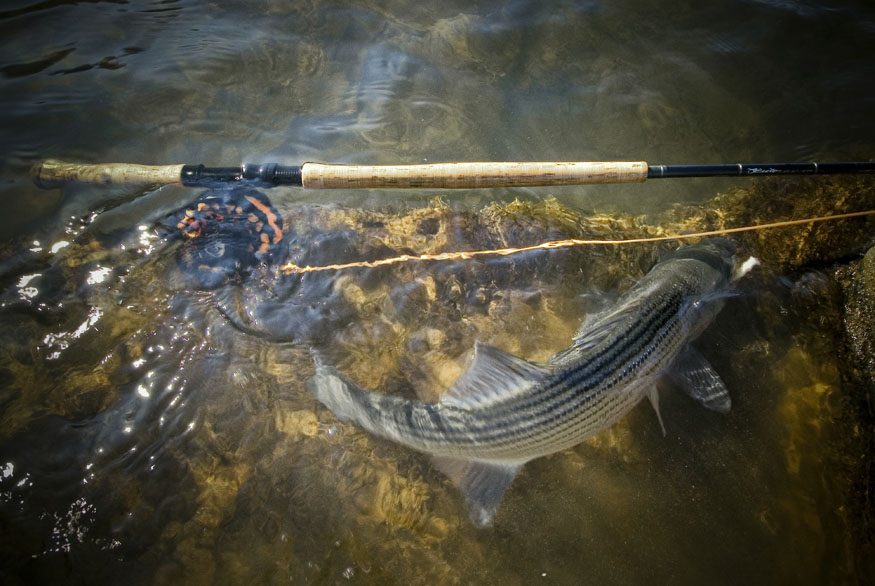
Standard schoolie, approximately 6 lbs. This one may even have been a bit on the smaller side. I estimate 70%-80% of what I catch are in this 5-7 lb. range.
Kind of our medium class; this one was right at 11 lbs. on the boga. Probably 20-29% are at this size for me.This is my final class. I’ve only caught a handful above 15 lbs., and I’ve seen a few more caught in that range. I am speaking of fly fishing and things I have obviously witnessed myself–everyone knows someone who knew a guy who caught a 30 lber. I believe some of that happens but I tend to want to see proof or at least know the guy and know he had a boga, because for people not used to catching big fish, overestimating is very easy.
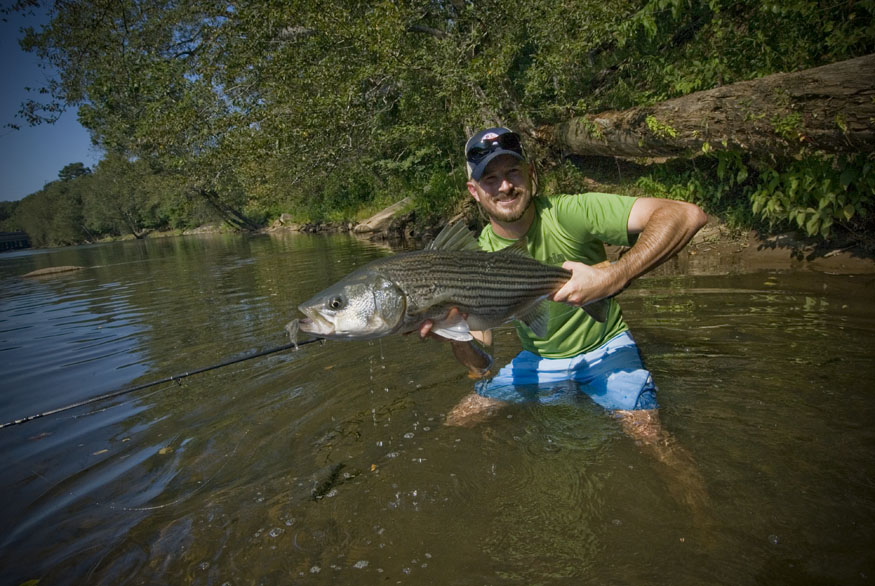
15 lbs.
17 lbs.
18 lbs.James’s is the biggest I’ve personally witnessed.
Zach
Aug 1, 2013 at 3:11 pm #74588 Jay MalyonMember
There were stripers stocked in the the early 90’s for sure. And there definitely are stripers over 20 lbs in there.
Aug 1, 2013 at 3:20 pm #74590 Scott K.Member
There were stripers stocked way back when – but those were atlantic strain (longer and skinnier). The newer ones are gulf strain (shorter and fatter, apparently). Also, note that, although the study says there is spawning, they weren’t able to find any young of the year fish in west point.
Some GON board posts from years and years ago reference stocking back in the 1990s.All that said, the old adage – there are no stripers in the hooch – holds. This isn’t for the faint of heart. Despite the pics above, the hooch is a really freaking hard fishery – there are 70 miles of river for the fish to inhabit and spread-out in.
Aug 1, 2013 at 4:56 pm #74591Jay MalyonMemberThis is a pretty interesting link…
The Striped Bass Fishery of the Gulf of Mexico, United States: A Regional Management Plan
http://www.gsmfc.org/publications/GSMFC%20Number%20137.pdf“No striped bass eggs or larvae were collected, but the
collection of three age-3 striped bass in that portion of the river indicated some striped bass
reproduction and recruitment occurred in the system as late as 1996. Striped bass had been
stocked above West Point Dam only in 1990 and 1992.”Aug 1, 2013 at 5:17 pm #74592The Itinerant AnglerSo we know of 1990, 1992, and then 2005 and I think there’s been some sporadic stocking since then. I could definitely see 20 year old fish being over 30 pounds, but there can’t be many of them left… unless they have in fact reproduced when no one was looking.
That’s kind of what I am trying to figure out. Can we identify by size certain year classes and thereby gain some understanding of how long it takes the West Point/Chattahoochee system to grow, say, a 20 pound fish. Because if we know there were heavy stockings in 2005 and we know the fish gain say a pound a year on average, that suggests by the mid 2020s the Hooch will be averaging what the Cumberland system does in Tennessee.
Zach
Aug 1, 2013 at 5:31 pm #74593The Itinerant AnglerJust scanning unsourced forum posts from back before the 2005 stocking, it looks like 1990 and 1992 may have been the only stockings prior to 2005:
“In 1990 26,000 were stocked and in 92 126,000 were stocked.”
That is not very many fish at all. For comparison, I once totaled up the amount of trout stocked in a year below Bull Shoals Dam in Arkansas. They were stocking something like 1.1M fish per calendar year there.
According to the NOAA, “Striped bass are a long-lived species; they can live roughly 30 years.”
So, working off those figures, it would seem probable that there are still several 1990 fish swimming around and quite a few more 1992 fish, since 5X as many were stocked. The 1990 fish would now be 23 years old and should be extremely large, with the 1992 fish not far behind.
It seems unlikely to me that the 18-pound range fish would have gotten that big in only the 8 years since 2005, but at the same time that doesn’t seem big enough for a striper that is at least 21 years old. That’s less than a pound a year of average growth.
Which gets me back to wondering what was happening between 1992 and 2005. I think there must have been some natural reproduction, if indeed those were the only three stockings.
Zach
Aug 1, 2013 at 6:45 pm #74595Gary Sundin
MemberInteresting discussion. You could be right, I suspect it will remain just a matter of opinion unless young of the year are sampled in the lake. YOY sampled in the lake should be the easiest way to verify recruitment. There is so much ambiguity. From the quick look around I had through various press releases and popular articles online, I can’t tell if Atlantic strain fish were stocked between ’92 and ’05, and it definitely seems like a few supplemental Gulf strain fish have been released since ’05. Also, the age/weight relationships have a lot of variation. Of the several popularly-available charts (there are many) I checked out, 17 lb. fish could reasonably be 8-year olds, although most 8-YO would be more like 13-15 lbs. In fact, a non-negligible proportion (eg. 20%) of 8-YOs could be in the 19-22 lb. range in some populations. In other words, what you’re describing seems to fit pretty well with the 2005 stocking concept, in my opinion. If there were a lot of fish in the, say, 20-30 lb. range, that might imply otherwise. As is, the few big fish that are caught could be the really old fish, very well-fed 8-YO, or natural recruits. Regardless, if biologists consistently and effectively sample West Point (and I don’t know if they do) without seeing any new recruits, then I don’t believe we’ll see anything in the upper Hooch population that suggests natural recruitment.
As an aside, I saw stripers spawning gang-busters this spring for the first time in a location where I’ve been fishing for years. There was zero chance of success at the location, but it was interesting to see the act in a GA river. Mike Lewis was with me and I kept claiming it was gar until we finally got close enough to see the lines on the fish. So I think stripers probably spawn all over GA, even in unexpeted locations, in “ideal” conditions. It seems perfectly possible that a tiny fraction of the eggs survive during good years in a place like the Hooch. The question is whether there is ever enough to be significant to the population.
G
Aug 1, 2013 at 7:18 pm #74596The Itinerant AnglerThat’s good to know, Gary, and I value your opinions on this because I know you have a legitimate science background. I’m glad you posted. Interesting in the extreme that there is a component of 8 year olds which may already be above 20 lbs. I’ve spotted several large-looking fish over the years, but trying to eyeball weight on a fish in typically at least 4 feet of water is a fool’s errand. Every time I have told myself they had to be over 20 lbs., I’ve later walked myself back off the ledge. Maybe my eyes weren’t always wrong. I won’t know until I catch one, I guess.
Zach
Aug 2, 2013 at 12:10 am #74600henryc
MemberHey Zach,
Stripers in our lakes grow approx. 3-4 lbs/year once adult schoolies. After stocked as a fingerling it takes approx. 2-3 yrs to see these fish as 2-3 lbers. Then they grow… A 4 yr old fish should be about 6-8 lbs. They usually only go til 13/14 yrs before dying off…
Henry
Aug 2, 2013 at 4:34 pm #74603The Itinerant AnglerThat’s helpful; thanks Henry. Do you know whether there have indeed been supplemental stockings since 2005, and if so, how many per year and which years?
Thanks man and good to see you here.
Zach
Aug 2, 2013 at 10:51 pm #74604 Kent EdmondsMember
Zach, I’m thinking that there were some more stripes stocked a year or two after 2005, but can’t say for sure. The decision to start stocking stripes again in was made to further the goal of the re-introduction of native species (Gulf strain stripes) as well as lower costs as striper fry don’t require the in-house cross fertilization.
Striper stocking started in West Point in the 1980’s I think. Those were Atlantic strain. The 1990 and 1992 stockings were Gulf strain. After that (`til 2005), it was only hybrid stripes that got put in as they tolerated the warmer better and were more manageable because of their shorter life expectancy. Also (and I never quite got this one) a lot of Atlanta anglers complained about stripes running up river eating the the snit trout.
I would guess that the over-20# fish would have to be from the 90’s stocking. Or it’s even possible that there has been some very limited reproduction of the fish from the 80’s or 90’s.
The big 43# (on the bogo) fish we caught was actually below West Point on the riverine headwaters of Bartlett’s Ferry (aka, Lake Harding). They have continued to stock stripers there since the 80’s and still do. Interestingly, there was a phenomenal hybrid fishery on Bartlett’s Ferry in the late 90’s though the early 2000’s….even though hybrid had never been stocked there! These were all fish that had come down from West Point (through the dam). So I don’t know, but it may even be possible that some of your Hooch stripes came down from Lanier.
I think the current West Point record stands at 35#, caught back in 2009 (upriver during the spawn). That was certainly a fish from the 90’s (or even the 80’s).
Here’s a 2005 press release from the DNR:
Gulf race Striped bass stocking into West Point ReservoirGulf race striped bass are native to the Chattahoochee River, and before dams blocked their movement, probably traveled the river well above Atlanta. Native Chattahoochee River striped bass are genetically distinct from Atlantic basin striped bass, which is commonly stocked into Georgia’s reservoirs. Gulf race striped bass were once found in rivers from Texas to the Suwannee River, Florida. Except for small populations in the Apalachicola River system including the Chattahoochee and Flint Rivers in Georgia, and infrequent catch reports in a few other river systems, they are no longer common throughout their range.
One of the WRD, Fisheries Management Section’s priorities is the recovery of native riverine fish species, which includes Gulf race striped bass in the Chattahoochee and Flint River systems. In 1990 and 1992, WRD tried an experimental stocking of Gulf race striped bass into West Point Reservoir. This action was taken to assist Gulf race striped bass restoration efforts. These fish can provide a brood fish source for later hatchery production, and are a source for additional numbers of fish in the Chattahoochee River when they move through the dam. Stocking West Point with striped bass has the added benefit of providing anglers with a fish that will reach a large, trophy size.
The experimental stockings proved successful. Fish survived and grew well, with reports of fish over 20 pounds caught by anglers. Fish traveled from West Point upstream as far as Morgan Falls dam. The area below the dam is stocked with trout, and there was initial concern that striped bass would negatively impact the trout population. The area below Morgan Falls is also now stocked with shoal bass fingerlings in an attempt to reestablish this native species in the Chattahoochee River. Shoal and striped bass are both present in their native range and will successfully coexist without negative impacts to the shoal bass population.
Striped bass stockings will be phased in and hybrid stockings phased out over several years to avoid sudden changes in the fishery and allow time for evaluation of the stockings. Some of these striped bass will undoubtedly move into the Chattahoochee River as far upstream as Morgan Falls dam. Research conducted in 1998 found that striped bass below Morgan Falls dam consumed a variety of prey including crayfish, shad, suckers, sunfish, and trout. However, trout made up a small percentage of the prey found in striped bass stomachs.
The reservoir stocking efforts will hopefully accomplish two goals.
· Hasten recovery of the naturally reproducing Gulf race striped bass population in the Chattahoochee River by providing a brood source and by enhancing the existing remnant population downstream of West Point when fish move through dams.
· Provide reservoir anglers the opportunity to catch larger striped bass. Striped bass are much more likely to reach ten pounds than are hybrid bass, and many will be over twenty pounds.
In March 2000, a survey of Chattahoochee River anglers was conducted by WRD. Eighty-four (84) percent of anglers responded that they supported WRD considering stocking fingerling striped bass into the Chattahoochee River below Morgan Falls dam. WRD is assuming that those sentiments have not changed and that Chattahoochee River anglers will support stocking Gulf race striped bass into West Point Reservoir. Please contact Brent Hess, Fisheries Biologist (706-845-4290) if you have questions.Kent - FlyFishGA
Aug 3, 2013 at 12:50 am #74605Jason DeBacker
MemberIt’s interesting that the GA DNR doesn’t publish stockings like many other states do… It’d be worth contacting someone at the agency who could settle this.
The study cited above does at least suggest that other stockings have happened since 2005:
Since 2005, Gulf-strain striped bass have been stocked in West Point Reservoir in the hope that a naturally-reproducing population would become established. During the same timeframe, W. F. George was stocked to provide a recreational fishery. … Successful reproduction of landlocked populations of striped bass is rare (12) and continued supplemental stocking is typically required to maintain a viable fishery. However, during 2010, stocking did not occur in these reservoirs in an effort to determine if natural reproduction could be detected. Although no naturally-reproduced fish were collected in West Point Reservoir, several naturally-reproduced young-of-the-year (YOY) were collected in W.F. George Reservoir (Rob Weller, GA-DNR, Personal Communication). The magnitude and the possible location of this spawning event is unknown.
Aug 3, 2013 at 12:54 am #74606The Itinerant AnglerGreat information Kent and I agree with Jason that it’s weird they don’t document and publish their stocking–especially of a native species, which really no one can reasonably object to.
As for eating snit trout: yes they do. And more power to them. Trout are the invasive here. Striped bass is easily the best fishery Atlanta has; it’s just that they are very very difficult for the average angler to catch, especially on fly. Scott is right–they take an enormous investment of time and they really demand that you improve your skillset up to the required level. But once you’re there, they are so awesome. I know very little about deep stillwater striper fishing like you and Henry do, Kent, and it really encourages me to keep trying because I know those big big fish are out there.
I love trout fishing. I’ll love it until the day I die. But in Georgia, I just thank God that we have stripers.
Zach
Aug 3, 2013 at 3:05 pm #74618 Mike LewisMember
Zach,
I’m not sure there is really any solid proof that these fish are spawning successfully, but I have caught some real small stripes a handful of years ago. Can’t find a picture unfortunately. I haven’t personally witnessed spawning attempts in the Hooch, but have elsewhere in GA as Gary mentioned.
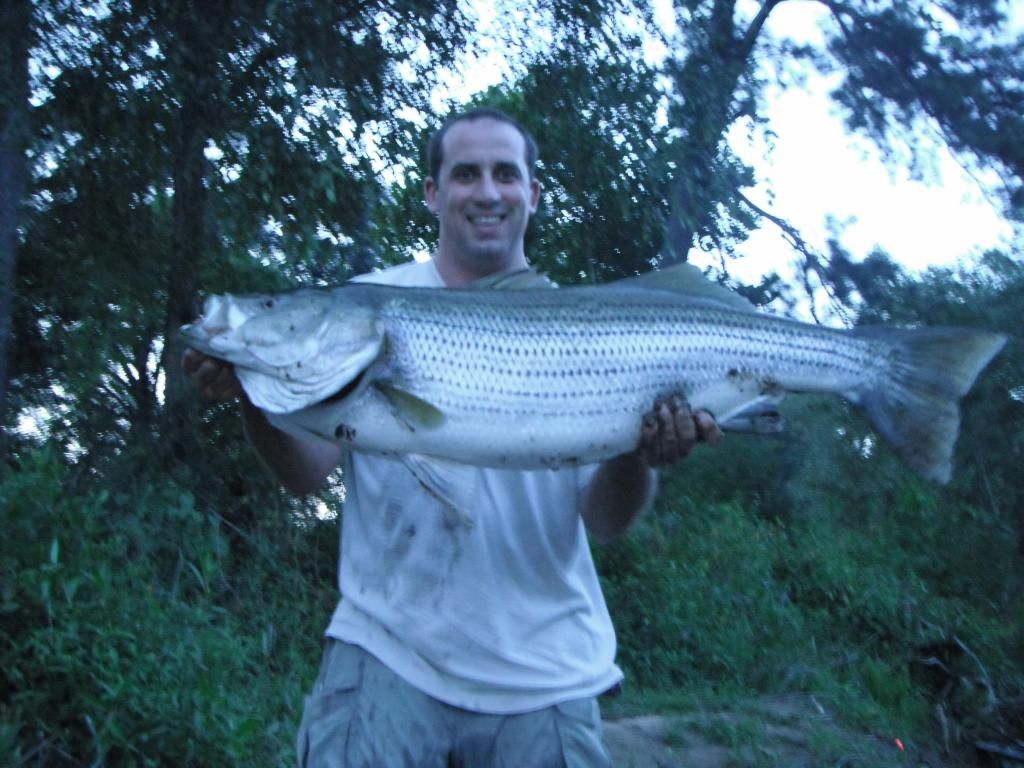
As for fish topping out at 20 pounds, I don’t think so. I’ve seen a few over that this year and took this picture of of my buddy in July 2010 of a 43″er (no accurate weight, but charts would indicate it is a bit over 30 lb http://www.stripers247.com/striped-bass-length-to-weight-chart.php). It was caught on a topwater plug on a pretty heavy bait caster. In an area you fish very often. Sorry for the low quality, right at dusk.
http://i662.photobucket.com/albums/uu347/mrmikelewis/july2010007_zps91e2f58c.jpg
Aug 3, 2013 at 10:10 pm #74623Jay MalyonMember
Not sure where this info was sourced from. Still interesting.
Aug 3, 2013 at 11:50 pm #74625The Itinerant AnglerNice, thanks Jay.
Sep 10, 2014 at 7:23 am #88141The Itinerant AnglerI am kicking this thread back to the top. In the last couple weeks I’ve been catching some of the smallest stripers I’ve ever seen in the Hooch. These little torpedos have all been in the <3 lb. class, which is great to see because I interpret this as the 2011 stocking class beginning to make its way up the river.
Given the large amount of bait fishing pressure up by Morgan Falls and the consequent number of killed fish (both intentional and otherwise), the DNR was going to have to put more fish in or this fishery was going away. This year has been pretty sorry from a conditions perspective, but when conditions were good, I still felt the overall number of fish was down. I suspect that's a double-edged sword: bigger fish that are still in the river are now wary after having been caught a couple times, and the medium-size schoolies that were our 7-10 lb bread and butter are now largely either grown up or dead.
What are y'all's thoughts? Anyone have a more recent striper stocking graph for West Point? Anyone heard whether the DNR is going to ban bait fishing altogether on the Hooch as they had considered?
Zach
Sep 10, 2014 at 7:38 am #88143Mike LewisMemberI caught some in the under the 1 or 2 pound class back in May. Also have caught and had buddies catch a few over 20 lb this year. Numbers do seem down.
I will say pressure has been at an all time high, at least in June-July.
No news yet from the DNR, I think the “questionnaire” that they put out was received pretty poorly statewide as it was mailed out to residents of bordering counties only.
I didn’t really mind that part, but I didn’t care for how the question was asked – ban all bait or not. Right now we have a no live-bait fish ban with a one rod in the water per person maximum. I think the rule as is a good balance (if strictly enforced as written – but that’s a different discussion for DNR manpower). But the question asked by the DNR did not have an option to say “keep rules as currently exist”. I doubt you would ever see a majority vote on full ban on bait in this stretch, especially with the GON trolls.
Sep 10, 2014 at 7:47 am #88145R Black
MemberDoes anyone know how DNR goes about determining the age of stripers? If it could be done fairly easily and accurately it might help answer some of the questions.
Sep 10, 2014 at 7:53 am #88147The Itinerant AnglerYou’re absolutely right about that Mike. My issue with the bait fishing is not the bait fishing itself. It’s the fact that it’s so easy to break the rules.
I saw a couple guys fishing with VERY large coolers. Way too big to need for mere cut bait. They also had more than one rod going. If DNR is in the area it’s easy for those guys to just dump the cooler overboard and claim they were dumping ice (thus releasing any live bait) and to reel up one rod and stow it. From a distance (except the two rods thing) you can’t tell a guy who is fishing live bait from a guy fishing cut bait. I’ve seen a couple interactions get ugly, and frankly have been involved in a couple, where the non-bait fishing angler simply asked the bait fisher what bait he was using. One time I intended to be offensive because I suspected the guy was using live bait. The other time I was caught by surprise when the person turned hostile, because I hadn’t even thought they might be cheating the rules. In retrospect I think they were both using live bait and didn’t like being called out.
If ALL bait fishing was banned you could tell from a distance what was going on. I have no problem with any form of fishing, but in the case of the Hooch, the stripers are a very limited resource with a great deal of pressure. You think pressure is high now? I think the word is just getting out in the bait fishing community. I see the numbers increasing exponentially year over year and I expect that trend to continue unless DNR does something. A bait ban to me is a great compromise because people can always fish flukes, which are just as fun but not nearly as destructive. If you’re too lazy to make a cast and reel it in versus sitting there getting drunk and watching a float, I don’t have much sympathy for you.
This isn’t a fly v. conventional thing although I am sure the bait guys see it that way. This is a killing fish thing. Is there even a striper creel limit and if so why would it ever be more than one fish a day? The DNR’s own advisory warns people not to eat more than one fish out of there a MONTH! Strictly from a public health perspective they would be doing people a favor by enforcing C&R with a trophy slot of anything above 20 lbs.
Zach
-
AuthorPosts
- You must be logged in to reply to this topic.