


Article: Taper Tech
SOME MONTHS AGO A FRIEND RECRUITED ME to teach her how to fly fish, and the first time I put a fly rod in her hands, she cast it more than 100 feet. Impossible? That all depends on the line. In this case, my friend was throwing a 15-foot two-handed rod with a 75-foot level shooting head. All she really had to do was get it all moving and then let go. And yet, despite achieving world-class distances, she would never have been able to catch a fish, because the line—constructed from scraps and lacking a proper taper—would not completely unroll. Though enjoyable to cast, this unconventional setup amounted to little more than a backyard plaything. If nothing else, however, it illustrates the importance of tapering to fly-line performance.
Last fall, when we examined the structure and composition of fly-line coatings (“Cooking Up Some Lines” American Angler, September/October 2008), we knew that the subject of fly-line tapering was too vast to shoehorn into the same article. And yet, the taper built into a fly line is what determines whether—and how—a line will unroll or “turn over.” Because fly-line tapering is essential to performance, this time we’ll give the subject the individual attention it deserves.
Generally speaking, fly-line manufacturers ask three questions when creating new tapers: “First, how can we improve the angler’s casting?” says Steve Hemkens, senior product development specialist at Orvis. “Second, what advantages can we give the angler in roll casting, mending, and using the line to catch fish? Finally, what special features do we need for a certain species or style of fishing?” To better understand how manufacturers tweak a generic fly-line profile to produce the array of specialized tapers we enjoy today, it is essential to review some basic terminology.
The Basics
The simplest type of fly line is the level line, which has no taper at all from one end to the other. It is a straight line with parallel sides its entire length. Level fly lines are both hard to cast and hard to aim, and very few are manufactured today. The next simplest is the double taper, which is simply a fat level line tapered to a finer point on both ends. Weight-forward lines have a bulge—or head—at their fronts, helping the angler load his rod by putting more weight in the section of line being waved in the air. The weight-forward line is the most common type of fly line today and the basis for all the species-specific tapers.
“Ultimately, the weight-based naming system has become almost completely arbitrary, especially when it comes to fly rods.”
From the reel end, weight-forward lines start as a thin, level section called the running line. The running line is thin so that the heavy weight-forward head can pull it through the guides as easily as possible. After the running line, the taper gradually increases in diameter until it reaches the belly or weight-forward section. The tapered section behind the belly is called the rear taper. The belly itself is another level section, but much thicker than the running line. After a few yards of belly, the line tapers back down to its tip. This front taper largely controls how a line will behave during a cast. Finally, after the front taper, there is another very short level section known as the tip. The entire tapered portion of the line, from the rear taper to the tip, is called the head.
Nate Dablock, product design manager for Cortland Line, explains that weight-forward floating fly lines fall into three main categories: generalist, precision, and heavy duty. Generalist are all-purpose fly lines. Precision lines are for making soft and accurate fly presentations, and heavy-duty tapers aid in casting wind-resistant or heavy flies, such as a bass bug or weighted nymph. The main difference among these designs is in the
front taper, which dictates how hard and fast the line will finish unrolling and turn over the fly.
“Take a precision line, for example,” says Dablock. “We make the front taper fairly long—eight to ten feet—so the energy in the cast dissipates slowly and smoothly, like you’d want for a dry fly.”
At the end of that long front taper is an unusually lengthy level tip—four feet on Cortland’s Spring Creek 444 series line. “That long tip assures that the fly will drift slowly to the water; almost all the energy is gone from the cast after the front taper unrolls, and what little bit is left just sort of puffs that tip out.” Of course, such a delicate line would struggle to turn over a big bass bug.
Heavy duty lines “have a very short, abrupt front taper,” says Bruce Richards, product development engineer for 3M/Scientific Anglers. “All the energy rolling down the line is forced into the smaller tip very quickly,” he says, “and that energy has to go somewhere, like into flipping over the bug.” Thus, the shorter a line’s front taper, “the more energy ultimately gets transferred to the fly.” And the more energy the fly receives, the bigger the bug a particular cast can turn over. Other heavy-duty lines, such as Rio’s Nymph and Clouser models, use the same technique in what’s called a “bullet taper” (because it looks like the necking down of a rifle cartridge into the bullet). Depending on where—and over how much distance—the manufacturer places this rapid decrease in line diameter, the strength of the turnover can be controlled.
A generalist fly line splits the difference to avoid being either too hard or too soft when it flips over a fly. Where a precision front taper might spread itself over 8 to 10 feet, and a bass-bug front taper over only 4, your generalist line will taper to a point in 6 to 8 feet—the sweet spot for the widest range of conditions. Lines such as Cortland’s Precision Platinum Trout, Airflo’s Freshwater Tactical, Scientific Anglers’ Mastery Trout, and Orvis’s Wonderline Trout are all generalist tapers.
How Do Fly Lines Fly?
Bruce Richards of Scientific Anglers, along with Dr. Noel Perkins of the University
of Michigan, set out to answer a very basic question: Why do fly lines stay in the air? The answer may surprise you. “In a cast, fly lines suffer drag from air resistance,” explains Richards, “and that drag pushes on both the top running leg of the loop (called skin drag) and on the front of the loop (called form drag).” It turns out that form drag is far stronger than skin drag. Obviously, this air resistance pushes backwards, slowing the line down. But, “as a fly line unrolls, the top leg must roll down.” And, as the line tries to push itself down, form drag tries to force it back up. Thus, “the major forces acting on a line are both back and up. We call that lift.”
There’s also another factor in play: speed. “A fly line comes by the angler’s head at over two hundred miles per hour,” says Airflo’s North American distributor, Tim Rajeff. As the line tapers, the energy being concentrated into a smaller diameter must go somewhere, and it turns out that this is expressed as a huge speed increase. “Theoretically,” says Richards “in a vacuum, the tip of a line could approach the speed of light.” In fact, every time you crack your leader after breaking off a fly, you are creating a miniature sonic boom!
Of course, fly lines come nowhere near the speed of light. “That’s because for every doubling in the speed of an object passing through air, the air pressure quadruples,” says Richards. “This means that while the line tries to speed up, the air forces it to slow back down even faster.” Manufacturers use these quirks of physics to their advantage, controlling when, where, and how hard a line will turn over by tweaking its front taper.
—Z. M.
How much tapering is really going on here? Not much. “To tell the truth, most anglers couldn’t even perceive the actual taper as it happens,” says Rio’s marketing manager and noted Spey-casting authority Simon Gawesworth, “because in some cases the differences in thickness over an inch of line might only amount to the diameter of, say, 8X tippet. Nevertheless, those small changes do affect the physics of the cast, and they definitely add up to make one line very different from another.”
Improving Your Cast
Every angler wants a line to improve his cast, and manufacturers have the same goal. They tweak a line’s casting qualities mostly by altering the length and rear taper of the line’s head. “Belly lengths are a big deal when it comes to casting,” says Cortland’s Dablock. Shorter belly lengths mean shorter overall head lengths (which are easier to cast because you have to carry less in the air). Some beginner lines, such as Scientific Anglers’ Mastery Headstart, have heads only 35 feet long. Shorter head lengths also allow for quick casts when a rapid presentation is desirable. Monic’s GSP Tarpon Fly Line, for example, has a belly only 17 feet long to quickly aerialize enough weight to load the rod.
On the other hand, longer heads are better for distance casting. Rio’s Gawesworth explains that the more line you can false cast in the air, the longer the overall cast will be. “If you start with seventy feet of line in the air and then begin the shoot, that cast is going to go farther than one which starts with only thirty feet in the air.” Some distance-taper lines, like SA’s Mastery Expert Distance or Snowbee’s Extreme Distance, have heads over 70 feet long! Because it can be challenging to carry that long a head with the running line already out of the tip-top, distance lines have very lengthy rear tapers, as well. Transferring energy from a thin running line into a fat weight-forward head is notoriously difficult even for the best casters.
The rear taper has another important role to play besides helping anglers cast farther: “Controlling the line on the water,” says Orvis’s Steve Hemkens. “The thicker that rear taper is, the farther away you can mend line, and the better you’ll roll cast. That’s why many anglers who nymph a lot still use double-taper lines—they always have the tip of their rod on the head, because there’s no running line.”
Of course, most of us fall in between the need for a super-long head and the casting aid of a super-short head. And, while we need some rear taper to work our mends, we’d also like to be able to shoot line—the whole point of using a weight-forward line in the first place. Thus, most lines have total head lengths in the 40- to 50-foot range—a typical fishing distance. “Unfortunately,” says Orvis’s Tim Daughton, a product development specialist, “most anglers pick their lines on the basis of parking- lot casting, and a lot of times, that leads them to a line that casts well with a lot of head out the tip, but that doesn’t fish as well in more reasonable distances.”
The Name Game
The problem Daughton alludes to is far from new. In the 1960s, the American Fishing Tackle Manufacturer’s Association (AFTMA) came up with a system for naming fly lines based on the amount of grains in their first 30 feet, measured from the tip.
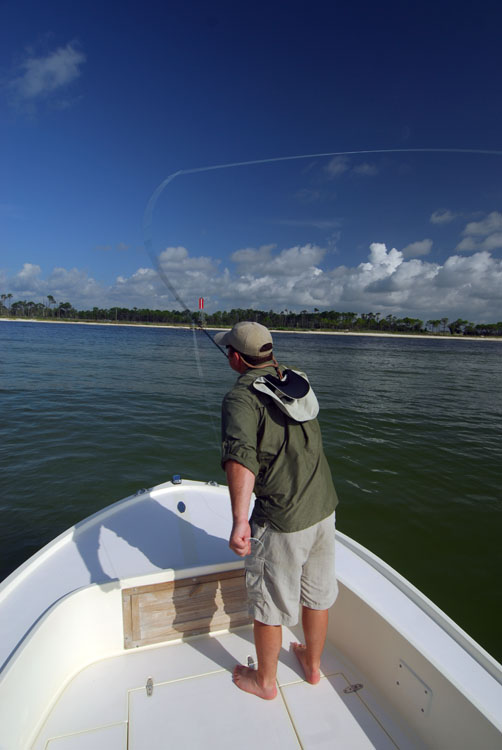
(For those keeping score at home, a “grain” weighs 1/7,000th of a pound.) Five-weight lines have around 140 grains in their first 30 feet. Eight-weight lines have about 210 grains, give or take about 10 grains in either direction. Fly-rod manufacturers quickly came out with 5-weight rods, or those meant to cast a 5-weight line.
Much has changed since the 1960s. As new-fangled graphite fly rods grew stiffer and faster, the norms of fly fishing shifted. Very few modern rods bend like their 1960s counterparts with just 30 feet of line out. Of course, most anglers don’t want such slow, flexible rods; fast action is far more desirable these days. However, the moving target that is “fast action” has created an arms race between fly-rod and fly-line manufacturers. “Ultimately,” says Rio’s Gawesworth, “the (weight-based) naming system has become almost completely arbitrary, especially when it comes to fly rods.”
Enter the half-weight-heavy fly line. Because many anglers have difficulty controlling the fastest rods with their rated lines, manufacturers began offering lines which exceeded their grain window by a half line size. The extra weight helps bend faster rods and slows them down, making them more manageable. Rio’s Grand and SA’s Mastery GPX are examples of this half- weight-heavy profile.
Off with Their Heads
Of course, nothing says you have to use a rod with its rated line. Many anglers experiment outside official grain ratings. Shooting-head lines are the best example. A traditional shooting head is a 30 foot section of heavy fly line looped to a very thin monofilament running line. When the angler releases the head, the running line is drawn rapidly out behind it, like a weight- forward line on steroids. To further pump up the action, many anglers use heads that are rated two to three line sizes too heavy. (Thus, on an 8-weight, you throw a 10- or 11-weight shooting head because you get only 30 feet of line weight to load your rod.) The deeper the bend, the farther the head goes, meaning anglers can make 100-foot casts with little backcast room. Basically, these are fly fishing’s version of casting a heavy plug.
The disadvantage of traditional shooting heads is the abrupt transition between running line and head, which causes a nasty hinging effect that is difficult to handle. Manufacturers, seeing an opportunity, came up with “integrated shooting lines,” which have short rear tapers behind a head that blends seamlessly into a running line instead of monofilament, avoiding the loop-to-loop connection and thus aiding control. Further, the skinny running lines of integrated shooting lines are less prone to tangling.
AFTMA Fly Line Grain Weight Chart
The original AFTMA grain-weight chart established in the 1960s still serves as a set of rough guidelines for designating line sizes. The standard weight indicates the weight in grains of the first 30 feet of line for each line class.
| Line Rating | Standard Weight | Grain Window |
| 1 weight | 60 | 54-66 |
| 2 weight | 80 | 74-86 |
| 3 weight | 100 | 94-106 |
| 4 weight | 120 | 114-126 |
| 5 weight | 140 | 134-146 |
| 6 weight | 160 | 152-168 |
| 7 weight | 185 | 177-193 |
| 8 weight | 210 | 202-218 |
| 9 weight | 240 | 230-250 |
| 10 weight | 280 | 270-290 |
| 11 weight | 330 | 318-342 |
| 12 weight | 380 | 368-392 |
| 13 weight | 450 | 435-465 |
| 14 weight | 500 | 485-515 |
| 15 weight | 550 | 535-565 |
Rio’s Outbound series—popular with saltwater anglers who need to reach breaking fish in a blitz situation–and almost all Jim Teeny lines are examples of integrated shooting tapers.
The Balancing Act
Just as with line chemistry, manufacturers must balance competing factors to make a line that will meet the widest possible range of needs. The biggest factor is angler skill. With a wide variety of people using these lines, manufacturers have to be careful not to fudge by making a line with, for example, too short a head (good for beginners, bad for distance); or not enough rear taper (great for shooting, poor for on-the-water handling). The biggest change in the last few years has come from species-specific naming. In some cases, tapers may be practically identical for, say, pike and bass, but the new naming system helps anglers know precisely what a particular line is calibrated to do—in many ways an improvement over the old line-rating system, which gave anglers minimum guidance.
Though little more than long plastic noodles at their most basic level, modern fly lines are among the most complex pieces of tackle we use. Without them, no matter how impressive our rods, most of us would have little to show for our long hours on the water.
This article originally ran in the May/June 2008 issue of American Angler magazine. To download a PDF copy of the original article (with magazine layout), click here.
Leave a Reply