






Lightning Bug Nymph
- This topic has 17 replies, 12 voices, and was last updated Mar 6, 2009 at 8:51 pm by
brucec.
-
AuthorPosts
-
Feb 17, 2009 at 4:57 am #6520
Neal Osborn
Member
The lightning bug has become my favorite nymph attractor pattern. This is certainly a well recognized pattern and often found in the go-to fly box. However, not everyone knows how to tie it properly. Sounds like a good reason to do a tutorial.
Hook: Scud hook or curved hook of choice, size 12Tail: Pheasant tail fibers, about 6 total, three-fourths-hook-length
Body: French tinsel, medium (flat silver) by UTC
Rib: Ultra wire, red, small, by UTC
Thorax: Blended mixture of hairs mask fibers (tan) and finely cut fibers of crystal flash (chartreuse), tri-lobal-fiber (crystal tri-lobal hackle peacock), and SLF (rust-brown), blended together in a spice/coffee grinder.
Head: Silver tungsten bead, 1/8”
Thread: Rust, 8/0 or 6/0 (I use 8/0)
Adjectives: Brush-on super glue.
First make the blended fiber mixture for the thorax. This is like Grandma’s kitchen – add a little bit at a time.First, take a clump of tan hare’s ear fibers. I always pre-blend my hare’s ear in tan/black/green and make a stock.

Then cut up some fibers of crystal flash, tri-lobal-fiber (the stuff used to make braided worms), and SLF.


Put the ingredients in the spice blender and mix.

Add little bits at a time until you have something like this.

Put the tungsten bead on the hook.

Tie in the pheasant tail a bit past the bend of the hook and then wrap back to the head. Leave the tag end of material in place (i.e. don’t cut it).

Carefully wrap the pheasant tail back toward the tail about three wraps and then come back to the head and tie off.

Now cut the remaining material flush. This technique helps to build and form a body foundation. Notice the nice taper.

Tie in the red wire to the tail. Then wrap back to the head.

Tie in tinsel to the tail. Then wrap back to the head.

At this point apply a small amount of superglue to secure the foundation.


Tightly wrap the tinsel to the head and secure with a few wraps of thread.

Apply a small amount of superglue over the tinsel. This not only secures the foundation but prevents the wire over-wrap from slipping. Wait a few seconds to start the wire. This allows the glue to firm up every so slightly.

That’s how you get nice symmetric wire ribbing. All nice-and-tight and secure.

Now build the thorax. This is the part of maximal frustration. You want to get a nice tight wrap without having the fine fibers scattered. The traditional method is to dub the fibers and then wrap but I am often frustrated using this technique on this particular fly because the dubbing blend is comprised of many different “types” of material and the shinny stuff just falls off the dub. Instead, I now use a dubbing loop and apply the fibers in fine even clumps. Then spin the loop tightly and palmer toward the head. Remember to securely close the loop before starting.


It should look like this when finished. Nice and tight.

Trim the scattered fibers. Finished.

Have fun. The lightning bug is a great pattern.


 Feb 17, 2009 at 9:25 am #57172
Abe Mathews
MemberNever heard of that before, but that’s a very interesting pattern.
Feb 18, 2009 at 12:04 pm #57173keith b
MemberThise are pretty sweet bugs Neal.
I have fished this pattern on the Home waters many times with success.Feb 18, 2009 at 1:44 pm #57174Rob Snowhite
Memberdude you are rediculous.
i’m going to go get my 3d glasses from coraline and re visit this thread.
Feb 18, 2009 at 4:12 pm #57175john michael white
MemberNice tutorial Neal!
Feb 19, 2009 at 4:54 pm #57176Grant Wright
MemberAwesome fy; I love the custom blend method.
Feb 19, 2009 at 10:32 pm #57177tim matthews
MemberOk- Those are the best lighting bugs i have seen. I would like 3 or 4 of those if you can spare them- Let me know.
Tim Matthews
Feb 21, 2009 at 2:55 am #57178cole m.
MemberAwesome!
Feb 26, 2009 at 12:41 am #57179MemberNeal- What’s the deal with those sexy lightning bugs- Since you know my address I was wondering why I haven’t received my supply.
Really you are a fantastic tyer.
Feb 26, 2009 at 2:43 am #57180MemberI got your flies right here Tim 😉 Hahahaha.
I will tie a few extra for you.
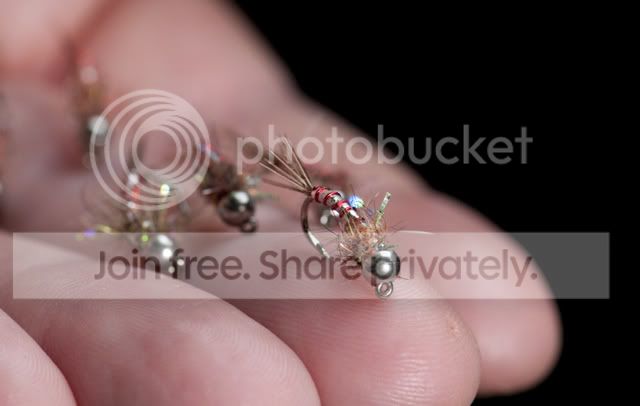
Feb 26, 2009 at 3:15 am #57181MemberCloseup – Bugs in Hand
 Feb 26, 2009 at 3:51 am #57182Member
Great looking fly! Great Photo!
Feb 27, 2009 at 1:20 am #57183MemberNeal- Thanks for the finger “of flies”. No really those are great just as all the patterns you are tying. As someone who has just started really getting into it I love to see yours as well as the other guys flys.
Cole had a good link to a tying light- What light do you use????Feb 27, 2009 at 5:39 am #57184 Cameron MortensonMember
Neal…who is your hand model?
Feb 27, 2009 at 5:44 am #57185MemberTim – The best light solution IMHO is the classic Ott lamp http://www.ottlite.com/p-62-classic-task-lamp.aspx.
Feb 27, 2009 at 3:06 pm #57186dusty montgomery
MemberI really like this fly Neal. I sat down last night, tied a dozen or so caddis pupae, then tried the lightning bug nymph only to find that I could not find my pheasant tails-I suspect my dog, and we will be discussing this later. Do you only tie this in 12s, and does the color of the dubbing/synthetic blend matter very much?
Cameron – don’t make me do a special finger picture for you too – it might not be as pleasant 😉
Be careful Neal, I have friends who have spent the night in the clink for offering these gestures to those in his profession! 😉
Dusty
Mar 1, 2009 at 4:40 am #57187mike ormsby
MemberNeal sweet pattern — can’t wait to try (or should I say tie)
Mar 6, 2009 at 8:51 pm #57188brucec
MemberJust saw this post about the Lightning Bug Nymph. I learned about it 2 years ago while on a trip to Montana. It saved the trip for us. When we got back to NY, I just stayed with it and it did equally as well on the Catskill streams.
Great fly and terrific tutorial.
BruceC
-
AuthorPosts
- You must be logged in to reply to this topic.