






Decline and Fall of the Chattahoochee River
Blog › Forums › Fly Fishing › Decline and Fall of the Chattahoochee River
- This topic has 16 replies, 9 voices, and was last updated Jul 20, 2012 at 11:27 pm by
Chris Corneli.
-
AuthorPosts
-
Jun 15, 2012 at 4:22 pm #6005
Zach Matthews
The Itinerant AnglerBack in the 1990s, the Chattahoochee River was regionally known as a trophy brown trout fishery. The river is in two stages: the Buford Dam tailwater and the Morgan Falls Dam tailwater.
Buford Dam blocks Lake Lanier and remains a decent trout fishery with reproduction of wild browns and the occasional fish over 20″ caught, often on bait. However it has a turbidity problem, with an average summertime turbidity in the middle of the tailwater at Medlock Bridge of about 2 NTUs, which is a measurement derived from the amount of light refracted off the particulate in the water.
A really fine trout stream like the Yellowstone will have an average turbidity of .5 to 1.0 NTUs, meaning the Hooch is running about 2X-4X dirtier than a Western trout stream on average at the present time.
And that’s below Buford Dam in the “clean” section. Morgan Falls Dam blocks the Hooch to form Bull Sluice Lake. The dam was constructed to power Atlanta’s street cars and at one point the lake there was over 40′ deep. Today you can stand on a dry silt island within a fly cast’s distance of the back of the dam itself. Here’s a pic:

The average NTU reading for the lower Hooch, below Morgan Falls, is presently about 5-10. This is where there was once a trophy brown trout fishery, and it is now where I primarily catch striped bass. Even the striper fishing goes to hell above 10 NTU, which is actually where we are today after a couple recent rainstorms. It takes about a week without rain for the tailwater to “bottom out” at 5 NTU. The lowest I have ever personally seen it was 4 NTU, last August following a cold winter (which impeded biological growth) and then in a drought with low water.
Here’s the turbidity meter for the Hooch:
http://ga2.er.usgs.gov/bacteria/
Notice that it is also a bacteria counter. I contracted an adenovirus last summer which resulted in me taking 6 months of steroid drops to my left eyeball (which felt like someone was pulling it out of socket with barbecue tongs). Adenoviruses are associated with human feces, and I’m reasonably sure I got it from swimming in the Hooch.
These turbidity ratings are a direct result of runoff from metro Atlanta, which went from a population of less than 1.5M in 1960 to a more than 5M today. The growth accelerated in the 1990s, and the city actually put on 38% from 1990-2000, when the Hooch was getting killed.
I frequently see point sources of runoff while I’m on the river. You’ll be moving along and suddenly a feeder creek from a development will be dumping silt in. This is almost always the result of someone failing to keep up their silt fences while doing new construction and really ought to be reported so they can be ticketed. It’s depressing but there it is.
The only way stuff like this gets better is if people take an interest, realize how much conditions have declined, and try to enforce the clean water laws (CWA and NPDES) that we have in place. So if you see someone polluting, call the city or the DNR! I smelled a sewage smell the other day by Ray’s on the River and called the Sandy Springs Water Department. They were very proactive and got a guy out there to check the creek behind the restaurant – he even called me on the phone to confirm the location.
Zach
Jun 15, 2012 at 4:55 pm #52933 Steve K.Member
Zach,
I’ve lived in the ATL most of my life and remember the “good ole days” when you could catch some really nice holdover fish below Morgan Falls.
If you look at some satellite photos (Google Earth or Terraserver) you can clearly see all the silt behind the dam. In my opinion, MF would be a prime candidate for a breach and mitigation. I’d be interested in how far that would extend the cold water fishery.
At some point…and we may be there now….there will not be enough “clean” water to dilute the treated wastewater effluent and the river below the city will be nothing more than a sewage canal.
Jun 15, 2012 at 5:55 pm #52934 Scott K.Member
Thanks Zach –
First, this brings to mind a couple of things.
1. New dams are being proposed in the Hooch watershed.
First – Glades – up around Lanier. Involves some crazy water piping from the Hooch to fill it and maintain it. http://www.gladesreservoir.com/
Second – Bear Creek Resevior – South Fulton – I don’t have a link to the proposal, but they too propose to pump water out of the Hooch for storage.
2. This is a really interesting video series about some guys that made a Quixotic voyage in a dory down the MS river. Much talk is about the pollution, dams, etc. Being from Memphis originally, before watching this, it was one of my big dreams to canoe the entire Mississippi – no more. http://vimeo.com/channels/omrp
3. For a real time chart of turbidity, see the last chart on: http://waterdata.usgs.gov/usa/nwis/uv?02336000 Note that the bacterial levels are calculated based on the turbidity level since they are well correlated and turbidity is more readily measurable.
4. An interesting document about the MF dam and its generation scheduling. http://www.georgiapower.com/lakes/hydro/pdfs/OperationsPrimer.pdf
5. Really interesting movie on Colorado river and the fact it doesn’t flow to the ocean. There is a longer version somewhere. http://www.youtube.com/watch?v=SNlSRyanQg8&feature=player_embedded#!
6. We live in an industrialized nation and reap the benfits of that every day in uncountable ways. A natural effect of this is that water becomes a means to an end and gets dirtier. At some point, though, our technology should advance sufficently to be able to scub completely any water that we are discharging as a point souce and to mitigate the harms of non-point source poluution. For instance, most rivers are cleaner now than they were in the 1960s or even the 1980s. I don’t think we are at this point yet, however.
Second, on the hooch – For the lower hooch below MF, the primary WQ issue is the siltation back behind the dam. Basically, all of the silt from all of the city’s northern development is sitting somewhere in bull sluice. This silt is causing the water coming out of the dam to be relatively turbid from the get-go. If you actually go above MF, the channel of the hooch on the sluice has surprisingly clear water. It is much much more turbid below the dam. By the way, if you’ve never been on the sluice, its one of the most beautiful in-town places you will find… it feels very remote and, because of the geography, you really can’t see or hear the city around you.
The silt casues the turbidity and the silt has caused the decline of the MF tailwater’s trout fishing – apparently, there used to be some monster holdover fish in the river. Now with the lake shallow and the river temperatures in the 80’s in high summer, holdovers almost certainly don’t exist.
I guess the issue is, how do you deal with this…. It would be great if all of the silt were removed (but this would stir up heavy metals and other similar items for some time while being removed – which creates its own set of regulatory permitting issues) and it would be great if the dam came down. However, both of those are expensive processes and, in terms of economic benefit, without other action further downstream, my fear I doubt there is currently a value proposition to do either. The river is reasonably well commercialized down below the in-town reach of the hooch. There is the crap plant and the entirety of chatahoochie industrial boulevard. There are the other dams, there are the other lakes, there are the nuke plants, farmlands, etc. etc.
All that said, I think there are some points of light. Now, more than in the past, there is a good deal of interest in the hooch. Notably, Sweetwater Brewery raises some degree of awareness, several businesses operate some type of float trip / rental business on the hooch, there are volunteer groups that do clean-up trips in and around the hooch and now there is a new Chatahoochie Nature Center up near Roswell. The key will be how these groups leverage the public and whether enough of a groundswell can build up to do a watershed-wide clean-up effort. Note that one of the dams has just recently been removed at Columbus.
One thing you can do as an individual is, as Zach points out, to report discharges. Since most cities have dedicated water quality staff, and they want to use them, they are usually more than willing to jump all over this stuff. Call them.
Jun 15, 2012 at 7:21 pm #52935The Itinerant AnglerScott my belief is that if the present practice of doing nothing continues, Bull Sluice has only a few more years as an actual reservoir before it simply becomes a higher level channel.
Jun 15, 2012 at 8:16 pm #52936Chris Corneli
MemberI heard from an engineer at Ga Power that Morgan falls facility is always in the red as it barely produces any power. They have looked into shutting it down and removing the dam but found that it would be more expensive to remove it than run it at a loss for 10+ years. Flood control was also a concern. Ga power did a very nice biological survey of the of the river. http://www.georgiapower.com/lakes/hydro/pdfs/Fish_Aquatic.pdf
Thanks for posting this Zach.
Jun 15, 2012 at 8:29 pm #52937The Itinerant AnglerI look forward to that Chris.
Jun 15, 2012 at 8:56 pm #52938 Justin WittMember
Glad to hear your eye cleared up. I remember back when Bill Campbell was mayor the city received some ridiculously huge amount of money from the fed, with which it was to solve the problem of the municipal sewer system overflow, which dumps right into the river (and your eye) every time there is a big rain. Campbell used it to print some questionnaires, held two meetings, and the rest of the money disappeared. Unfortunately when he was tried later for an indictment by a federal grand jury on racketeering, bribery and wire fraud charges after a five-year federal investigation into corruption during his years as mayor of Atlanta, he was acquitted of all of it except some tax evasion. And the river still runs full of sewage every time it rains.
Jun 15, 2012 at 9:59 pm #52939Scott K.MemberIt is absolutely appalling that raw sewage overflow still runs freely into the Hooch.
Hooch discharges.

On siltation – my thought is that the siltation behind MF is one of the most pressing, “under the radar but we’ll have to deal with it eventually” issues on the Hooch. This issue, I’m sure is not just isolated here, but will be a persistent problem nationwide as more and more dams are silted in. I think there has been a big to-do with a dam by Stanford’s campus for quite some time.
Thinking about it a little more, the folks that probably have the most incentive to dredge bull sluice are GA power and the city of ATL. GA Power because part of the reason that GA power can’t make much from MF is that the storage capacity has been so reduced by the siltation, they can only turn the turbines on for a limited period of time before it drains the place, and as Zach says above, exposes just maaaasive amounts of silted boggy bottom. Also, apparently GA power is entitled to a statutory rate of return based upon their asset base, which has a very broad meaning – if they could capitalize the cost of dredging into that base, they could raise rates and recoup it.
City of ATL because it would increase the amount of water stored above atlanta for drinking water purposes (though, I’m frankly not sure if “stored above atlanta” and “usable” are synonymous). I am sure Florida and Alabama would have something stern to say about dredging it out for water storage purposes.
Obviously, the dam coming down would be the best result. Now that dam removal has taken root in the west to some extent, I’m hopeful that this eventually turns into national legislation incenting dam owners to take them down….
Jun 16, 2012 at 2:16 am #52940 Mike LewisMember
I look forward to that Chris. But regarding flood control, I just don’t see how that Dam has anything to offer. From normal to overflowing you are talking about maybe four vertical feet. That’s not much of a storm…
I have been below it when they sluiced over the top one time. That was interesting.
Zach
It will take me a bit to digest all of what has been written in this thread. However regarding floods, I can tell you (as a registered professional engineer) that MFD provides zero flood control with regards to the 100-year flood and the FEMA flood insurance study and maps. It was of zero help in 2009 as well with the big flood.
I am a big fan of either dredging the silt or dam removal.
Jun 18, 2012 at 11:43 pm #52941anonymous
Memberman…sounds nastier than even the Detroit river…i bet the view is better though!
Jul 12, 2012 at 8:08 pm #52942Scott K.MemberFor the hooch fans in the area, here is a recent news story about the siltation behind MF.
Jul 12, 2012 at 8:13 pm #52943The Itinerant AnglerI have seen those guys have to give up practice when the levels are low enough to expose the mud flats.
Jul 19, 2012 at 4:48 pm #52944duncan elkins
MemberLooks like Morgan Falls was relicensed in 2008. That was probably the best opportunity to get it removed, so we’re probably stuck with it for another 26 years.
That PDF linked above contains some interesting reading, including acknowledgement of a recommendation the the Upper Chattahoochee Riverkeeper and American Rivers that GaPower investigate dredging the pool. But, “As noted, the sediment in the reservoir is at or approaching equilibrium, which means that the total amount of sediment currently within the reservoir is not expected to increase, rather the amount of sediment should be at or nearly the same in the future. Staff expects that because the reservoir is nearing, or at, equilibrium, the total amount of sediment obstacles that the boating clubs experience should not increase in the future.”
Further down:
“Commission staff did not find that all of the erosion was caused by the operation at Buford dam. Rather, staff found that the most common potential sources of erosion observed during the 2005 reconnaissance survey (in descending order of frequency of occurrence) were adjacent impervious surfaces (and associated runoff), stormwater runoff from surrounding areas, public recreation/access activities, and water level fluctuations associated with Buford dam peaking releases. Typically, the sites with a high potential for erosion were in areas
having a lack of vegetation caused by activities other than project operations, such as human activity, runoff from adjacent impervious surfaces, animal activity, Buford dam flows, and storm water discharges.
Georgia Power proposes to provide a one time funding for the Riverkeeper’s Get The Dirt Out Program, which helps educate and increase awareness among the public about water quality issues and measures to control urban runoff from areas outside the
project boundary.”Jul 19, 2012 at 6:17 pm #52945The Itinerant AnglerDuncan –
I have personally witnessed creeks running into the Hooch below Lanier turning brown with the lightest rain. These creeks come from housing complexes with parking lots, cul-de-sacs, and new construction.
Jul 19, 2012 at 8:02 pm #52946Jason DeBacker
MemberI totally agree that building has really been the downfall of the Hooch. While the bacteria bothers us, I think the nutrients from the sewage are a net plus for the trout (I know one disgusting spot where you can catch football shaped fish on blood worms til you get tired). It’s the building and the warm water run-off that “killed” the Hooch (rather, returned it to its natives). I think building (and especially the almost universal violations of stream buffers) is/has now ruined the Toccoa. It was the dam work that recently killed the fish (though they’ve been replanted), but the insect populations have been dwindling for years as the river has seen much more development.
I think the striped bass decimating trout in the Hooch is a bit overblown (see, for example, http://www.sdafs.org/meetings/99sdafs/sbasseco/hess1.htm), but I’d be interested to know more about experiences on other rivers, especially Southern tailwaters like the Cumberland. On the Hooch, I thought this was used as an excuse to curtail the striper/hybrid stocking in West Point, when in fact environmental factors were causing the decline in the trout fishery.
And let me defend the Hooch below Buford a little. It’s not all that artificial – unless it’s resumed in the last few years while I’ve been paying less attention, they haven’t stocked brown in many years. Also, it does lay claim to the state record brown trout, so it’s not just small fish: http://www.georgiawildlife.com/node/181 (I’m really getting old when 2001 doesn’t seem that long ago).
That said, I’m glad to see the Hooch below Morgan Falls having been returned to it’s natural residents – stripers and shoalies.
Jason
Jul 20, 2012 at 11:03 pm #52947MemberJason,
You are correct, the Buford Dam tailwater has a stable population of naturally reproducing browns. I think Zach was specifically referring to the stockers because they are far more susceptible to predation than wild fish. Stripers would probably improve the brown trout fishery. I don’t think MF will be removed for quite some time, but its fun to think about.
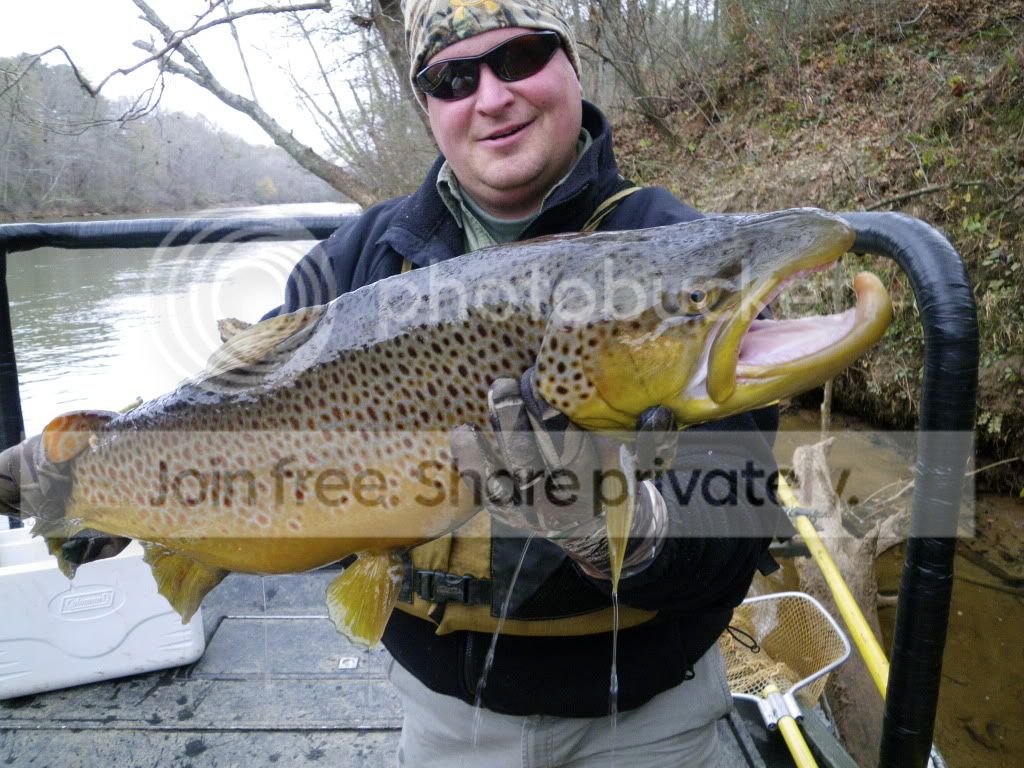
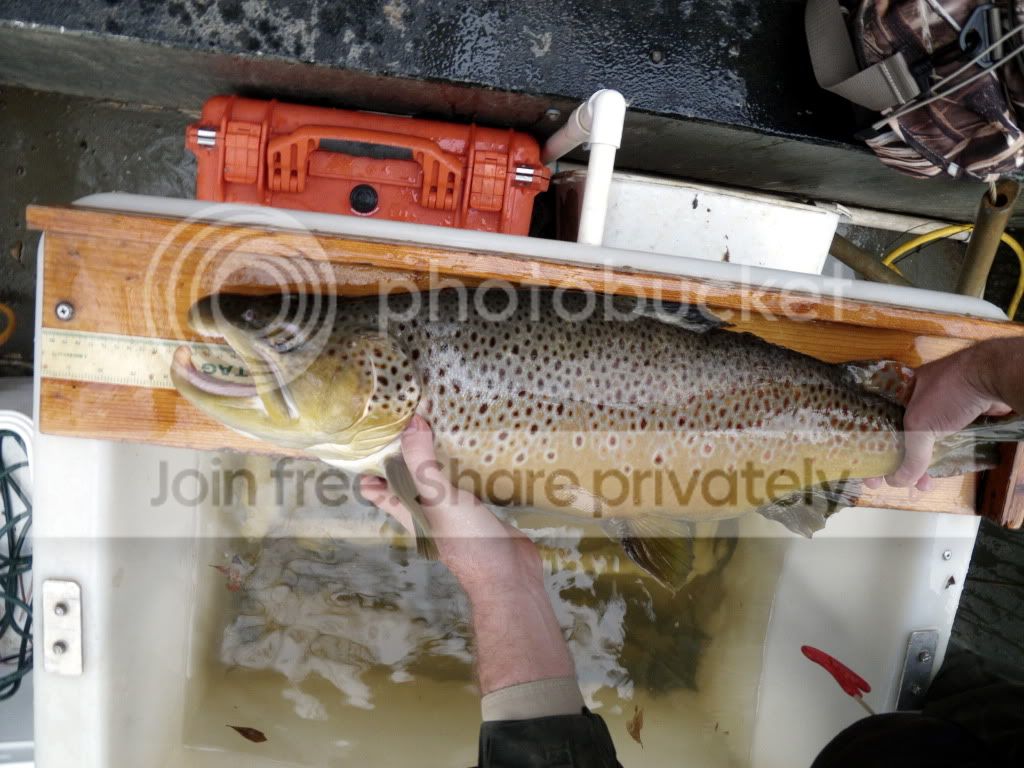
Jul 20, 2012 at 11:27 pm #52948MemberAnd…. The Hooch still has some big ones too. Netted this guy last November while volunteering on a GaDNR survey. Another volunteer is holding the fish after measurement.
-
AuthorPosts
- You must be logged in to reply to this topic.