






Brook vs Brown vs Rainbow
Blog › Forums › Fly Fishing › Brook vs Brown vs Rainbow
- This topic has 9 replies, 5 voices, and was last updated Oct 19, 2011 at 10:47 am by
Mike Cline.
-
AuthorPosts
-
Oct 17, 2011 at 5:39 pm #5707
Tim Schulz
MemberHi all,
Google’s Ngram Viewer is a cool tool for viewing the relative frequency with which phrases have occurred in books over time. For fun, I used the tool to compare the frequency of the phrases ‘brook trout’, ‘brown trout’, and ‘rainbow trout’:

(For those of you familiar with Ngram, I used the corpus English for these plots.)
Some observations:
1. Brook trout were more popular in books until 1900, when something big happened for both rainbow and brown. Mostly for brown. (Perhaps this is due to some anomaly in the Google book database?)
2. Brook trout bounced back and took the lead around 1910.
3. The three were similar until about 1960, when rainbow trout surged.
4. Brook and brown both increased in the early 1980’s.
5. Rainbow took an abrupt decline just before 2000.Anyone know the stories behind any or all of these observations?
Best,
TimOct 17, 2011 at 6:02 pm #50162Zach Matthews
The Itinerant AnglerTim –
First of all, great post. Obviously all we can offer is speculation but we might be able to put together some informed opinions.
Brook trout were the classic and available trout of the Eastern United States until the advent of refrigeration and the discovery of successful ways to transplant trout eggs. The first truly successful “egg box” was invented by a Frenchman named Richard Vibert in the 1950s, which is how places like Kerguelen Island in the Antarctic Ocean as well as Argentina got stocked. Prior to that, trout eggs were packed on ice and had to be stocked within a certain radius of railroad terminals.
So, before 1900, there really wouldn’t have been many if any brown or rainbow trout in the Eastern U.S. Browns were European in origin and Rainbows are native to the Pacific Northwest. So that is not a Google anomaly but a reflection of the available target species in the most populous part of the country (and the the area of the English speaking world with the biggest publishing industry).
In 1900 you have railroad construction and I would assume a surge in interest in the newly stocked fish. That coincided with heavy logging in the eastern U.S., which cut down the forests which kept the streams cool enough for brookies. That’s also not long after the transcontinental railroad was completed, allowing shipment of rainbow trout eggs from the West. That wouldn’t have been a high priority so I suspect it took several years for anyone to have the time or wherewithal to even try stocking them. And no one realized how successful rainbows would be as transplants either.
The parity you see from 1910 through the 1960s could be because brookies were the preferred targets of dry fly anglers, which was being invented in the Catskills region of New York around the 1900-1920 timeframe and then perfected in the 1930s. Most dry fly how-to books would thus have focused on brook trout for that period. Meanwhile browns had also been stocked and carried an Old World mystique, so they would have been a target of opportunity, and finally rainbows in their native range in the Pacific Northwest were finally in an area with a growing population. This chart doesn’t reflect it but I bet overall numbers of fishing books were up too in that period.
Rainbows would have surged ahead in the Anything Goes 60s because that’s when the majority of exotic stocking programs were most active. Almost all southern rainbows were planted in the 1960s behind our new hydroelectric dams, for instance. That is right after the advent of the Vibert box I mentioned earlier. That’s also the nadir of the eastern boreal forest and thus the minimum point for available brook trout habitat.
Brook and brown trout increasing in the 1980s I think has two separate causes: browns for their trophy qualities as catch and release became the vogue, and brookies because their forests had grown back and they were both expanding their range and being subjected to intense re-stocking and interest from environmentalists.
The 2000 era rainbow trout decline could be due to whirling disease but I suspect you’re actually seeing market saturation and publishing factors at work. People got bored of reading about the same old same old, as I know well from my writing efforts. I have a pretty good idea of what kind of story a magazine would buy these days, I’d say, and nymphing for stocker snit rainbow trout is going to be at the bottom of that list.
Those are my wild speculations and rank guesses!
ZachOct 17, 2011 at 6:26 pm #50163MemberThanks for those excellent insights Zach.
Great suggestions throughout, but this one in particular made me smile:
“nymphing for stocker snit rainbow trout is going to be at the bottom of that list.”
Oct 17, 2011 at 9:12 pm #50164andrew stoehr
MemberI’m surprised that there’s no obvious spike after “The Movie” came out!
Interesting posts!
Oct 18, 2011 at 1:02 am #50165brian primeau
MemberTim, that is very cool and some interesting theory as well Zach.
Andrew, here is your spike. It had less to do with one trout over another than fly fishing and trout vs say bass for example.
Cool tool Tim, thanks.
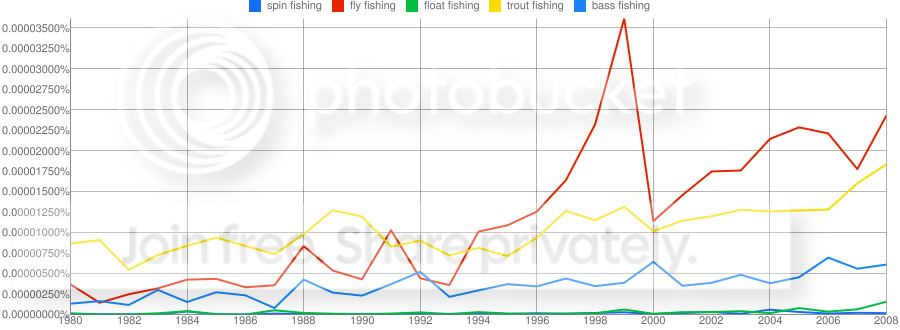
The “Movie” came out in 1992 but took a year for non fly folk to catch on.
They all sold their stuff 6 years 😀 later where the “natural” line would have been anyway.Oct 18, 2011 at 2:08 am #50166MemberExcellent chart Brian. It is interesting to see how abruptly the spike dropped back to the underlying growth trajectory.
Oct 18, 2011 at 1:12 pm #50167The Itinerant AnglerBrian –
That is also a great post man.
You know here’s the thing I glean from that: after the bubble burst there was a real perception that the bottom had fallen out of the market.
Oct 19, 2011 at 2:45 am #50168MemberZach, you are right on. There are three types of fly shops in my mind.
1) Fly guy who wants to own a shop because it’s a passion
2) Business person who finds fly fishing and has the skills to make it work or the smarts to not do it in the first place.
3) Person who wants to guide and knows the best way to be able to guide is to own a fly shop.Any of them can have success, any of them can fail. The best shops that I know of are run by #2 hiring the guys with the passion.
I would like to say something about the anglers though. This is only my perception having been fly fishing since “Pre Movie” and guiding for 8 years. and having worked in two fly shops.
The dudes and dudettes who are learning fly fishing today are passionate about the sport and spend much time getting the learning curve short. (Time on the water) They “get it” for the most part. They are mechanics, web designers, line workers, truck drivers, carpenters etc. Many would rather spend a Saturday night fishing until midnight than go drinking with their buddies. They might own a TFO and be perfectly happy with it or are saving up for a Scott that they will own for ten years or buy used.
What we saw during the time around “The Movie” was a bunch of Brie-eating posers wearing Orvis – (Did I say that out loud?) That fished for a season or two – got thier photos and hung their rods on the wall beside their dusty unused Gibson guitars.
These new guys with their underwear hanging out will actually spend time alone on the water without the fanfare.
I am always surprised when they say “What Movie?”
It is refreshing and for the most part, life on the rivers is civil.
They see it on commercials or in books and it looks …. you know.
And it is…you know.At the same time, the “Stuff” is less expensive and better quality. Back in the day it was Hardy, Orvis then Sage, Winston. Anything else for the most part was crap. Maybe that isn’t fair though, we just couldn’t find stuff nor research it. Martin and Fenwick did good job.
These folks are starting out with more info, the ability to research and get opinions with the click of a mouse and buy online if they like or visit bricks and mortar to test out a model. But most of all – these guys pay for lessons then buy their equipment afterward.
I must admit of late though that “The Movie” to them is getting to be their buddies with a digital movie or “GoPro” camera and posting on Utube – The Jury’s still out there, but it’s viral nature keeps the paycheck coming for the shop owners.
What did “Loop” say? “It’s not your grandfathers sport anymore.”
Now it’s an extreme sport. ::)Oct 19, 2011 at 3:11 am #50169MemberInteresting observations Brian.
About 15 years ago a friend and I were watching a hockey game in a bar along the San Juan river after a day of ‘theme park’ fishing. Seated at the table next to us were about 5 guys: 4 who had recently discovered fly fishing, and a friend of theirs who hadn’t fly fished before that day. I still remember the ‘newbie’ lecturing his friends: “I know you guys think this is special, but you are just fishing worms and bobbers.” The hot pattern that day was a San Juan worm drifted below a yarn indicator. The new ‘experts’ seemed a bit ticked off, but the new guy said something like “relax, guys, fishing is fishing.”
Oct 19, 2011 at 10:47 am #50170Mike Cline
MemberAt couple of observations.
-
AuthorPosts
- You must be logged in to reply to this topic.