






Native Ultimate Rigging and Loading
Blog › Forums › Fly Fishing › Native Ultimate Rigging and Loading
- This topic has 27 replies, 12 voices, and was last updated Apr 11, 2010 at 11:15 pm by
dusty montgomery.
-
AuthorPosts
-
Jun 19, 2009 at 5:52 pm #4868
Mike Cline
MemberI own two different models of the Native Ultimate 12-The Tegris and the standard Poly boat. (There is slightly different rigging between them because of materials—the Tegris has far fewer surfaces to mount stuff). Both are rigged to support fishing in rivers—large and small where there is some Class II or III water at times. Anytime you are floating with any significant current, there is a probability of overturning the kayak as it hits an obstruction—seen or unseen. Even though the Ultimate 12 is an incredibly stable boat, it can be easily dumped by sliding sideways up the backside of a large boulder in current. I know, because I’ve done it. Because of that, equipping, rigging and loading the kayak should ensure that there is a minimum of stuff that is not attached in some way to the boat. Why? Well when it enters the water it will either float away or sink to the bottom. Usually the paddler isn’t focused on retrieving gear until it is way too late. So if it is attached to the boat in some way, you’ll probably get it back.
Basic Rigging:
Wading Tether or Bowline: In a river, I use the kayak primarily for transportation to points where wade fishing is possible. But instead of dragging the kayak up on the shore and leaving it, in many cases I can actually wade very long distances up or downstream with the kayak tethered to me but out of the way. The kayak is there when I need a gear change, refreshment or transportation to another piece of water, but out of the way while fishing. To do this, a wading tether is necessary. The tether is a 15’ high quality line (3/16” or ¼”) attached to the bow of the boat with an adjustable loop and snap to attach to the paddler. The loop allows quick attachment (or removal) of the line to the paddler’s waist, and the snap is used to attach the loop to the PFD to keep if from falling from the waist. (I never float or wade without wearing the PFD). The line is attached to the bow at two points for durability. The other advantage of a wading tether, especially if you keep it attached all the time, is that you can exit the boat in fast, but wadeable water and focus on stabilizing yourself without worrying about holding on to the boat. In fact, although you’d think the boat would impede stable wading, when the tether is tight, it acts as something to hang on to and assist in balancing yourself.
Ultimate 12 Poly Wading Tether
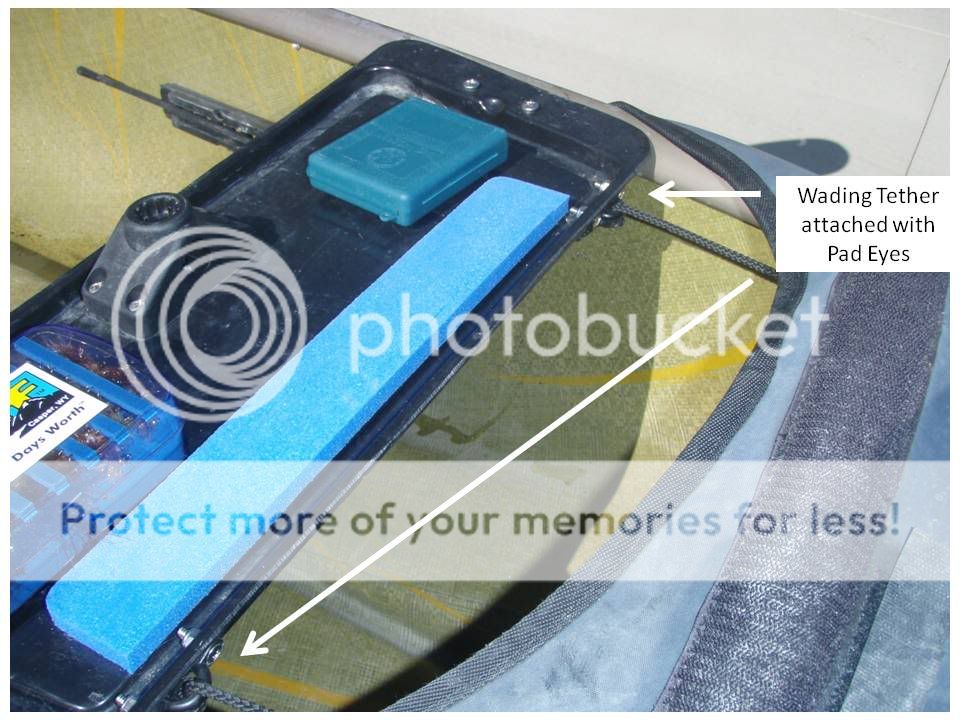
Ultimate 12 Tegris Wading Tether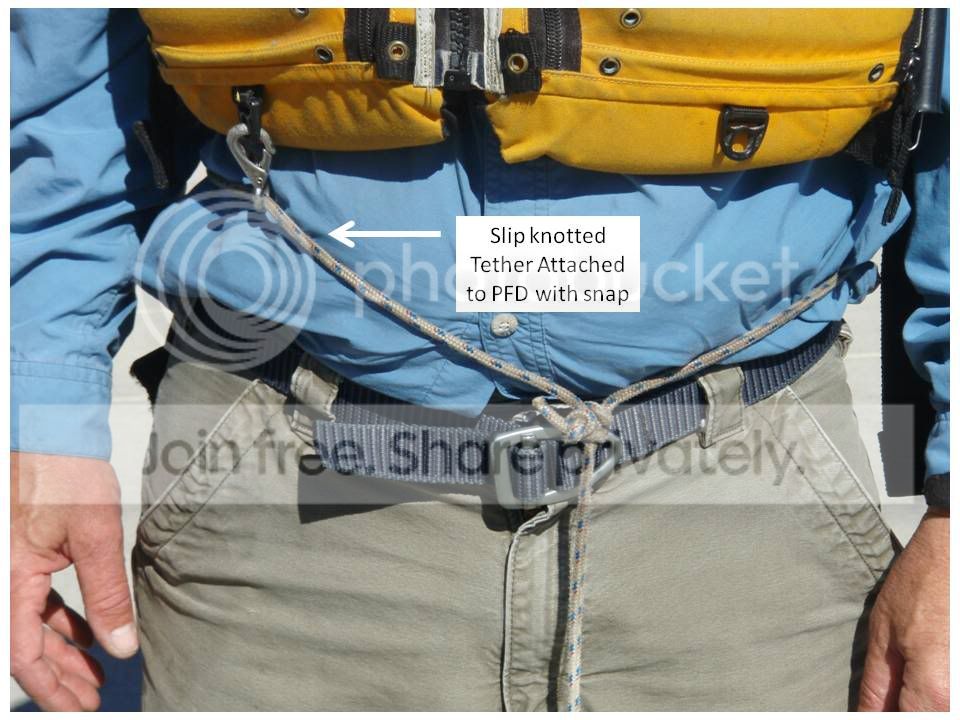
Wading Tether attached to PaddlerAnchor Trolley and Drag Anchor: An anchor trolley is an essential piece of rigging and both my boats are rigged with one of the standard aftermarket systems. I use a small clam cleat to secure the trolley in position on the Tegris and a double J-hook to secure it on the Poly boat. As for an anchor, I use a 3′ piece of 3/8” galvanized chain attached to 20’ of 1/4” line. The line is attached to the trolley with a carabineer for a quick release if necessary. I use the anchor for two purposes, slowing the drift of the boat in current when I am fishing from the boat, and positioning the boat when wading. The drag chain rarely gets caught on bottom obstructions, even logs and trees, so it is a perfect solution for slowing your drift safely. When wading upstream with the boat tethered, the anchor isn’t needed because the boat follows the angler. However, when wading downstream (something streamer anglers do a lot), you don’t want the boat floating downstream in front of you. So you put the anchor out and adjust the trolley so the boat stays behind the angler. This even works well on saltwater flats where both the tide and wind can push the tethered boat in front of the wading angler. The drag chain and trolley will easily keep the boat out of the angler’s way. This cant be done with claw or mushroom type anchors.

Ultimate 12 Tegris Anchor Trolley and Drag Chain Anchor
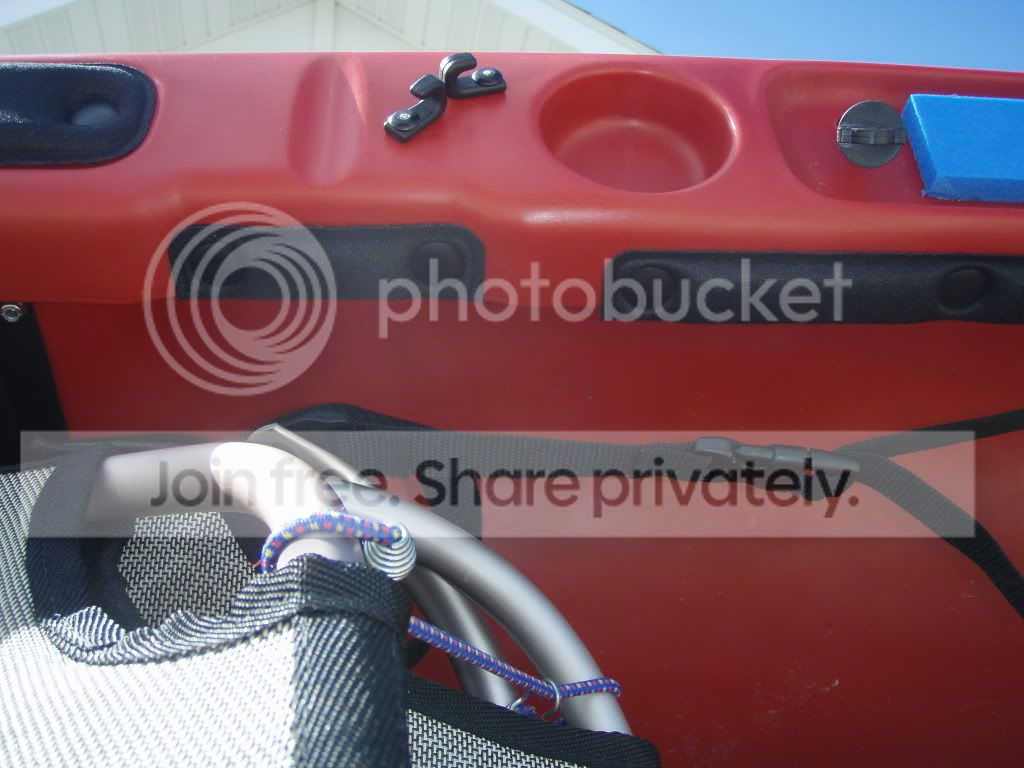
Opposing J-Hooks to secure anchor trolley positionRod Holders: I haven’t put any rod holders on the backup kayak, but have two Scotty Fly Rod holders on the Tegris on the rear thwart with another mount on the console. In open water the holders are very useful for securing extra rods or both rods if floating through rough water. In tighter, small winding streams, I don’t use the holders and only keep one rod rigged. A 9’ rigged fly rod in the holder can very easily get caught in streamside brush or bang up against rocks. This is not desirable in current where the rod or fly line will almost always break if you can’t stop the boat.
Loading and securing gear: As I said earlier, if you dump your boat and the gear isn’t secure to the boat, you are going to lose it. All my fly boxes that I use in the kayak have a piece of Velcro on the bottom that will stick to another Velcro patch on the console. Because the Ultimate accumulates some water, if the box isn’t attached, then it is in a dry bag. All my fishing gear is contained in two small dry bags that can easily be secured to the boat. Leaders and such are in one bag, reels and extra fly boxes in another. Another bag contains emergency gear and food. If an extra rod is not rigged or in the rod holder, then it is in its hard case and secured to one of the thwarts. When camping, all the camping gear is in a dry bag that stows nicely under the bow skirt (Bow skirts are useful for a lot of reasons). I always secure my paddle to the boat with a paddle leash as I never want to be up the creek without a paddle. Even my landing net is secured to the boat with a leash. Probably the only thing I don’t (can’t) secure is the essential bilge pump (but its bright orange and floats).
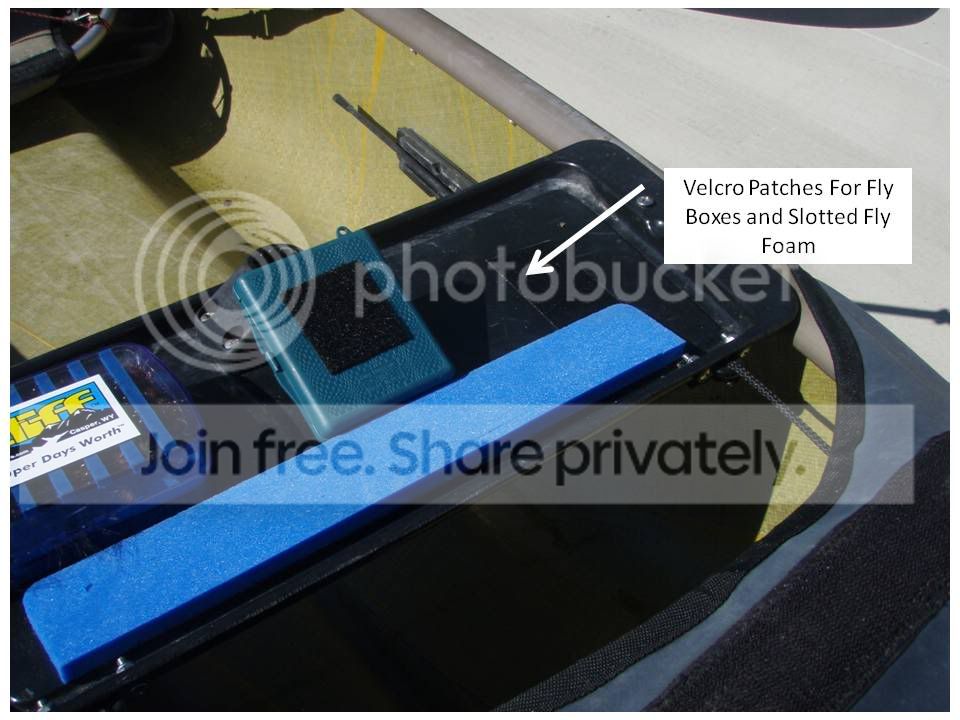
Fly boxes secured with Velcro patchesFly patches and tippets: One of useful things I’ve found is the addition of slotted foam fly patches on the boat. They are a great place to store wet flies and don’t allow them to get lost or float around in the boat. While underway, I keep my tippets handy hanging from a pad eye on the console.
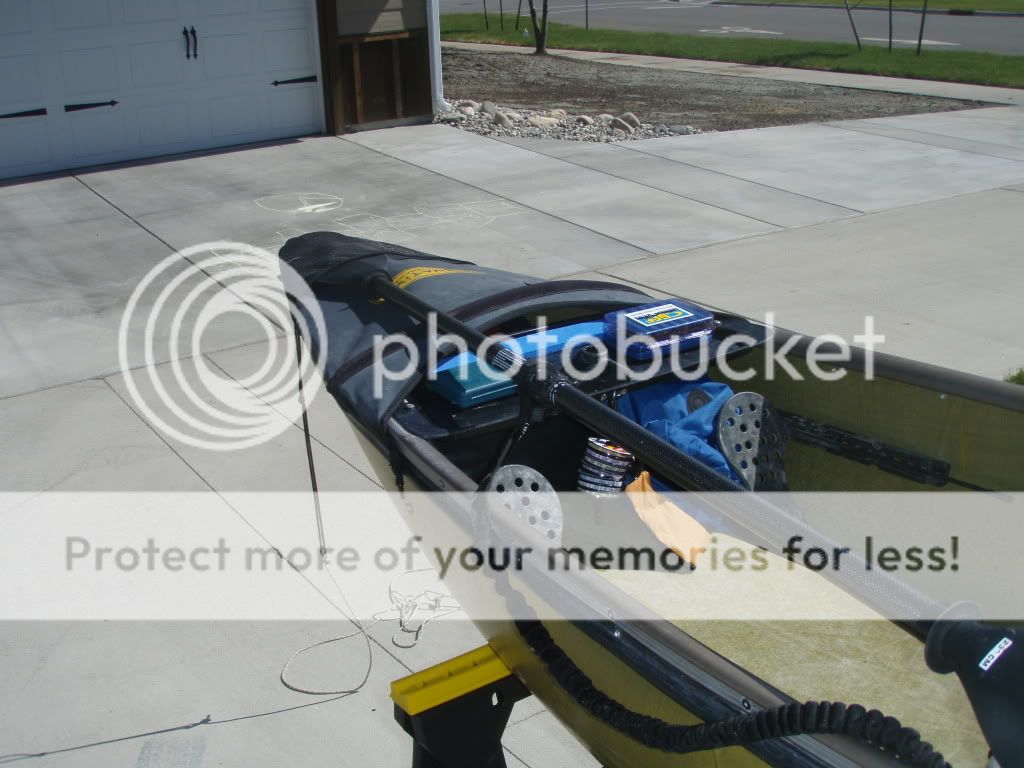
Paddle stowed in bow skirt with paddle leash
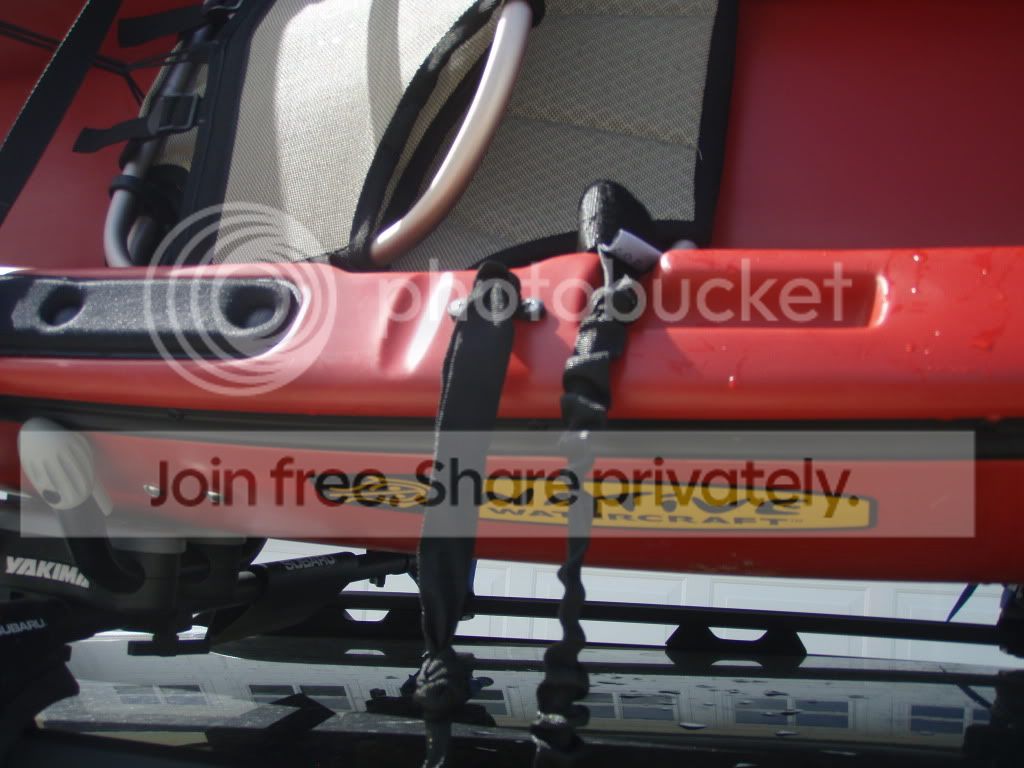
Paddle leash attached with Pad Eye
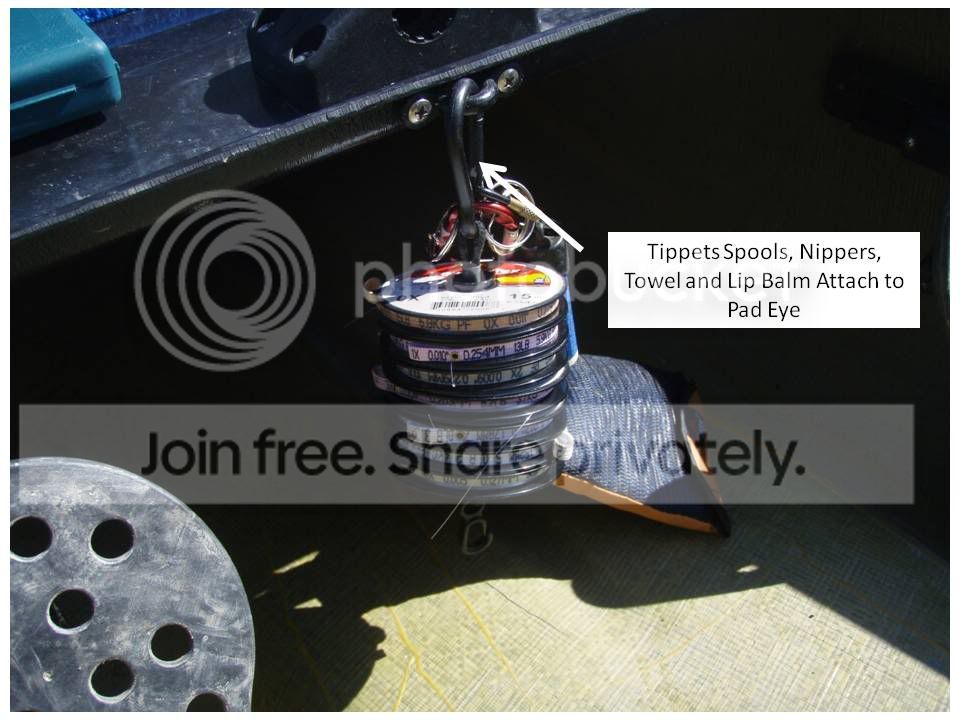
Tippet Spools on console
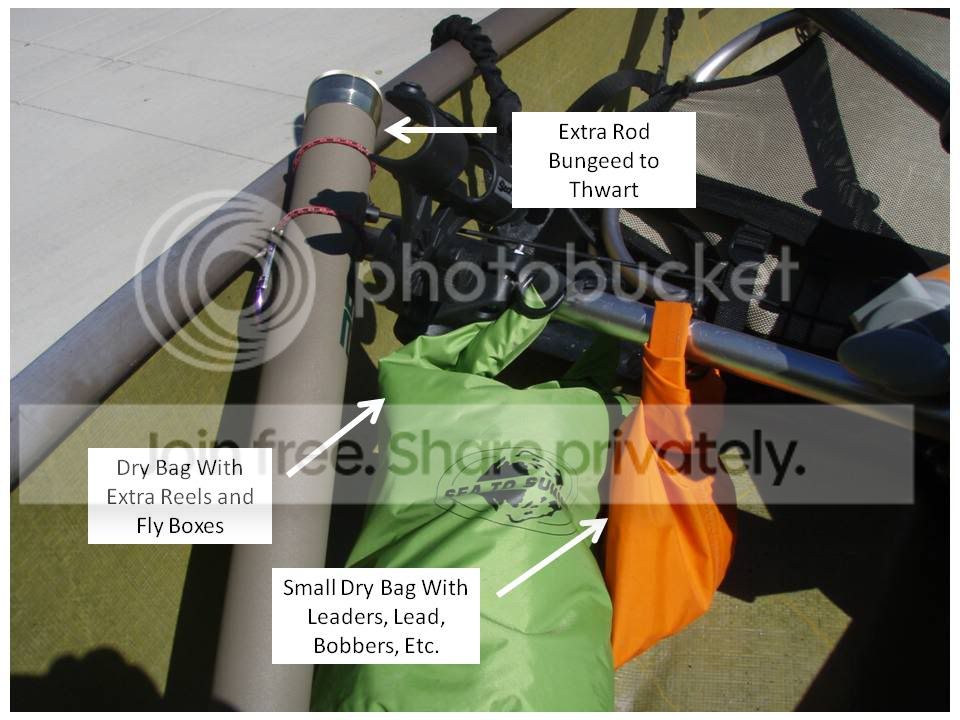
Fishing gear stowed in rear of boat
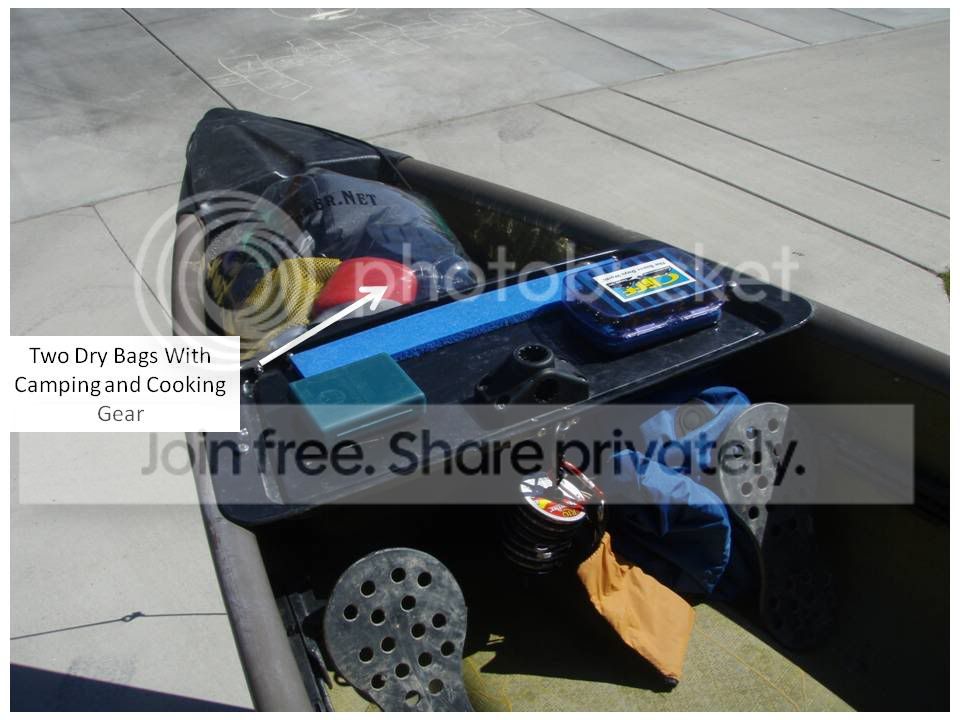
Camping and Cooking Gear Stowed in Front of Boat
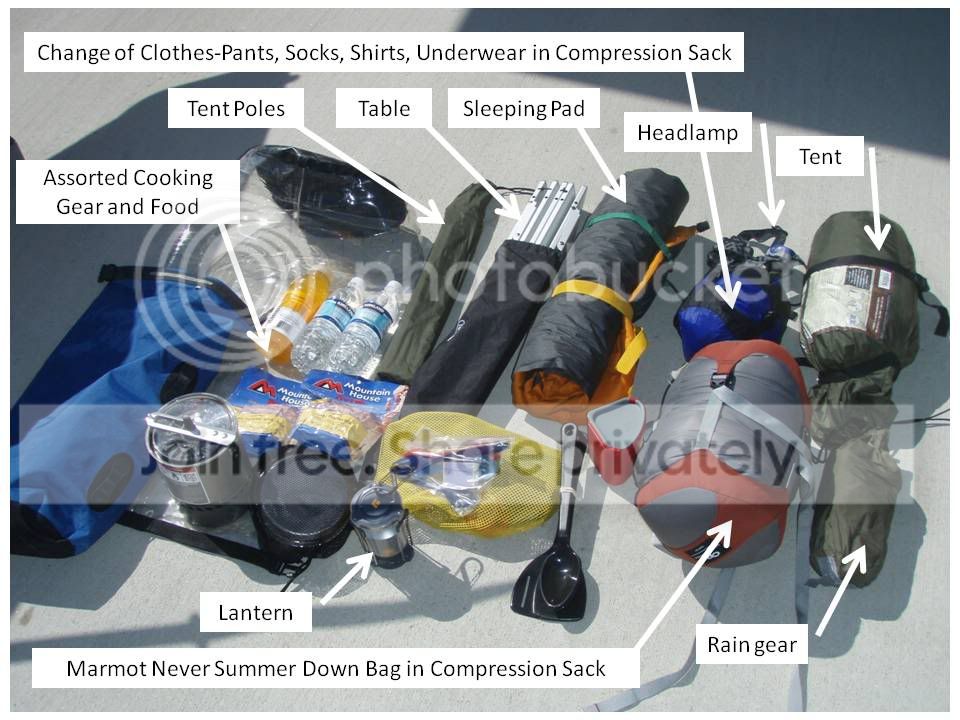
Gear un-stowed that fit in bow of boatHope this helos answer questions on how I rig my Ultimate 12s
Jun 19, 2009 at 6:03 pm #42847Neal Osborn
MemberDamnit Mike!
Jun 19, 2009 at 7:39 pm #42848 Tim AngeliMember
Mike,
This is a great tutorial.
Jun 19, 2009 at 8:04 pm #42849 John BennettMember
You are the man Mike for including this
You probably just sold a Native…If I could I’d buy one from you just for that.
The 1 thing I wasn’t sure about was whether or not I could also use a Native for some back country camping. No white water so thats not a issue, it would all be calm water with Portages being the worst hardship/hurdle.
Now I just need to decide between a 14.5 (more capacity when tripping) and 12 Tegris (half the wieght on portages).
Jun 19, 2009 at 8:12 pm #42850 Cameron MortensonMember
Mike Cline…I’ll reread this thread again this evening but damn…you gave us all the knowledge right there.
Jun 20, 2009 at 12:47 pm #42851Tim Schulz
MemberMike,
Thanks for sharing this.
Jun 20, 2009 at 2:28 pm #42852 Mark SchaferMember
Great post Mike I’m stealing all your ideas… thanks
Jun 20, 2009 at 2:36 pm #42853MemberI’m not too comfortable with the idea of being tethered to my boat when wading and fishing, but, based on your strong endorsement, I’ll have to give it a try.
Tim,
I’ve been doing it so long that it just comes natural.Jul 8, 2009 at 3:55 pm #42854bob mccain
MemberHi Mike,
Thank you so much for posting your Native Watercraft rigging. I think you have a super system, and frankly, I’m going to copy it as much as possible!
Concerning the wading tether and it’s attachment to the boat; it looks like you have the 15′ of rope fastened to an elastic thing which is then fastened to the bow in two places. Would you mind detailing that a little more? I’m assuming you have drilled two holes and used those to fasten the elastic thing inside the boat. Additional pictures or information would be greatly appreciated.
I have the 14.5 Ultimate tandem
Thank you agian, this post has already been very helpful to me.
Bob
Jul 8, 2009 at 11:56 pm #42855MemberHi Mike,
Thank you so much for posting your Native Watercraft rigging. I think you have a super system, and frankly, I’m going to copy it as much as possible!
Concerning the wading tether and it’s attachment to the boat; it looks like you have the 15′ of rope fastened to an elastic thing which is then fastened to the bow in two places. Would you mind detailing that a little more? I’m assuming you have drilled two holes and used those to fasten the elastic thing inside the boat. Additional pictures or information would be greatly appreciated.
I have the 14.5 Ultimate tandem
Thank you agian, this post has already been very helpful to me.
Bob
Bob,
Actually configuring a tethering line can be done in several ways.
Jul 9, 2009 at 12:05 am #42856MemberA business trip took me to Florida for the week and I took the opportunity to go on an Ultimate flats trip in the Charlotte Harbor area on monday for redfish and snook. The daytime tides were marginal and the wind made fishing tough. However, the nighttime dock fishing for snook was dynamite. Paddled around all-day and night (didn’t get back to the putin until 2AM – about 10 miles total in an Ultimate 14.5 with a guide in another Ultimate boat. Instead of anchors we used Stick It Anchor Pins to secure the boat in wind and tides. In combination with an Anchor Trolley, I was pretty impressed with their utility.
Here’s the website. Anyone using a kayak in waters with shallow sandy or muddy bottoms ought to consider one of these.
Jul 10, 2009 at 11:10 am #42857John BennettMemberOn my way up to the Park I stopped in at a Canoe/Kayak outlet to get a first hand look at Natives and will be demoing one this weekend. The organisor of a yak fishing tournament I’ll be at, has arranged for one of the sonsors to bring one. So long as thers no nasty surprises I think I’m sold.
While at the outlet, I was able to sit in the Tegris. Not only was it super comfortable, at 30 lbs vs 60+ it’s almost a done deal. Will make portaging that much easier ad apparently there’s a removable yoke you can buy. I figure with the yoke and either the bow skirt or full skirt it’s good for tripping.
The only real hurdle I have left is trying to gauge how much cargo/gear it can carry and how it will handle/perform while loaded. Specs say it’s rated for 350lbs, I’m 180. So leaving room *technically* I should be able to load 125lbs comfortably.
Jul 10, 2009 at 11:19 pm #42858MemberWhile at the outlet, I was able to sit in the Tegris. Not only was it super comfortable, at 30 lbs vs 60+ it’s almost a done deal. Will make portaging that much easier ad apparently there’s a removable yoke you can buy. I figure with the yoke and either the bow skirt or full skirt it’s good for tripping.
The only real hurdle I have left is trying to gauge how much cargo/gear it can carry and how it will handle/perform while loaded. Specs say it’s rated for 350lbs, I’m 180. So leaving room *technically* I should be able to load 125lbs comfortably.
The Tegris performs just like the poly Ultimate 12 but its light weight makes it so much easier to transport and wade with.
Jul 11, 2009 at 10:36 am #42859John BennettMemberMike this thread and your help has been indespensable especially for me given my needs and what I’m looking for.
Cheers.
JJul 12, 2009 at 12:36 pm #42860MemberMike this thread and your help has been indespensableJ
Thanks, glad its been useful
Jul 13, 2009 at 12:09 pm #42861John BennettMemberWell the weekend was great. Arrived mid day Sat and promptly hit the water in search of Yak Anglers competeing to get images before they had to be on shore.
Afterwards I was able to demo a 12 foot Ultimate. Very impressed, but a wee bit cramped. Especially if I was to load my Pelican and my 500mm.
Sunday morning 6am back on the water to cover the event. Got some of my best ever Loon images……….Major Bonus.
Back at 10am, to take my youngest duaghter out in a Hobie Tandem so she could try to catch a couple small bass and qualify in the kids division.
20 minutes later she’s landing a Musky ;D ;D ;D ;D
After that I’m back and out in a 14.5 Ultimate Propel.
Sweet ride but I prefer the paddle.When its all said and done I’m very much leaning towards a 14.5 Ultimate now. While it’s heavier at 60pds thats no worse than many 16foot Canoe with regards to portaging, unless you spend $3,500 plus for a good Kevlar Canoe.
J
Jul 13, 2009 at 1:15 pm #42862MemberAfterwards I was able to demo a 12 foot Ultimate. Very impressed, but a wee bit cramped. Especially if I was to load my Pelican and my 500mm. After that I’m back and out in a 14.5 Ultimate Propel.
Sweet ride but I prefer the paddle.When its all said and done I’m very much leaning towards a 14.5 Ultimate now. While it’s heavier at 60pds…
Nothing wrong with the 14.5 at 65 lbs. I paddled one over ten miles last Monday on the flats in Gasparilla Sound in Florida. It has great stability for stand-up fishing and paddling.
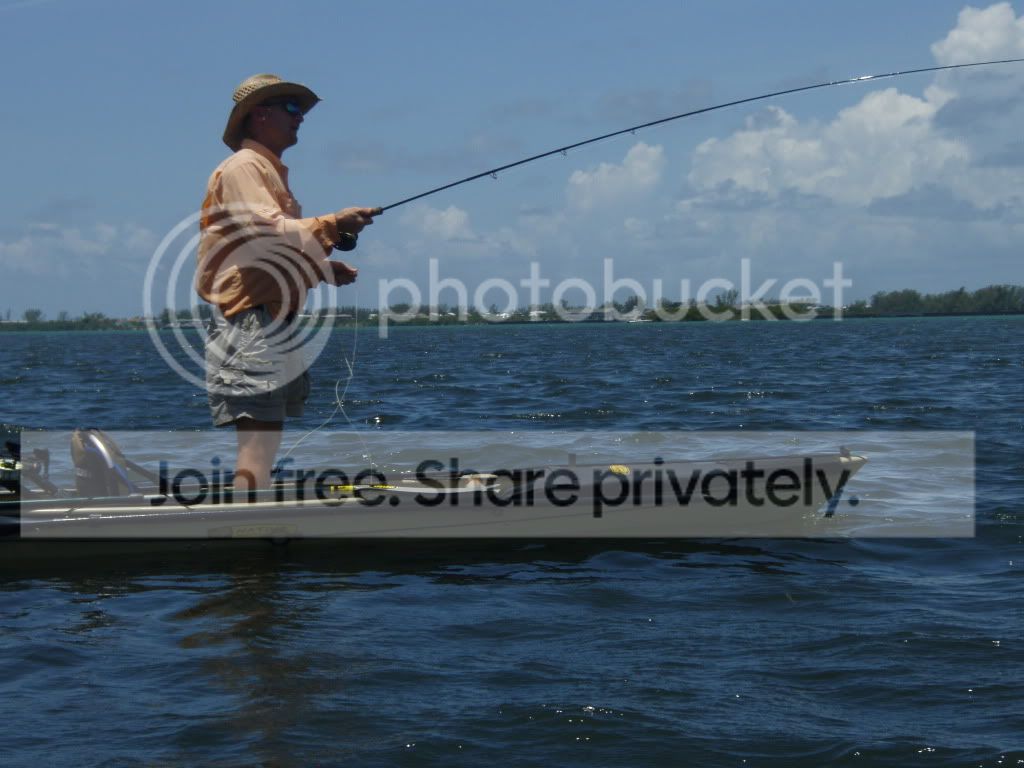
My partner in Gasparilla SoundThe one caution I’d make is that you realize that anything stowed in the bow of the boat (whether or not there is a bow skirt) is essentially unavailable while you are in the boat. Additionally, with the 14.5, the second section of the stern is essentially the same. Unfortunately, although you can stand in an Ultimate comfortably, you can’t walk to the bow or stern as you can in a more stable boat. Although you can move forward on your knees to reach the bow section, its a pretty tippy move. Trying to get your hands on anything out of reach behind you is pretty much impossible while in the boat.
I say this only to point out that regardless of length, you’ll have about the same amount of gear access while underway in both the 12 and 14.5. However, once you can exit the boat–shallows, flats, rivers, the 14.5 clearly has more storage capacity. Good Luck with whatever you decide.
Jul 14, 2009 at 10:37 pm #42863MemberHi Mike,
Thanks for this explanation.
“Bob,
Actually configuring a tethering line can be done in several ways. The photos show my Tegris which has the solid console. On the front edge of the console are two strap eyes on each side. A single line is strung through each and knotted. The line forms a loop that is run through the standard handle loop at the bow. To that loop is attached by wading tether. On a poly boat, one just attaches two strap eyes on the bow along the edge of the boat about a foot apart. The tether is then run through both with a double knot at the end to secure the tether.
The real trick with the tether is to distribute the pressure off just a single point on the kayak. This make the tether more durable. The last thing you want to do is attach a line directly to the bow loop. When I get home, I try and post a few pictures about what I mean. “
I have a pretty good idea of what you are describing with regard to the attachment of the tether to the bow of the poly boat, but I’m really looking forward to the photos to see if I understand correctly.
Thanks again for all your help.
Bob
Jul 15, 2009 at 1:49 am #42864MemberBob,
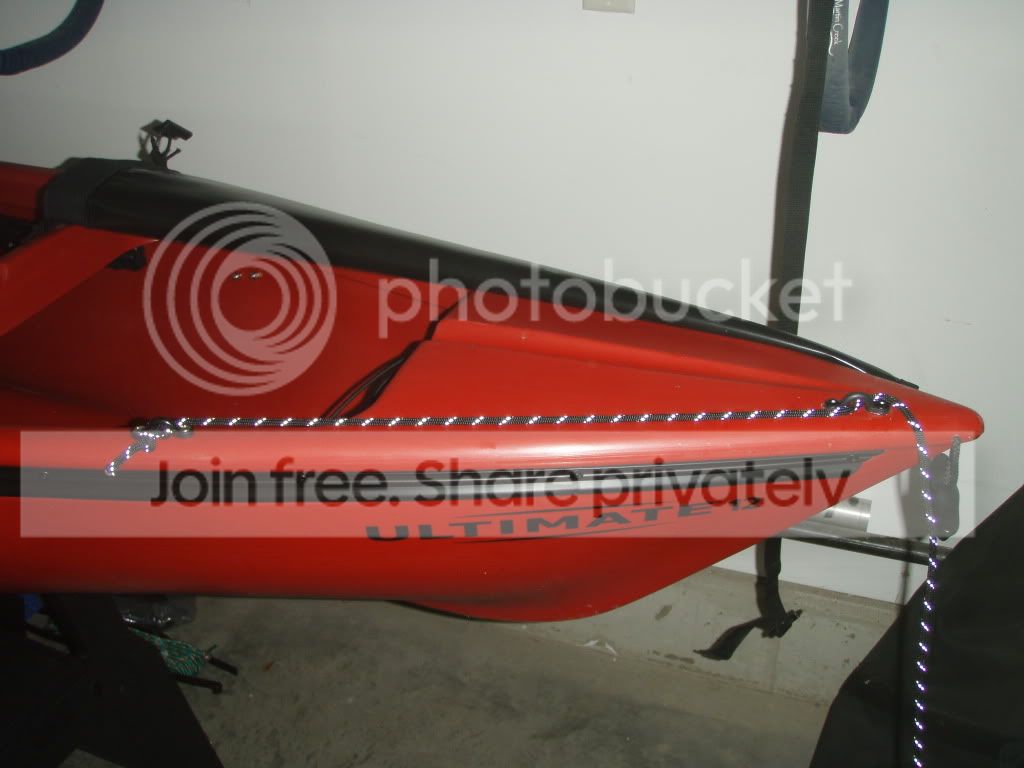
Here’s a photo. Sorry I didn’t include it before. This is a pretty standard setup for a wading tether on any brand of poly boat. Two padeyes at the bow–either on top or just along the side. Then a line is run through both with a double knot to secure the line on the sternmost eye. Just a technique to spread the pressure along the boat, instead of strictly at the point of the bow.
Always choose high-quality line–Sailing quality–for the wading tether. It takes alot of abuse and you don’t want it ever to part while in strong water or dragging the kayak over obstacles, shallows, etc,. Additionally, make sure the tether, once you are attached, is long enough so you can reach the stern of the boat. If it is too short, you have to un-tether to reach items in the stern when beached or wading.
 Jul 15, 2009 at 1:18 pm #42865Member
Mike,
Thanks so much for this photo and explanation. Immensely helpful.
You are the man!
Bob
-
AuthorPosts
- You must be logged in to reply to this topic.