






Remember the Simms Camouflage Waders?
Blog › Forums › Fly Fishing › Remember the Simms Camouflage Waders?
- This topic has 26 replies, 15 voices, and was last updated Jan 21, 2009 at 6:09 pm by
Michael Exl.
-
AuthorPosts
-
Jan 19, 2009 at 2:51 pm #3789
Zach Matthews
The Itinerant AnglerBack in about 2002-2003, Simms had a full range of camouflage breathable waders in their Guide series (which I still wear as my primary waders – I have two pairs).
Jan 19, 2009 at 3:01 pm #32894regan c. kenyon jr.
MemberZach-
I’m almost certain I saw in someone’s catalogue a line of camo waders.
Jan 19, 2009 at 8:58 pm #32895 Mark SchaferMember
Yeah… I remember them and at the time wondered why Simms was bothering trying to get into the waterfowl area. It seems like the ad was in
Jan 19, 2009 at 9:02 pm #32896The Itinerant AnglerMark –
I am not seeing any breathable camo waders on the market which would compare, in my opinion, to Simms’ construction, and I am extremely hard on waders.
Jan 19, 2009 at 9:33 pm #32897Mark SchaferMemberNo argument on the Simms quality but curious as to why a camo pattern. My summer carping waders are LaCrosse they say breathable, but not really.
Jan 19, 2009 at 11:18 pm #32898 Roy ConleyMember
I also do not understand the Camo pattern.
Jan 19, 2009 at 11:44 pm #32899The Itinerant AnglerYou guys haven’t done a lot of mountain brookie fishing have you? 🙂
Jan 20, 2009 at 1:22 am #32900Neal Osborn
MemberHave you ever taken a really really really close look at how drab we look in all tan! I can only imagine how unnatural this looks to a fish to see a big “bare” spot in the background; I’m sure they notice the absence of pattern in the setting of otherwise varied natural cover. Seriously, I’m about ready to embrace camo patterns just to get some variation in the outfit. What about Velcro camo patches, hahaha, just a thought.
BORING!
 Jan 20, 2009 at 1:53 am #32901Mark SchaferMember
For what it might be worth here are some interesting articles on fish vision http://www.sexyloops.com/articles/index.shtml scroll down a little ways. Yes… some days I do have to much time on my hands but these guys can be good for a laugh.
Jan 20, 2009 at 2:41 am #32902Roy ConleyMemberYou guys haven’t done a lot of mountain brookie fishing have you? 🙂 You don’t do a lot of “waving a rod around” up there, Roy. Well over half your casts are simply dapped into the hole at the length of the rod. Anything that will allow me to creep to within 9 feet of a trout without looking like a bright tan blob is going to be a benefit, I’m pretty sure.
Zach
Zach, I have only been doing it since 1964 or so. I guess you are looking like one of the camo guys that fish places like Waters Creek. Camo head to foot and belly crawling to the edge of the pool. I have never seen the need for this, even on the tiny brookie streams. Those creeks are nearly devoid of food and the brookies are so aggressive that a tan # 18 elk hair caddis will almost catch every fish in a pool. On a good day.
Roy
Jan 20, 2009 at 12:39 pm #32903The Itinerant AnglerI’m sure you’re right, Roy, and it would probably be overkill.
Jan 20, 2009 at 2:10 pm #32904Anonymous
InactiveI am extremely hard on waders.
ZachCurious…what is the lifespan of a pair of Zach Matthews worn waders?
How about the rest of you?
Jan 20, 2009 at 2:20 pm #32905Grant Wright
MemberI’ve never owned a pair of waders that haven’t leaked after one calender year, and I’m not buying the bottom of the barrell stuff,
Orvis, Patagonia, Simms – all leak, which is crazy considering I prefer to wet wade if at all possible.
Jan 20, 2009 at 2:58 pm #32906The Itinerant AnglerMy waders last a very long time but only because I overhaul them regularly and because I always buy the thickest legs I can afford. I killed several pairs of thin waders in less than 18 months when I first started fishing; once I switched to Simms Guides (and learned to take care of them), I was able to get a lot more time out of them. I don’t really like to walk in to one particular spot and sit on it (though in some areas that’s all you can do, to be sure). I also don’t do much boat fishing. So my waders see a lot of miles. My original Simms Guides were bought in about 2001-02. They have had their feet replaced by Simms ($50), have been scrubbed clean and Revivexed five or so times with an iron and a dryer, etc., and have approximately thirty Aquaseal patches on the insides. I eventually retired them when the Revivex no longer kept away wet out for a day. My newer Guides were bought the last season Simms made them and have the front-facing seams. I think that was 2005. They have the original feet still, probably a half dozen patches, and have been fully Revivexed twice. Their gravel guards are starting to shred.
I’ve seen what Alaskan guides like Ian Crabtree and Matt Jones can do to a pair of waders in a season and I am certainly not putting that much hurt on them. Since 2003 (when I got out of college), I have averaged approximately 45-50 days a year on the water, much of that in mountain fisheries like the Smokies. I probably hike an average of four miles in a day’s fishing. I’ve run through four pairs of boots since college, walking the felt off. My current pair has had almost all its grommets replaced with zip ties (credit Carter Simcoe; a great fix), and the rubber is showing through the felt at the toe. Those will need to go soon, too.
If you really think about the level of wear I’ve put on these waders, it’s greatly in excess of what I would have done to a pair of jeans, etc. Thus I think you have to credit Simms with making a really solid product. I have never had a seam failure (size them properly and you won’t). I’ve only ever had the neoprene tape come off the boots, and that was after 3 seasons in the first Guides and it didn’t make them leak. I scoot over logs, kick through blackberry bushes and rhododendrons, and slither and worm my way around log jams all the time. In my opinion, most (high quality) wader failure, like most rod breakage, is due to user error (ripping them on obstacles instead of carefully unhooking them, hooking oneself, etc.) Of course, none of that applies if the waders aren’t well made.
Zach
Jan 20, 2009 at 3:39 pm #32907David L. Darnell
MemberThese are my chest highs, get some weird looks when people come close and see the Simms name on them.
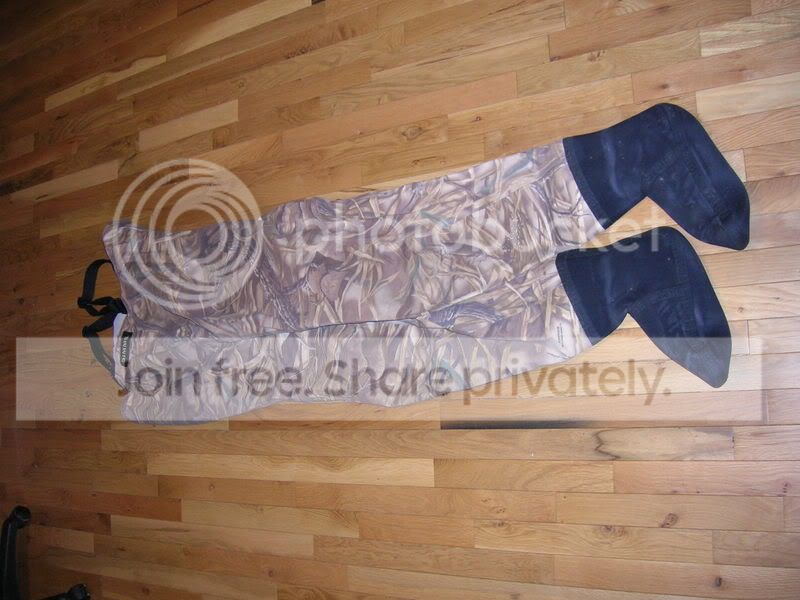
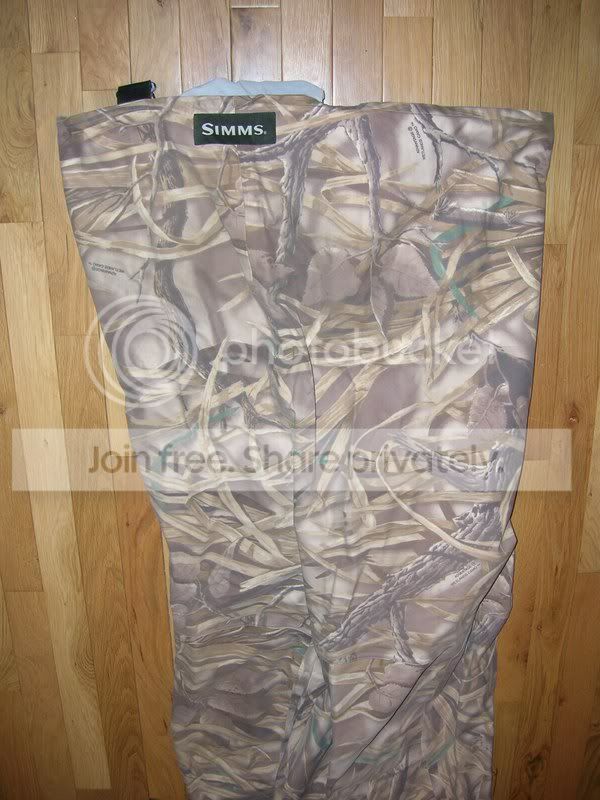
Don’t know if it’s true or flyshop hype, but was told I got one of the last pair out of the factory.
They are XL and when I get the waist highs will be all but retired, Simms may want them back for display someday 😉
Jan 20, 2009 at 4:54 pm #32908MemberZach,
How does the Revivex treatment work – I’ve never heard of the stuff.
Jan 20, 2009 at 5:21 pm #32909The Itinerant AnglerFrom my 2006 article, “Breathing Underwater”:
“DWR Treatments
One of the areas of greatest innovation in the past ten years has been DWR treatments applied to breathable fabrics. This is the stuff that makes water bead up on your waders or jacket. The first DWR treatment to hit the market was called Scotch Guard, and you may recall having applied it to your sofa. According to Ned Hutchinson, the fly-fishing product designer at Cloudveil, you can imagine DWR like “a forest of trees.” On a molecular level, the DWR coating has a series of tiny, round, water-repellent spheres, which make up a “canopy.” The canopy stands above the exterior layer of the breathable fabric on a set of tiny “trunks,” just like a forest. When a droplet of liquid water hits the DWR treatment, it gets caught in the “leaves” of the canopy and cannot penetrate to the actual fabric, making water bead up.
Unfortunately this tiny protective forest is not indestructible. Over time, through use and wear, the trunks of these trees can break, removing the protection and resulting in “wet out.” Dirt is also a major culprit in causing wet out, since it crushes those “trunks” and crusts over the canopy. Remember the last time you got in the water with a set of breathable waders on and saw that your fabric had turned dark? It probably felt like you were getting soaked, right? That’s wet out. In reality, you are still dry inside your waders, but because the exterior fabric is saturated and the microporous membrane sandwiched inside the wader cloth doesn’t provide any insulation, you can get condensation on the inside and feel much colder. Wet out is bad. Manufacturers like to prevent it if they can. Hence, DWR treatments. “The biggest change in the past ten years in terms of avoiding wet out,” Cloudveil’s Hutchinson explains, “is that now the forest has many more trunks. Instead of just one trunk holding up your ‘tree,’ now that trunk has support trunks going every which way.” After a given number of wash cycles, a DWR treatment will fail, so manufacturers have begun measuring this increased wet-out resistance by the number of wash cycles the treatment can endure. (Manufacturers recommend that fishermen wash their waders to maximize DWR performance and avoid wet out.) Products are beginning to hit the market that advertise a “30 DWR” treatment, which means the DWR coating should last through thirty trips to the Laundromat. A “100 DWR” coating is functionally a life-of-the-product application, and some products are beginning to reach this level (though not without cost).
Well, you say, how many wash cycles can the DWR treatment on my waders withstand? The likely answer is around twelve (a historical average), and since few of us wash our waders as often as we ought to, that number seems sufficient for the current lifespan of a set of breathable waders. If you are getting wet out, follow the manufacturer’s cleaning instructions on the inside of your waders and get rid of as much dirt as possible. Also, consider a DWR-replenishing treatment from a product like ReviveX (also made by Gore), which will return your waders to their water-droplet-beading natural state—though, unfortunately, never for as long as when they were new.”
HTH,
ZachJan 20, 2009 at 5:28 pm #32910Bryan Gregson
MemberHow about the rest of you?
Less than a year. Doesn’t matter on the thickness of the material for me, or what brand (Cabelas and Cloudveil has been the worst in my experience), or what I do to prevent breakdown (Nikwax or any other DWR treatment)… But then again, I use them more often than not and I don’t think any gear is actually made to last.
Jan 20, 2009 at 5:57 pm #32911MemberWow, I must admit that my waders are way passed due for a little TLC.
Jan 20, 2009 at 6:34 pm #32912Shannon Drawe
MemberOK, I need this stuff. A quick google and click over to Amazon shows there are more than one manufacturer of “Reiviex”, or at least a lot of different incarnations. Which of these would one want? Shannon
-
AuthorPosts
- You must be logged in to reply to this topic.